Selaginella leucobryoides
Mojave spike-moss
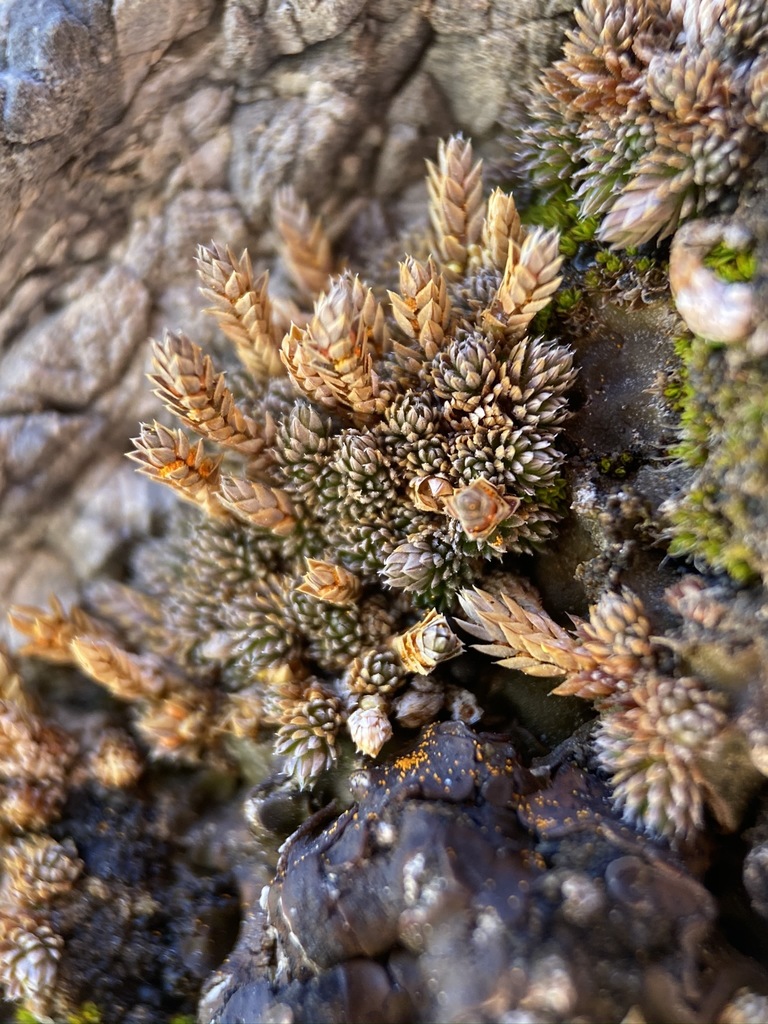
(c) Matt Berger, some rights reserved (CC BY), uploaded by Matt Berger · licence
Family: Selaginellaceae · Type: Herb · Native
Conservation status: CNPS 4.3
Selaginella leucobryoides (Mojave spike-moss) is a native California herb in the Selaginellaceae family, recognized by (S. watsonii); key feature is cushion-like vs shaggy mat growth form.
Mojave spike-moss is a California native spikemoss ranked 4.3 by CNPS, found in the Desert Mountains in limestone rock bases, cracks, and pinyon-juniper woodland at elevations of 600 to 2,300 meters. A distinctive green plant with a white cast that ages to tan, it forms delicate cushion-like tufts that become fragile when dry. Growing in small, compact clusters with stems 1.5 to 4.5 millimeters long, the spike-moss has lanceolate leaves with short, rigid awns. Its leaves are narrow, measuring 0.4 to 0.6 millimeters wide, with a glabrous base that decurves along the stem. The plant produces compact cones 4 to 15 millimeters in length, adding to its intricate botanical structure.
Identification and appearance
Key characters: 1 sympatric species (S. watsonii); key feature is cushion-like vs shaggy mat growth form
Habitat and range
Habitat: Base of rocks, cracks, generally limestone, amid scrub, pinyon/juniper woodland
Elevation: 600-2300 m
California counties: Inyo, San Bernardino
Outside California: southwestern Nevada, northern Arizona
Conservation status
CNPS 4.3
How to tell it apart
vs Cardionema: Selaginella has overlapping scales spiraling up the stem; Cardionema has paired leaves at intervals.; vs Lycopodium: Selaginella stems feel soft and flexible; Lycopodium stems are firmer and the leaves radiate out in all directions.; vs Polytrichum: Selaginella has square-sided cones and scales; moss capsules sit atop hairlike stalks.; vs Galium: Selaginella has tiny overlapping scales; Galium has narrow leaves in distinct whorls around square stems.; vs Brachythecium: Selaginella has square cones and spiraling scales; moss shoots are feathery with capsules on stalks.
Frequently asked questions
Is Selaginella leucobryoides native to California?
Yes. Selaginella leucobryoides is native to California (recorded as native).
Where in California does Selaginella leucobryoides grow?
Selaginella leucobryoides occurs in Inyo, San Bernardino, at elevations of 600-2300 m.
What plant family does Selaginella leucobryoides belong to?
Selaginella leucobryoides is in the Selaginellaceae family, genus Selaginella.
Is Selaginella leucobryoides rare or endangered?
Selaginella leucobryoides carries California Rare Plant Rank 4.3, state rank S3S4.
What habitat does Selaginella leucobryoides grow in?
Selaginella leucobryoides grows in Base of rocks, cracks, generally limestone, amid scrub, pinyon/juniper woodland.
Related species
Other California species in the same genus, family, or bioregion.
Sources: Jepson eFlora · CNPS Rare Plant Inventory · Index of California Plant Names · CalPhotos · CDFW CNDDB
Last updated 2026-10-07
Data from The California Species Project — 14,000+ California species with verified data from CNPS, CDFW, USFWS, Cal-IPC, and more.