Senecio elegans
Red-purple ragwort
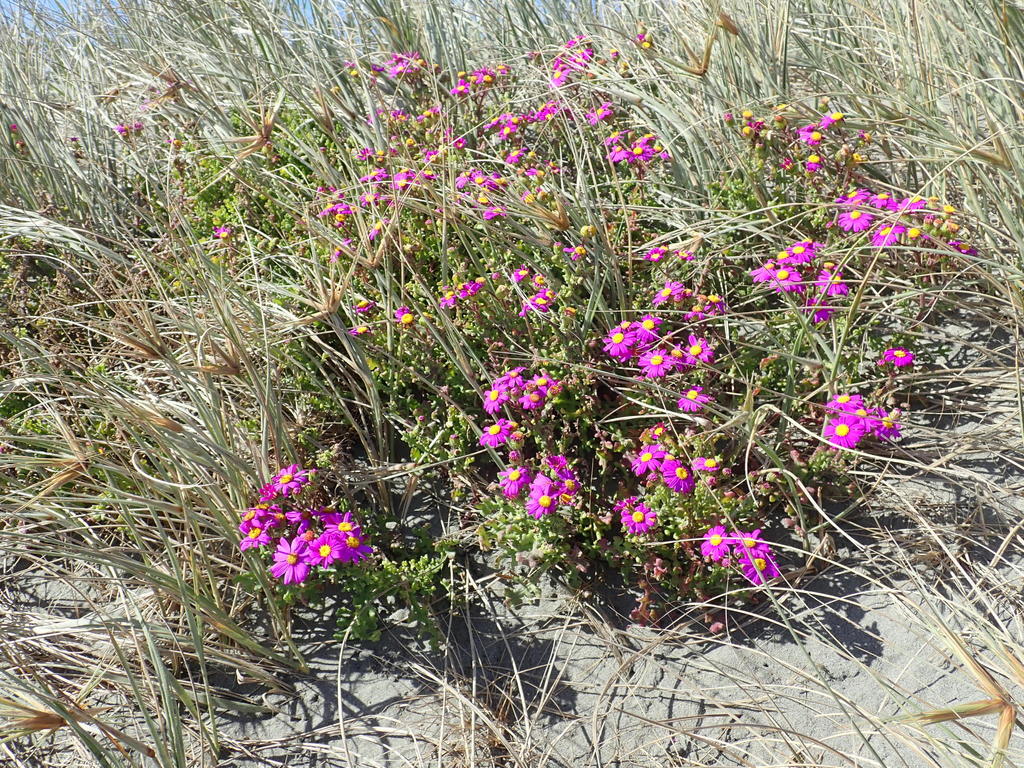
(c) Arnim Littek, some rights reserved (CC BY), uploaded by Arnim Littek · licence
Family: Asteraceae · Type: Herb · Not Native
Conservation status: Cal-IPC Yes
Senecio elegans (Red-purple ragwort) is a non-native California herb in the Asteraceae family, recognized by key diagnostic feature is unique red-purple ray color.
Red-purple ragwort is a naturalized annual found in coastal bioregions of Central Coast, San Francisco Bay, and Southern California in disturbed coastal sites at elevations below 100 meters. Flowering from March to June, this plant produces deep red-purple ray flowers in radiate heads arranged in flat-topped clusters up to 30 millimeters wide. Growing with branched, sticky-glandular stems 20 to 50 centimeters tall, it develops from a central taproot. Its leaves are primarily obovate, 3 to 8 centimeters long, with 1 to 2 pinnately lobed margins that have crenate or dentate edges. The distinctive flower heads feature conspicuous black-tipped phyllaries and numerous disk flowers, creating a vibrant display in coastal disturbed areas.
Identification and appearance
Key characters: 12 sympatric species; key diagnostic feature is unique red-purple ray color
Habitat and range
Habitat: Disturbed coastal sites
Elevation: < 100 m
Outside California: southern Africa
Bloom period
Senecio elegans blooms Mar-Jun.
Conservation status
Cal-IPC Yes
How to tell it apart
vs Packera: Senecio has larger leaves (over 2.5 inches) and often black-tipped bracts; Packera has tiny leaves (under 1.5 inches) with green or reddish tips.; vs Sonchus: Senecio has yellow daisy flowers with a neat single row of bracts; Sonchus has dandelion-like flowers and milky sap when broken.; vs Dudleya: Senecio is in the sunflower family with daisy flowers; Dudleya is a succulent with thick fleshy leaves and star-shaped flowers.; vs Ericameria: Senecio has one main row of equal bracts around flower heads; Ericameria has 2-4 overlapping rows of unequal bracts.; vs Taraxacum: Senecio has branching stems with multiple flower heads; Taraxacum has leafless hollow stems with single dandelion-like heads.
Frequently asked questions
Is Senecio elegans native to California?
No. Senecio elegans is not native to California (recorded as not native).
When does Senecio elegans bloom?
Senecio elegans blooms Mar-Jun.
What plant family does Senecio elegans belong to?
Senecio elegans is in the Asteraceae family, genus Senecio.
Is Senecio elegans invasive in California?
Senecio elegans is listed by Cal-IPC with an invasiveness rating of Yes.
What habitat does Senecio elegans grow in?
Senecio elegans grows in Disturbed coastal sites.
Related species
Other California species in the same genus, family, or bioregion.
- Senecio flaccidus — Threadleaf ragwort
- Senecio flaccidus var. douglasii — Douglas' threadleaf ragwort
- Senecio flaccidus var. monoensis — Smooth threadleaf ragwort
- Senecio fremontii — Dwarf Mountain Ragwort
- Senecio fremontii var. fremontii — Dwarf mountain ragwort
- Senecio fremontii var. occidentalis — Western dwarf mountain ragwort
Sources: Jepson eFlora · Index of California Plant Names · CalPhotos
Last updated 2026-10-07
Data from The California Species Project — 14,000+ California species with verified data from CNPS, CDFW, USFWS, Cal-IPC, and more.