Senna artemisioides
Silver senna
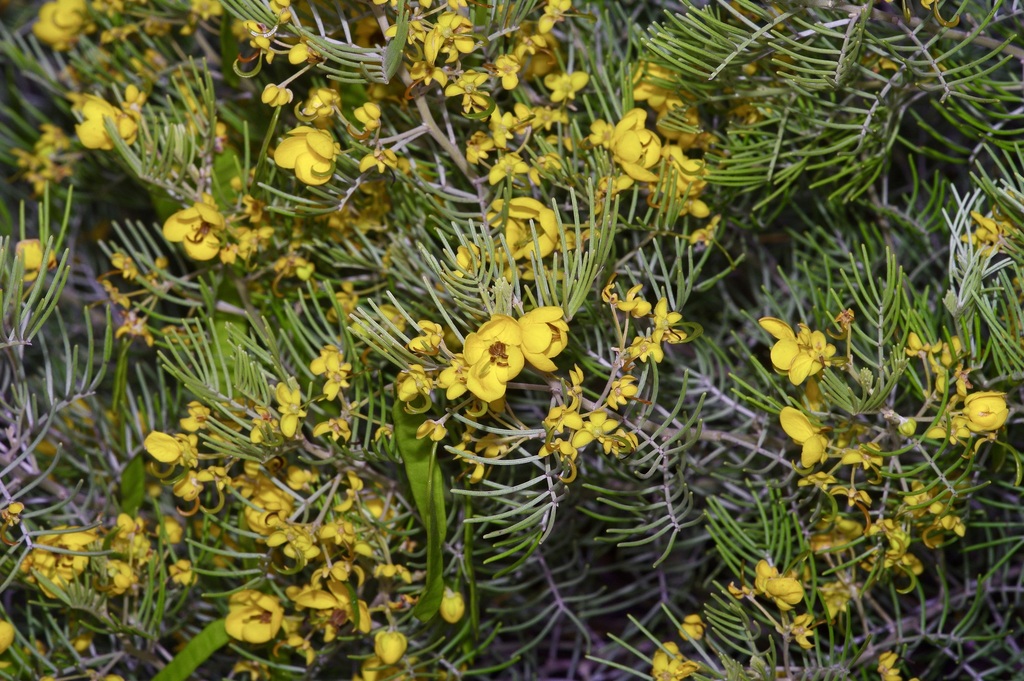
(c) Michelle W. (鍾偉瑋), some rights reserved (CC BY) · licence
Family: Fabaceae · Type: Shrub · Not Native
Senna artemisioides (Silver senna) is a non-native California shrub in the Fabaceae family, recognized by . Key feature is numerous very narrow linear leaflets.
Silver senna is a naturalized shrub found in southern California regions including the Southern California Coast, San Gabriel Mountains, San Bernardino Mountains, and Desert Sonoran areas in dry, sandy washes and rocky disturbed areas at elevations of 100 to 1,500 meters. Flowering from January to May, this plant produces bright yellow flowers approximately 7 to 10 millimeters long in clustered racemes with 4 to 12 blooms. Growing as a compact shrub less than 2 meters tall with sparse to dense hairy stems, it develops a spreading, unarmed structure. Its leaves feature 6 to 16 narrow linear leaflets, each about 10 to 25 millimeters long and only 1 millimeter wide, arranged on a 5 to 15 millimeter petiole with 1 to 3 small glands. The fruit develops as a flat, straight oblong pod 4 to 8 centimeters long, containing several seeds.
Identification and appearance
Key characters: 3 sympatric species. Key feature is numerous very narrow linear leaflets
Habitat and range
Habitat: Dry, sandy washes to rocky slopes, disturbed areas
Elevation: 100-1500 m
Outside California: Native to Australia, cultivated, naturalized in southwestern United States
Bloom period
Senna artemisioides blooms Jan-May.
How to tell it apart
vs Cassia: Senna and Cassia are now considered the same genus; plants in California are Senna.; vs Ephedra: Senna has bright yellow flowers and compound leaves; Ephedra is nearly leafless with jointed green stems.; vs Spartium: Senna has compound leaves with paired leaflets; Spartium has simple leaves or nearly leafless green stems.; vs Parkinsonia: Senna lacks spines; Parkinsonia has prominent straight spines at leaf nodes.; vs Asclepias: Senna has yellow pea-flowers and compound leaves; Asclepias has complex star-shaped flowers and milky sap.
Frequently asked questions
Is Senna artemisioides native to California?
No. Senna artemisioides is not native to California (recorded as not native).
When does Senna artemisioides bloom?
Senna artemisioides blooms Jan-May.
What plant family does Senna artemisioides belong to?
Senna artemisioides is in the Fabaceae family, genus Senna.
What habitat does Senna artemisioides grow in?
Senna artemisioides grows in Dry, sandy washes to rocky slopes, disturbed areas.
Related species
Other California species in the same genus, family, or bioregion.
Sources: Jepson eFlora · Index of California Plant Names · CalPhotos
Last updated 2026-10-07
Data from The California Species Project — 14,000+ California species with verified data from CNPS, CDFW, USFWS, Cal-IPC, and more.