Senna covesii
Coues' cassia
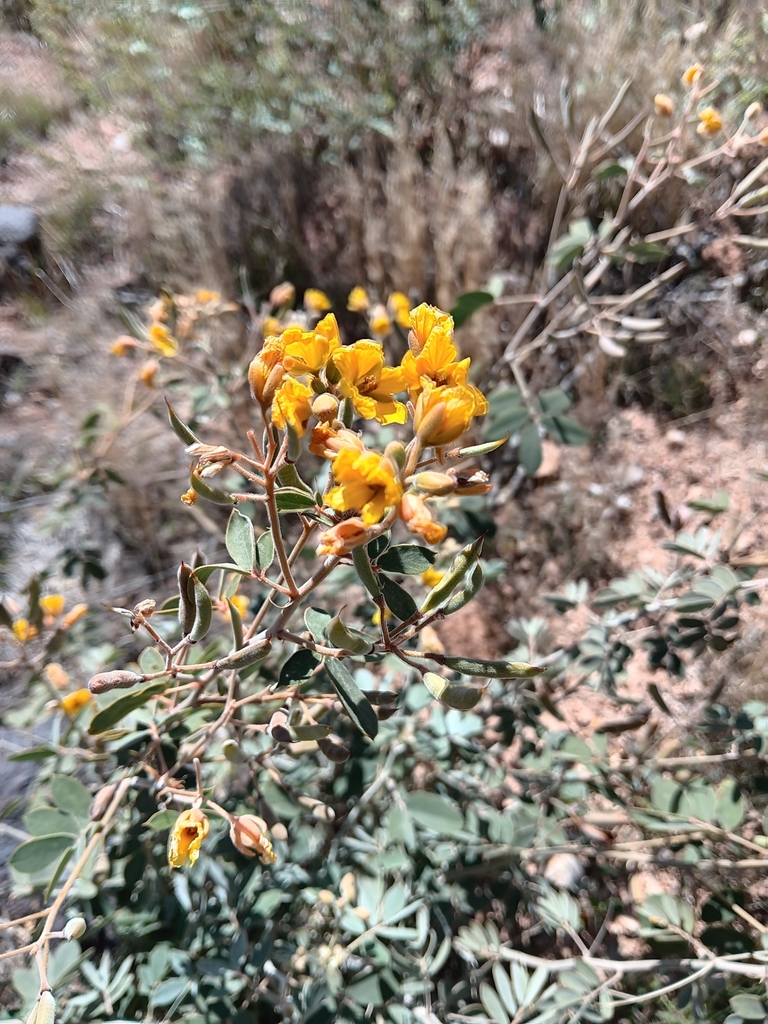
no rights reserved · CC0
Family: Fabaceae · Type: Subshrub · Native
Conservation status: CNPS 2B.2
Senna covesii (Coues' cassia) is a native California subshrub in the Fabaceae family, recognized by . Distinguished by dense white-gray hairs and overlapping leaflets.
Coues' cassia is a rare (CNPS 2B.2) California native shrub found in the southern desert regions in dry, sandy desert washes and slopes at elevations of 330 to 760 meters. Flowering from March to April and in fall, this plant produces golden-yellow flowers 12 millimeters long with prominent veining in small axillary racemes. Growing 3 to 6 decimeters tall with a dense white to gray hairy appearance, it forms a leafy subshrub with a compact structure. Its leaves feature 4 to 8 overlapped, opposite elliptic leaflets with bristle-like stipules, each leaflet 10 to 25 millimeters long. The plant produces erect, persistent fruits 2 to 5 centimeters long that remain on the shrub after flowering.
Identification and appearance
Key characters: 2 sympatric species. Distinguished by dense white-gray hairs and overlapping leaflets
Habitat and range
Habitat: Dry, sandy desert washes, slopes
Elevation: 330-760 m
California counties: Riverside, San Bernardino, San Diego, Imperial
Outside California: to southern Nevada, southwestern New Mexico, Baja California
Bloom period
Senna covesii blooms Mar-Apr(fall).
Conservation status
CNPS 2B.2
How to tell it apart
vs Cassia: Senna and Cassia are now considered the same genus; plants in California are Senna.; vs Ephedra: Senna has bright yellow flowers and compound leaves; Ephedra is nearly leafless with jointed green stems.; vs Spartium: Senna has compound leaves with paired leaflets; Spartium has simple leaves or nearly leafless green stems.; vs Parkinsonia: Senna lacks spines; Parkinsonia has prominent straight spines at leaf nodes.; vs Asclepias: Senna has yellow pea-flowers and compound leaves; Asclepias has complex star-shaped flowers and milky sap.
Frequently asked questions
Is Senna covesii native to California?
Yes. Senna covesii is native to California (recorded as native).
When does Senna covesii bloom?
Senna covesii blooms Mar-Apr(fall).
Where in California does Senna covesii grow?
Senna covesii occurs in Riverside, San Bernardino, San Diego, Imperial, at elevations of 330-760 m.
What plant family does Senna covesii belong to?
Senna covesii is in the Fabaceae family, genus Senna.
Is Senna covesii rare or endangered?
Senna covesii carries California Rare Plant Rank 2B.2, state rank S3.
Related species
Other California species in the same genus, family, or bioregion.
Sources: Jepson eFlora · CNPS Rare Plant Inventory · Index of California Plant Names · CalPhotos · CDFW CNDDB
Last updated 2026-10-07
Data from The California Species Project — 14,000+ California species with verified data from CNPS, CDFW, USFWS, Cal-IPC, and more.