Sequoia sempervirens
Coast redwood
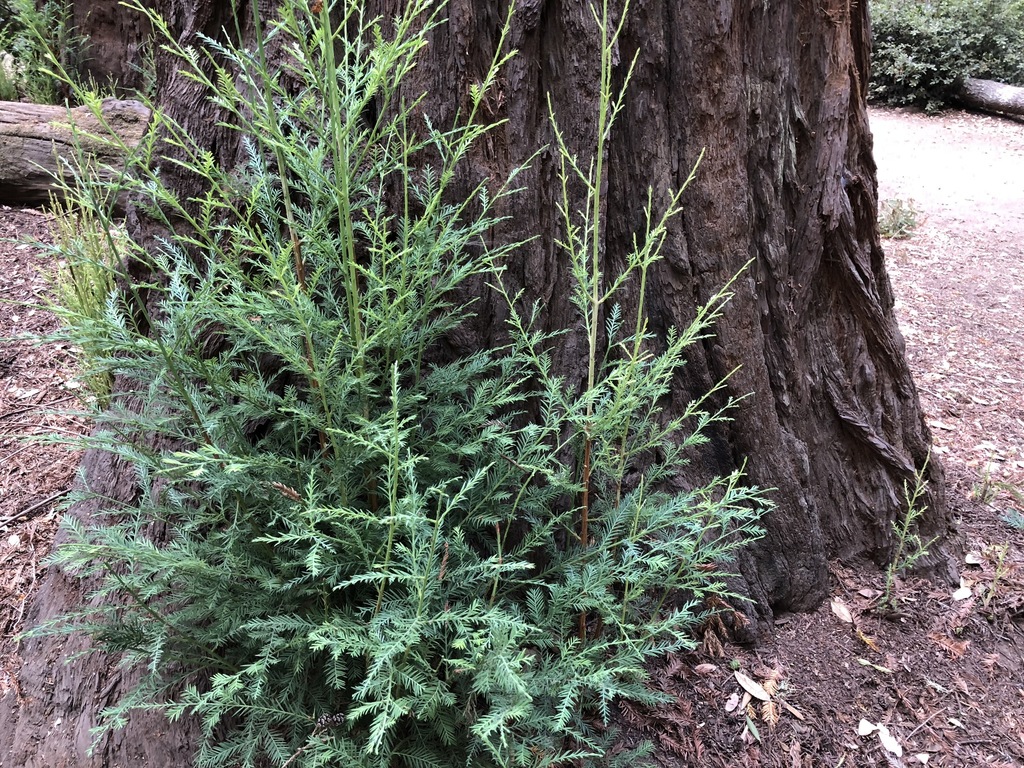
(c) Miguel Vieira, some rights reserved (CC BY), uploaded by Miguel Vieira · licence
Family: Cupressaceae · Type: Tree · Native
Sequoia sempervirens (Coast redwood) is a native California tree in the Cupressaceae family, recognized by Sequoia is a monotypic genus representing an ancient lineage of redwoods, endemic to the California coast.
Coast redwood is a native tree found in northern coastal California, western Klamath Ranges, and central coastal areas in redwood forest habitats at elevations below 1,100 meters. Its distinctive feature is the ability to sprout vigorously from its base when cut or from its entire crown after fire, with massive trunks reaching up to 110 meters tall and 9 meters in diameter. Growing with thick red-brown bark up to 30 centimeters thick and downswept branches, this tree forms a narrow conical to cylindrical crown that remains largely unbranched in its lower half. Its leaves are of two distinct types: small appressed awl-like leaves on rapidly growing stems and longer spreading linear leaves 5 to 25 millimeters long that grow in two roughly ranked rows. The seed cones are small and spherical, measuring 13 to 35 millimeters, containing 2 to 7 seeds with narrow lateral wings.
Identification and appearance
Key characters: Sequoia is a monotypic genus representing an ancient lineage of redwoods, endemic to the California coast
Habitat and range
Habitat: Redwood forest
Elevation: < 1100 m
California counties: Humboldt, Marin, Monterey, Del Norte, Mendocino, Alameda, Los Angeles, Orange, Contra Costa, Riverside, Santa Cruz, Sonoma, San Mateo, Santa Clara, Yolo, San Bernardino, Santa Barbara, Napa, Butte, Sutter, Sacramento, Tulare, Colusa, San Francisco, Siskiyou, San Luis Obispo, San Diego, Calaveras, Tehama
Outside California: southwestern Oregon
How to tell it apart
vs Sequoiadendron: Sequoia has flat needles in two rows on most branches; Sequoiadendron has only awl-shaped leaves pressed in four rows.; vs Taxus: Sequoia has reddish fibrous bark and scale leaves on some shoots; Taxus has smooth bark and only flat needles.; vs Pseudotsuga: Sequoia has two leaf types and fibrous bark; Pseudotsuga has only one needle type and hanging cones with three-pointed bracts.; vs Pinus: Sequoia has flat needles in two rows; Pinus has needles bundled in clusters of 1-5.; vs Abies: Sequoia has two leaf types including scales; Abies has only flat needles with white bands underneath.
Frequently asked questions
Is Sequoia sempervirens native to California?
Yes. Sequoia sempervirens is native to California (recorded as native).
Where in California does Sequoia sempervirens grow?
Sequoia sempervirens occurs in Humboldt, Marin, Monterey, Del Norte, Mendocino, Alameda, Los Angeles, Orange and other counties, at elevations of < 1100 m.
What plant family does Sequoia sempervirens belong to?
Sequoia sempervirens is in the Cupressaceae family, genus Sequoia.
What habitat does Sequoia sempervirens grow in?
Sequoia sempervirens grows in Redwood forest.
Related species
Other California species in the same genus, family, or bioregion.
Sources: Jepson eFlora · Index of California Plant Names · CalPhotos
Last updated 2026-10-07
Data from The California Species Project — 14,000+ California species with verified data from CNPS, CDFW, USFWS, Cal-IPC, and more.