Sesbania punicea
Scarlet sesban, Scarlet Sesban
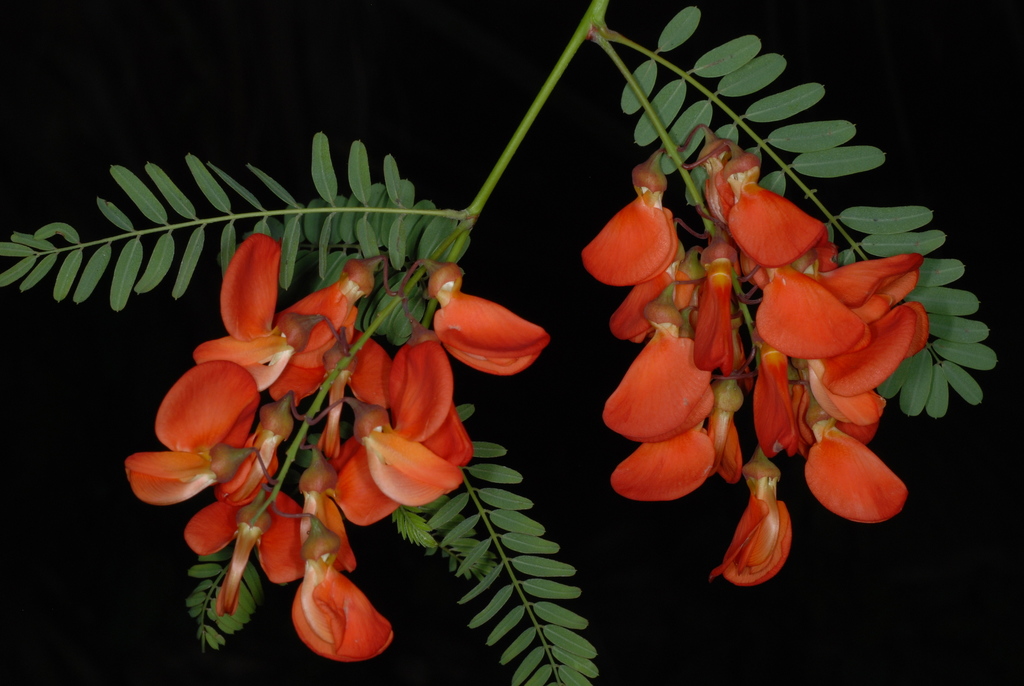
(c) Douglas Goldman, some rights reserved (CC BY-SA), uploaded by Douglas Goldman · licence
Family: Fabaceae · Type: Subshrub · Not Native
Conservation status: Cal-IPC Yes
Sesbania punicea (Scarlet sesban) is a non-native California subshrub in the Fabaceae family.
Scarlet sesban is a naturalized annual found in the North Coast Ranges, Great Valley, San Francisco Bay Area, and other regions at elevations below 200 meters, commonly growing along streams, lake shores, roadsides, and in cultivated settings. Flowering from June to September, this plant produces striking red flowers in small clusters of 5 to 15 blooms. Growing with slender stems and a spreading habit, it reaches moderate heights with multiple branches. Its compound leaves feature approximately 20 to 34 small elliptic leaflets, each 0.8 to 2.5 centimeters long, creating a delicate, feathery appearance. The fruit develops as an elongated pod measuring 4 to 8 centimeters in length, providing additional visual interest to this ornamental species.
Identification and appearance
Key characters: Geographically isolated species with distinctive scarlet flowers and oblong fruits
Habitat and range
Habitat: Along streams, lake shores, other moist sites, roadsides, often cultivated as ornamental
Elevation: < 200 m
California counties: Yolo, Orange, Sacramento, Shasta, Placer, San Joaquin, El Dorado, Fresno, Nevada, Stanislaus, Butte, Sonoma, Glenn, Contra Costa, San Mateo, Napa, Tehama, San Diego, Madera
Outside California: southeastern United States, native to South America
Bloom period
Sesbania punicea blooms Jun-Sep.
Conservation status
Cal-IPC Yes
How to tell it apart
vs Cleomella: Sesbania has 20-60 tiny leaflets per leaf; Cleomella has 3 simple leaflets.; vs Astragalus: Sesbania has 20-60 leaflets and very long pods; Astragalus has fewer leaflets and shorter pods.; vs Tara: Sesbania has much longer pods (4-20 cm); Tara has shorter curved pods.; vs Colutea: Sesbania has long slender pods; Colutea has inflated bladder-like pods.; vs Senna: Sesbania has more leaflets (20-60) and longer pods; Senna has fewer leaflets (8-20) and shorter pods.
Frequently asked questions
Is Sesbania punicea native to California?
No. Sesbania punicea is not native to California (recorded as not native).
When does Sesbania punicea bloom?
Sesbania punicea blooms Jun-Sep.
Where in California does Sesbania punicea grow?
Sesbania punicea occurs in Yolo, Orange, Sacramento, Shasta, Placer, San Joaquin, El Dorado, Fresno and other counties, at elevations of < 200 m.
What plant family does Sesbania punicea belong to?
Sesbania punicea is in the Fabaceae family, genus Sesbania.
Is Sesbania punicea invasive in California?
Sesbania punicea is listed by Cal-IPC with an invasiveness rating of Yes.
Related species
Other California species in the same genus, family, or bioregion.
Sources: Jepson eFlora · Index of California Plant Names · CalPhotos
Last updated 2026-10-07
Data from The California Species Project — 14,000+ California species with verified data from CNPS, CDFW, USFWS, Cal-IPC, and more.