Sesuvium verrucosum
Western sea-purslane, Western Sea-Purslane
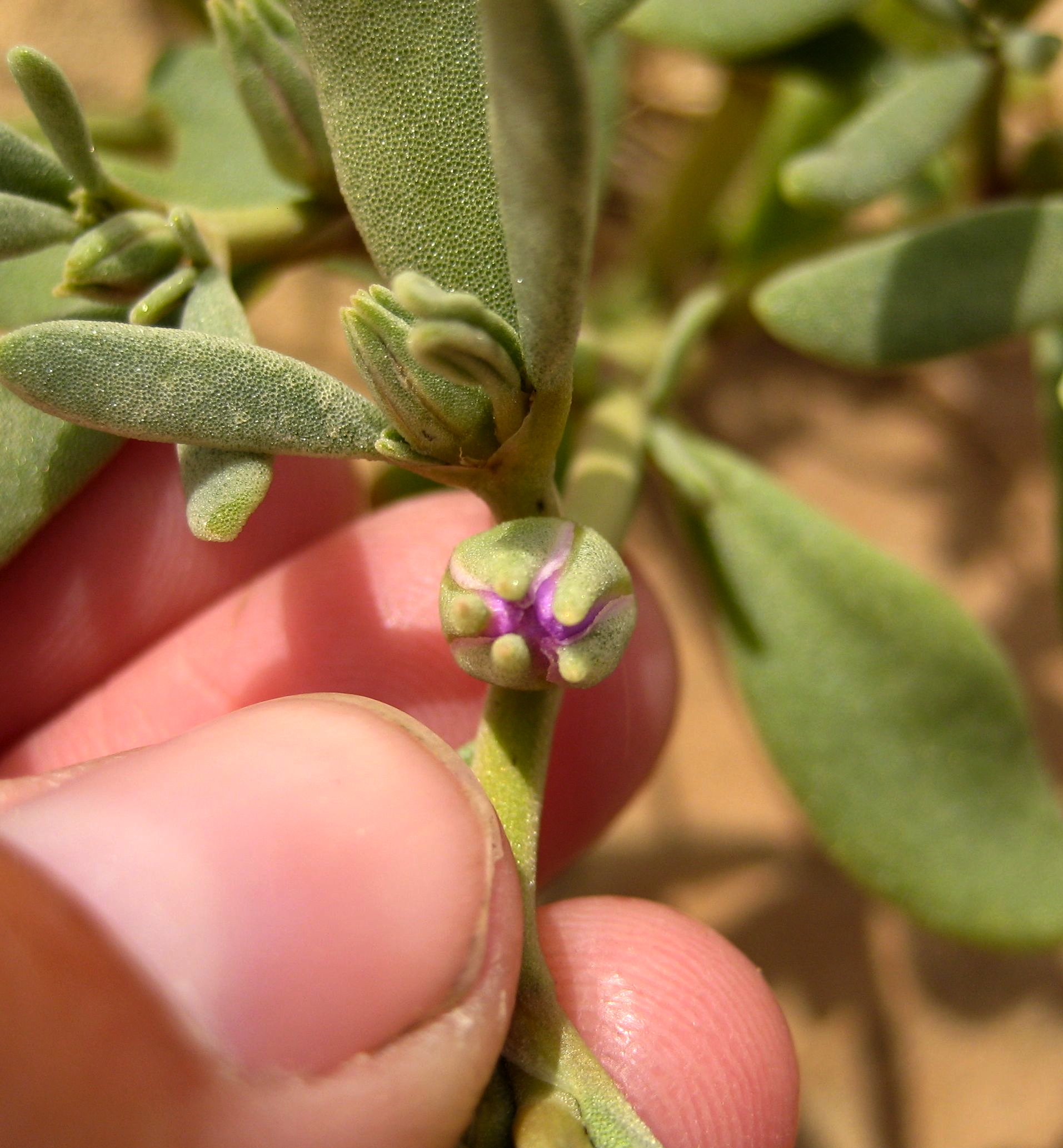
Photo by Chez Brungraber
Family: Aizoaceae · Type: Herb · Native
Sesuvium verrucosum (Western sea-purslane) is a native California herb in the Aizoaceae family, recognized by Sesuvium is primarily a tropical and subtropical genus with this species representing its northern range limit in California.
Western sea-purslane is a California native perennial found in northern coastal, Central Valley, southern coastal ranges, southern coastal, western Transverse Ranges, Peninsular Ranges, Great Basin, and Desert bioregions in moist or seasonally dry saline flats at elevations below 1,400 meters. Flowering from April to November, this plant produces red-tinged flowers with fused filaments in small axillary clusters. Growing with multiple branching stems up to 90 centimeters tall, it forms a low, spreading mat with minute papillate (warty) texture. Its leaves are distinctive, ranging from 0.5 to 4 centimeters long, linear to spoon-shaped, and clasping the stem at the base. When mature, the plant produces smooth fruits 4 to 5 millimeters long with tiny seeds less than a millimeter in size.
Identification and appearance
Key characters: Sesuvium is primarily a tropical and subtropical genus with this species representing its northern range limit in California
Habitat and range
Habitat: Uncommon. Moist or seasonally dry flats, margins of generally saline wetlands
Elevation: < 1400 m
California counties: Yolo, Los Angeles, Merced, Fresno, Orange, San Bernardino, Imperial, Riverside, Kern, San Diego, Inyo, Santa Barbara, El Dorado, Marin, San Joaquin, Solano, Tulare, Kings, Contra Costa, Lassen, Napa, Stanislaus, San Luis Obispo
Outside California: to Oregon, Kansas, South America
Bloom period
Sesuvium verrucosum blooms Apr-Nov.
How to tell it apart
vs Frankenia: Numerous stamens and fleshy leaves vs. Frankenia's few stamens and tiny scale-like leaves.; vs Carpobrotus: Opposite leaves and flowers with sepals vs. ice plant's alternate leaves and showy petals.; vs Jaumea: Succulent opposite leaves and single flowers vs. Jaumea's yellow daisy heads.; vs Atriplex: Opposite leaves and showy stamens vs. saltbush's alternate leaves and inconspicuous wind-pollinated flowers.; vs Mesembryanthemum: Opposite leaves vs. ice plant's alternate leaves.
Frequently asked questions
Is Sesuvium verrucosum native to California?
Yes. Sesuvium verrucosum is native to California (recorded as native).
When does Sesuvium verrucosum bloom?
Sesuvium verrucosum blooms Apr-Nov.
Where in California does Sesuvium verrucosum grow?
Sesuvium verrucosum occurs in Yolo, Los Angeles, Merced, Fresno, Orange, San Bernardino, Imperial, Riverside and other counties, at elevations of < 1400 m.
What plant family does Sesuvium verrucosum belong to?
Sesuvium verrucosum is in the Aizoaceae family, genus Sesuvium.
What habitat does Sesuvium verrucosum grow in?
Sesuvium verrucosum grows in Uncommon. Moist or seasonally dry flats, margins of generally saline wetlands.
Related species
Other California species in the same genus, family, or bioregion.
Sources: Jepson eFlora · Index of California Plant Names · CalPhotos
Last updated 2026-10-07
Data from The California Species Project — 14,000+ California species with verified data from CNPS, CDFW, USFWS, Cal-IPC, and more.