Setaria verticillata
Hooked bristle grass
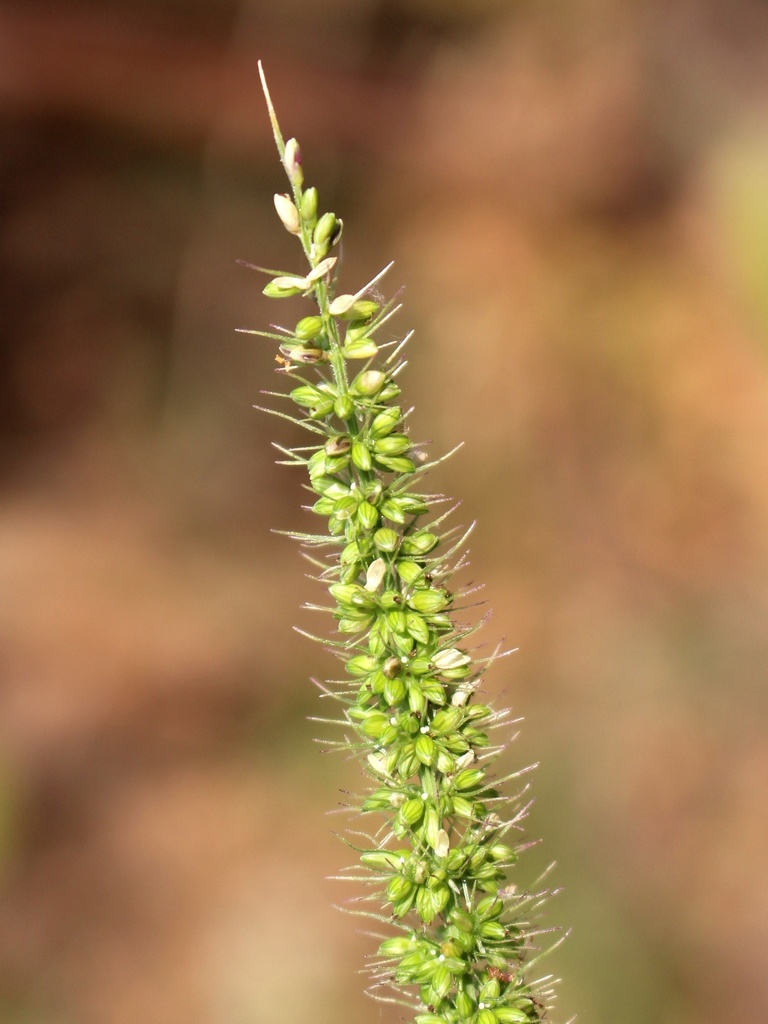
(c) Юрий Данилевский (Yuriy Danilevsky), some rights reserved (CC BY), uploaded by Юрий Данилевский (Yuriy Danilevsky) · licence
Family: Poaceae · Type: Grass · Not Native
Setaria verticillata (Hooked bristle grass) is a non-native California grass in the Poaceae family, recognized by decumbent habit and hooked bristles are key features.
Hooked bristle grass is a naturalized annual grass found in southern California coastal areas, western Transverse Ranges, Peninsular Ranges, and the Sonoran Desert's Coachella Valley in disturbed places, fields, and roadsides at elevations below 550 meters. Flowering from May to November, this plant produces green-tinged pale spikelets with distinctive hooked bristles that easily attach to clothing and animal fur. Growing with decumbent to erect stems 15 to 100 centimeters tall, it has a sprawling or upright habit in open areas. Its leaves are long and narrow, measuring 5 to 25 centimeters in length and 3 to 12 millimeters wide, with surfaces ranging from smooth to slightly hairy. The plant's characteristic hooked bristles make it particularly adept at seed dispersal through passive attachment to passing animals or humans.
Identification and appearance
Key characters: 5 sympatric species; decumbent habit and hooked bristles are key features
Habitat and range
Habitat: Disturbed places, fields, roadsides
Elevation: < 550 m
California counties: San Joaquin, San Francisco, Ventura, San Bernardino, Riverside, Orange, Fresno, Los Angeles, Santa Barbara, Yolo, Monterey, Napa, San Diego, Santa Clara, Sonoma, Kern, San Luis Obispo, Lassen, Sacramento, Stanislaus, Solano, Kings, Imperial
Outside California: widespread in North America, native to Europe
Bloom period
Setaria verticillata blooms May-Nov.
How to tell it apart
vs Cenchrus: Setaria bristles stay attached to the axis after the spikelet falls; Cenchrus bristles fuse into a spiny bur that drops with the seed.; vs Pennisetum: Setaria bristles are free and persistent below each spikelet; Pennisetum bristles form a deciduous involucre that falls as a unit with the spikelet.; vs Alopecurus: Setaria has stiff bare bristles subtending naked spikelets; Alopecurus has no bristles and its soft spikelets bear a bent awn from the lemma back.; vs Polypogon: Setaria's bristles are separate sterile branchlets left behind on the axis; in Polypogon the bristly look comes from awns on the glumes and the whole spikelet sheds.; vs Phleum: Setaria's cylindric head has projecting bristles between the spikelets; Phleum's dense spike is bristle-free with stiff, short-awned, keeled glumes.
Frequently asked questions
Is Setaria verticillata native to California?
No. Setaria verticillata is not native to California (recorded as not native).
When does Setaria verticillata bloom?
Setaria verticillata blooms May-Nov.
Where in California does Setaria verticillata grow?
Setaria verticillata occurs in San Joaquin, San Francisco, Ventura, San Bernardino, Riverside, Orange, Fresno, Los Angeles and other counties, at elevations of < 550 m.
What plant family does Setaria verticillata belong to?
Setaria verticillata is in the Poaceae family, genus Setaria.
What habitat does Setaria verticillata grow in?
Setaria verticillata grows in Disturbed places, fields, roadsides.
Related species
Other California species in the same genus, family, or bioregion.
Sources: Jepson eFlora · Index of California Plant Names · CalPhotos
Last updated 2026-10-07
Data from The California Species Project — 14,000+ California species with verified data from CNPS, CDFW, USFWS, Cal-IPC, and more.