Setaria viridis
Green bristle grass
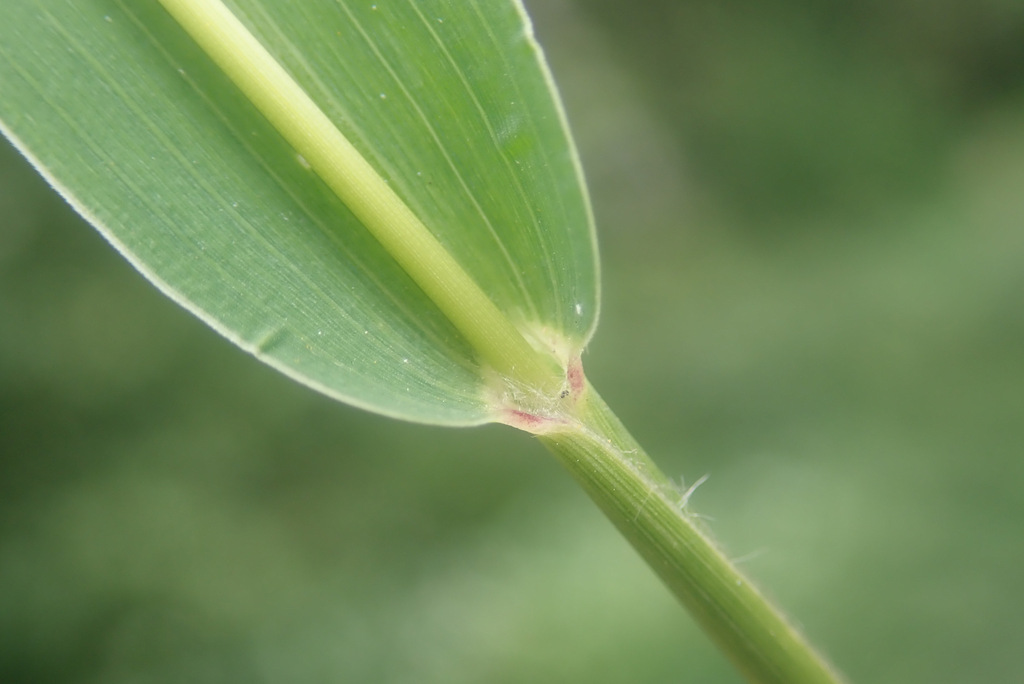
(c) Thomas Gyselinck, some rights reserved (CC BY), uploaded by Thomas Gyselinck · licence
Family: Poaceae · Type: Grass · Not Native
Setaria viridis (Green bristle grass) is a non-native California grass in the Poaceae family, recognized by widespread distribution, ciliate sheath margins somewhat diagnostic.
Green bristle grass is a naturalized annual grass found in northwestern California, the Sierra Nevada, Central Valley, San Francisco Bay Area, and southern desert regions in moist, disturbed areas, roadsides, and streambanks at elevations below 1,525 meters. Flowering from May to October, this plant produces pale green to green-white flowers in dense, bristly clusters 2 to 15 centimeters long. Growing with decumbent to erect stems 20 to 100 centimeters tall, the grass has scabrous leaf sheaths with ciliate upper margins. Its leaf blades are 8 to 20 centimeters long and 3 to 12 millimeters wide, with a smooth upper surface and a small ligule 1 to 2 millimeters long. The plant's distinctive bristly inflorescence features 1 to 3 short bristles surrounding each compact, approximately 2-millimeter-wide spikelet.
Identification and appearance
Key characters: 6 sympatric species; widespread distribution, ciliate sheath margins somewhat diagnostic
Habitat and range
Habitat: Moist, disturbed areas, roadsides, streambanks
Elevation: < 1525 m
California counties: Los Angeles, Fresno, San Joaquin, Santa Barbara, Kern, Santa Clara, Colusa, Butte, Contra Costa, Riverside, Marin, San Luis Obispo, San Bernardino, Siskiyou, Inyo, Lake, Shasta, Trinity, Tulare, Tuolumne, San Diego, Stanislaus, Imperial, Orange, Mono, Alpine, Mariposa, Mendocino, Merced, Monterey, Placer, San Francisco, Tehama, Yolo, Napa, Nevada, Plumas, Santa Cruz, Sonoma, Ventura, Sacramento, Glenn, Yuba, Lassen, Humboldt, Sierra, Madera, San Mateo, Alameda, Solano
Outside California: widespread North America, native to Eurasia
Bloom period
Setaria viridis blooms May-Oct.
How to tell it apart
vs Cenchrus: Setaria bristles stay attached to the axis after the spikelet falls; Cenchrus bristles fuse into a spiny bur that drops with the seed.; vs Pennisetum: Setaria bristles are free and persistent below each spikelet; Pennisetum bristles form a deciduous involucre that falls as a unit with the spikelet.; vs Alopecurus: Setaria has stiff bare bristles subtending naked spikelets; Alopecurus has no bristles and its soft spikelets bear a bent awn from the lemma back.; vs Polypogon: Setaria's bristles are separate sterile branchlets left behind on the axis; in Polypogon the bristly look comes from awns on the glumes and the whole spikelet sheds.; vs Phleum: Setaria's cylindric head has projecting bristles between the spikelets; Phleum's dense spike is bristle-free with stiff, short-awned, keeled glumes.
Frequently asked questions
Is Setaria viridis native to California?
No. Setaria viridis is not native to California (recorded as not native).
When does Setaria viridis bloom?
Setaria viridis blooms May-Oct.
Where in California does Setaria viridis grow?
Setaria viridis occurs in Los Angeles, Fresno, San Joaquin, Santa Barbara, Kern, Santa Clara, Colusa, Butte and other counties, at elevations of < 1525 m.
What plant family does Setaria viridis belong to?
Setaria viridis is in the Poaceae family, genus Setaria.
What habitat does Setaria viridis grow in?
Setaria viridis grows in Moist, disturbed areas, roadsides, streambanks.
Related species
Other California species in the same genus, family, or bioregion.
- Setaria adhaerens — Bur bristle grass
- Setaria faberi — Chinese foxtail
- Setaria parviflora — Knotroot bristle grass
- Setaria pumila subsp. pumila — Yellow bristle grass
- Setaria sp. — Bristle grass
- Setaria sphacelata — African bristle grass
- Sorghum bicolor — Sorghum
- Sorghum halepense — Johnson grass
- Sorghum sp.
- Spartina alterniflora x S. foliosa — smooth hybrid cordgrass
Sources: Jepson eFlora · Index of California Plant Names · CalPhotos
Last updated 2026-10-07
Data from The California Species Project — 14,000+ California species with verified data from CNPS, CDFW, USFWS, Cal-IPC, and more.