Sibara filifolia
Santa cruz island rockcress, Santa Cruz Island Rockcress
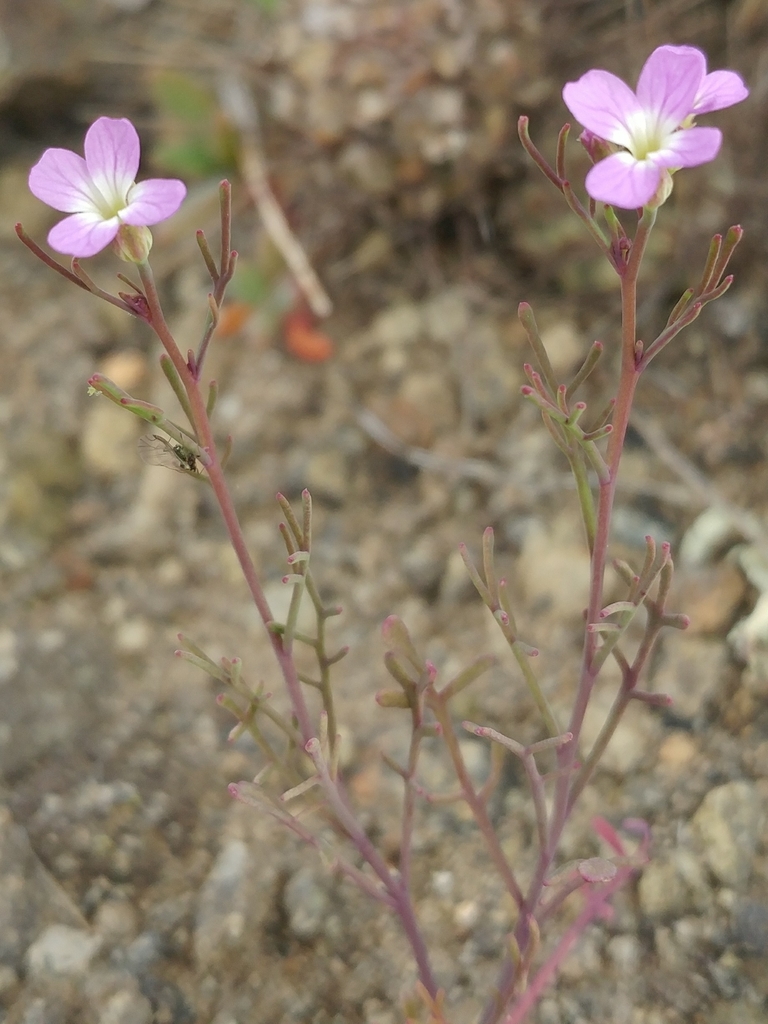
(c) Casey H. Richart, some rights reserved (CC BY) · licence
Family: Brassicaceae · Type: Herb · Native
Conservation status: CNPS 1B.1 · Endangered
Sibara filifolia (Santa cruz island rockcress) is a native California herb in the Brassicaceae family, recognized by . Distinguished by Channel Islands location and purple flowers.
Santa cruz island rockcress is a rare (CNPS 1B.1) California native annual found on the Channel Islands including Santa Catalina, San Clemente, and Santa Cruz islands in dry ridges at elevations below 500 meters. Flowering in April, this plant produces delicate purple to lavender flowers in small, spoon-shaped petals. Growing with slender stems 15 to 30 centimeters tall, it develops simple or few-branched stems that rise from the base. Its cauline leaves are pinnately divided with 5 to 15 millimeter linear lobes, each extremely narrow at 0.2 to 0.8 millimeters wide. The tiny fruits bear a short style and are supported by slender pedicels that spread slightly upward.
Identification and appearance
Key characters: Geographically isolated (0 sympatric species). Distinguished by Channel Islands location and purple flowers.
Habitat and range
Habitat: dry ridges
Elevation: < 500 m
California counties: Los Angeles, Santa Barbara
Bloom period
Sibara filifolia blooms Apr.
Conservation status
CNPS 1B.1 · Endangered
How to tell it apart
vs Caulanthus: Sibara leaves are feathery with thread-like segments; jewelflower leaves are broader with teeth.; vs Cardamine: Sibara has thread-like leaf segments; bitter cress has broader leaflets.; vs Planodes: Sibara seeds lack wings; Planodes seeds have papery wings.; vs Cakile: Sibara has delicate thread-like leaves; sea rocket has thick fleshy leaves.; vs Polyctenium: Sibara is annual with soft leaves; Polyctenium is perennial with rigid leaves.
Frequently asked questions
Is Sibara filifolia native to California?
Yes. Sibara filifolia is native to California (recorded as native).
When does Sibara filifolia bloom?
Sibara filifolia blooms Apr.
Where in California does Sibara filifolia grow?
Sibara filifolia occurs in Los Angeles, Santa Barbara, at elevations of < 500 m.
What plant family does Sibara filifolia belong to?
Sibara filifolia is in the Brassicaceae family, genus Sibara.
Is Sibara filifolia rare or endangered?
Sibara filifolia carries California Rare Plant Rank 1B.1, state rank S2.
Related species
Other California species in the same genus, family, or bioregion.
Sources: Jepson eFlora · CNPS Rare Plant Inventory · Index of California Plant Names · CalPhotos · CDFW CNDDB
Last updated 2026-10-07
Data from The California Species Project — 14,000+ California species with verified data from CNPS, CDFW, USFWS, Cal-IPC, and more.