Sibaropsis hammittii
Hammitt's clay-cress
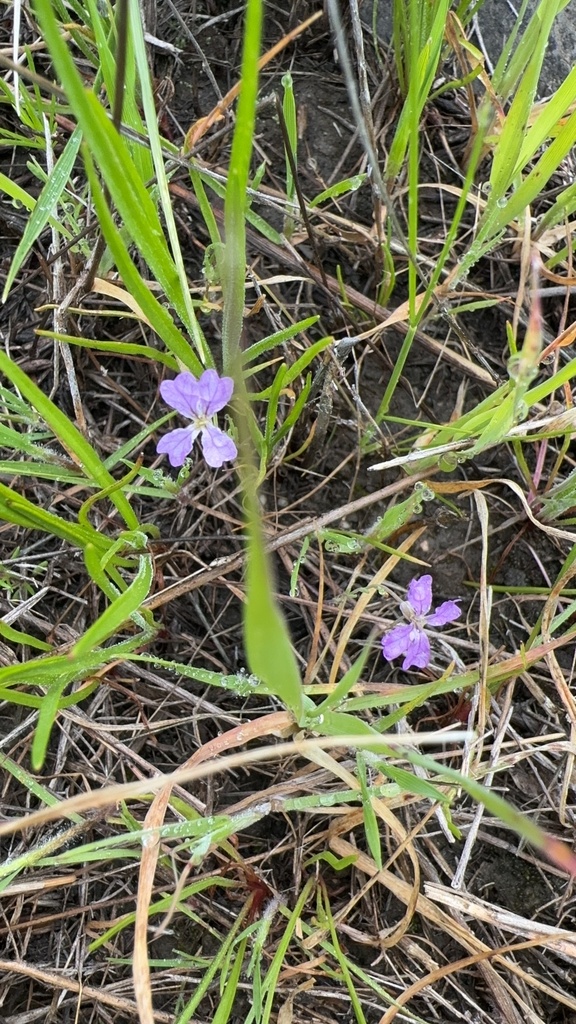
(c) Megan “Moe” Morelock, some rights reserved (CC BY) · licence
Family: Brassicaceae · Type: Herb · Native
Conservation status: CNPS 1B.2
Sibaropsis hammittii (Hammitt's clay-cress) is a native California herb in the Brassicaceae family, recognized by Sibaropsis is a monotypic genus endemic to Southern California, representing a unique lineage within the mustard family.
Hammitt's clay-cress is a rare California native annual herb ranked 1B.2 by CNPS, found in the Peninsular Ranges of the Santa Ana Mountains and San Diego County, growing in rocky washes, steep hillsides, and exposed calcareous rubble at elevations of 600 to 1,300 meters. Flowering from March to April, this plant produces delicate purple to pink flowers 8.5 to 10 millimeters long with darker veining and spoon-shaped petals. Growing 5 to 20 centimeters tall with erect, glaucous stems that are simple or slightly branched near the base, it appears slender and delicate. Its linear leaves are narrow, measuring 1.5 to 3 centimeters long and only 0.5 to 1 millimeter wide, growing sessile along the stem. The plant produces elongated linear fruit (siliques) 2 to 2.5 centimeters long, containing 24 to 44 small oblong seeds.
Identification and appearance
Key characters: Sibaropsis is a monotypic genus endemic to Southern California, representing a unique lineage within the mustard family
Habitat and range
Habitat: Washes, steep hillsides, dry flats, scree, calcareous rubble, rocky bluffs, exposed crevices
Elevation: 600-1300 m
Bloom period
Sibaropsis hammittii blooms Mar-Apr.
Conservation status
CNPS 1B.2
How to tell it apart
vs Streptanthella: Sibaropsis has longest stamens fused and sterile; Streptanthella has separate fertile stamens (needs magnification).; vs Streptanthus: Sibaropsis under 8 inches with flattened pods; Streptanthus much taller with cylindrical pods.; vs Caulanthus: Sibaropsis has flattened pods under 8 inches tall; Caulanthus has cylindrical inflated pods and grows taller.
Frequently asked questions
Is Sibaropsis hammittii native to California?
Yes. Sibaropsis hammittii is native to California (recorded as native).
When does Sibaropsis hammittii bloom?
Sibaropsis hammittii blooms Mar-Apr.
What plant family does Sibaropsis hammittii belong to?
Sibaropsis hammittii is in the Brassicaceae family, genus Sibaropsis.
Is Sibaropsis hammittii rare or endangered?
Sibaropsis hammittii carries California Rare Plant Rank 1B.2, state rank S2.
What habitat does Sibaropsis hammittii grow in?
Sibaropsis hammittii grows in Washes, steep hillsides, dry flats, scree, calcareous rubble, rocky bluffs, exposed crevices.
Related species
Other California species in the same genus, family, or bioregion.
Sources: Jepson eFlora · CalPhotos · CDFW CNDDB
Last updated 2026-10-07
Data from The California Species Project — 14,000+ California species with verified data from CNPS, CDFW, USFWS, Cal-IPC, and more.