Sidalcea calycosa subsp. calycosa
Vernal pool checkerbloom, hogwallow checkerbloom, Hogwallow Checkerbloom
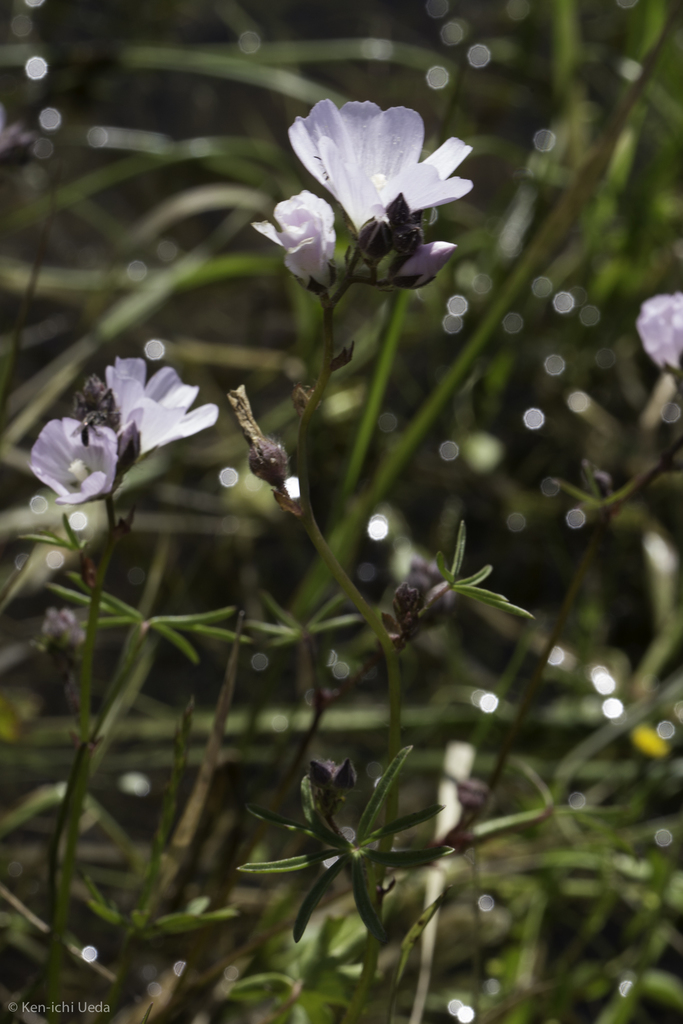
(c) Ken-ichi Ueda, some rights reserved (CC BY), uploaded by Ken-ichi Ueda · licence
Family: Malvaceae · Type: Herb · Native
Sidalcea calycosa subsp. calycosa (Vernal pool checkerbloom) is a native California herb in the Malvaceae family, recognized by annual habit and wetland habitat.
Vernal pool checkerbloom is a California native annual found in northern California bioregions including North Coast Ranges, California Red Fir forests, Sierra Nevada Foothills, Sacramento Valley, and northern San Francisco Bay, growing in wet places like vernal pools and foothill woodland openings at elevations below 1,200 meters. Flowering from March to June, this plant produces delicate pink to white flowers 10 to 20 millimeters long with petals slightly varying in pistillate plants. Growing 30 to 90 centimeters tall with a taproot, it forms branching stems that are generally smooth and occasionally fleshy. Its basal leaves are unlobed, persistent, with blades 2 to 5 centimeters wide and small stipules 2 to 5 millimeters long. The fruit segments are approximately 2.5 millimeters long with distinctive net-veined sides.
Identification and appearance
Key characters: 17 sympatric species - distinguished by annual habit and wetland habitat
Habitat and range
Habitat: Wet places, especially vernal pools, hog wallows, swales, foothill woodland, chaparral openings
Elevation: < 1200 m
California counties: Sonoma, Mariposa, El Dorado, Butte, Amador, Shasta, Fresno, Calaveras, Marin, Sacramento, Tulare, Nevada, Tehama, Placer, Madera, Colusa, Napa
Bloom period
Sidalcea calycosa subsp. calycosa blooms Mar-Jun.
How to tell it apart
vs Malva: Sidalcea has no bract ring below flowers and anthers in two circles; Malva has 3 bracts and scattered anthers.; vs Clarkia: Sidalcea has mallow flowers with fused stamens; Clarkia has 4 separate petals and 8 separate stamens.; vs Geranium: Sidalcea has bowl-shaped flowers with fused stamens; Geranium has 5 separate petals and long beaked fruits.; vs Malacothamnus: Sidalcea is herbaceous in meadows; Malacothamnus is a woody shrub in chaparral.; vs Calochortus: Sidalcea is a dicot with 5-petaled flowers; Calochortus is a monocot with 3-petaled flowers from bulbs.
Frequently asked questions
Is Sidalcea calycosa subsp. calycosa native to California?
Yes. Sidalcea calycosa subsp. calycosa is native to California (recorded as native).
When does Sidalcea calycosa subsp. calycosa bloom?
Sidalcea calycosa subsp. calycosa blooms Mar-Jun.
Where in California does Sidalcea calycosa subsp. calycosa grow?
Sidalcea calycosa subsp. calycosa occurs in Sonoma, Mariposa, El Dorado, Butte, Amador, Shasta, Fresno, Calaveras and other counties, at elevations of < 1200 m.
What plant family does Sidalcea calycosa subsp. calycosa belong to?
Sidalcea calycosa subsp. calycosa is in the Malvaceae family, genus Sidalcea.
What habitat does Sidalcea calycosa subsp. calycosa grow in?
Sidalcea calycosa subsp. calycosa grows in Wet places, especially vernal pools, hog wallows, swales, foothill woodland, chaparral openings.
Related species
Other California species in the same genus, family, or bioregion.
Sources: Jepson eFlora · Index of California Plant Names · CalPhotos
Last updated 2026-10-07
Data from The California Species Project — 14,000+ California species with verified data from CNPS, CDFW, USFWS, Cal-IPC, and more.