Sidalcea diploscypha
Fringed checkerbloom
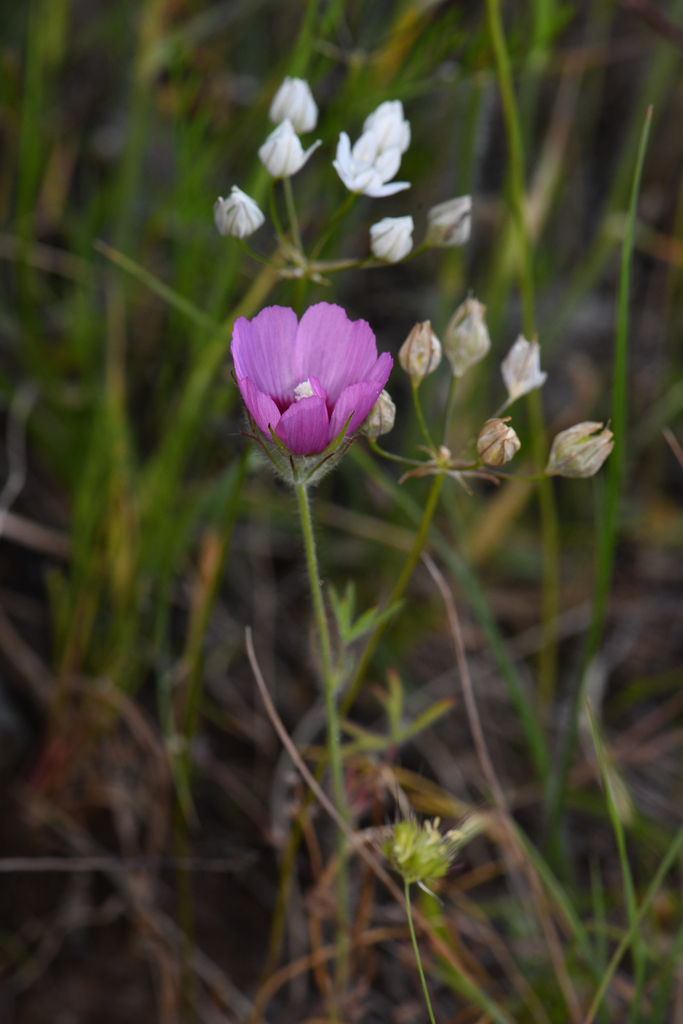
(c) Trevor Van Loon, some rights reserved (CC BY) · licence
Family: Malvaceae · Type: Herb · Native
Sidalcea diploscypha (Fringed checkerbloom) is a native California herb in the Malvaceae family, recognized by fringed petals and involucre-like bracts.
Fringed checkerbloom is a California native annual herb found in northern Coast Ranges, California Ranges, northern Sierra Nevada foothills, Sacramento Valley, central Coast, and San Francisco Bay Area in grasslands, open woodlands, and valleys, occasionally near vernal pools, generally on serpentine soils at elevations below 840 meters. Flowering from April to May, this plant produces dark pink flowers with delicate fringed petals approximately 20 to 35 millimeters wide, occasionally featuring a dark spot at the base. Growing 40 to 60 centimeters tall with stellate-puberulent stems covered in long, fine bristles, it develops distinctive upper leaves with narrow lobes. Its leaves are bristly-puberulent with unique stipules on mid to upper stems, divided into two or more linear lobes longer than 10 millimeters. The flower clusters are crowded, with calyces 8 to 12 millimeters long that often display a narrow purple line or spot at the base.
Identification and appearance
Key characters: 17 sympatric species - distinguished by fringed petals and involucre-like bracts
Habitat and range
Habitat: Grassland, open woodland, valleys, occasionally near vernal pools, generally serpentine
Elevation: < 840 m
California counties: Mendocino, Butte, Lake, San Mateo, Napa, Santa Clara, Sonoma, Yolo, Sacramento, Contra Costa, Yuba, Humboldt, San Luis Obispo, Colusa, Solano, Tehama, Sutter, Glenn, Marin, Shasta, San Joaquin, Calaveras, Alameda, Monterey, Tulare, Del Norte, Mariposa
Outside California: western Oregon
Bloom period
Sidalcea diploscypha blooms Apr-May.
How to tell it apart
vs Malva: Sidalcea has no bract ring below flowers and anthers in two circles; Malva has 3 bracts and scattered anthers.; vs Clarkia: Sidalcea has mallow flowers with fused stamens; Clarkia has 4 separate petals and 8 separate stamens.; vs Geranium: Sidalcea has bowl-shaped flowers with fused stamens; Geranium has 5 separate petals and long beaked fruits.; vs Malacothamnus: Sidalcea is herbaceous in meadows; Malacothamnus is a woody shrub in chaparral.; vs Calochortus: Sidalcea is a dicot with 5-petaled flowers; Calochortus is a monocot with 3-petaled flowers from bulbs.
Frequently asked questions
Is Sidalcea diploscypha native to California?
Yes. Sidalcea diploscypha is native to California (recorded as native).
When does Sidalcea diploscypha bloom?
Sidalcea diploscypha blooms Apr-May.
Where in California does Sidalcea diploscypha grow?
Sidalcea diploscypha occurs in Mendocino, Butte, Lake, San Mateo, Napa, Santa Clara, Sonoma, Yolo and other counties, at elevations of < 840 m.
What plant family does Sidalcea diploscypha belong to?
Sidalcea diploscypha is in the Malvaceae family, genus Sidalcea.
What habitat does Sidalcea diploscypha grow in?
Sidalcea diploscypha grows in Grassland, open woodland, valleys, occasionally near vernal pools, generally serpentine.
Related species
Other California species in the same genus, family, or bioregion.
Sources: Jepson eFlora · Index of California Plant Names · CalPhotos
Last updated 2026-10-07
Data from The California Species Project — 14,000+ California species with verified data from CNPS, CDFW, USFWS, Cal-IPC, and more.