Sidalcea hickmanii subsp. parishii
Parish's checkerbloom, Parish's Checkerbloom
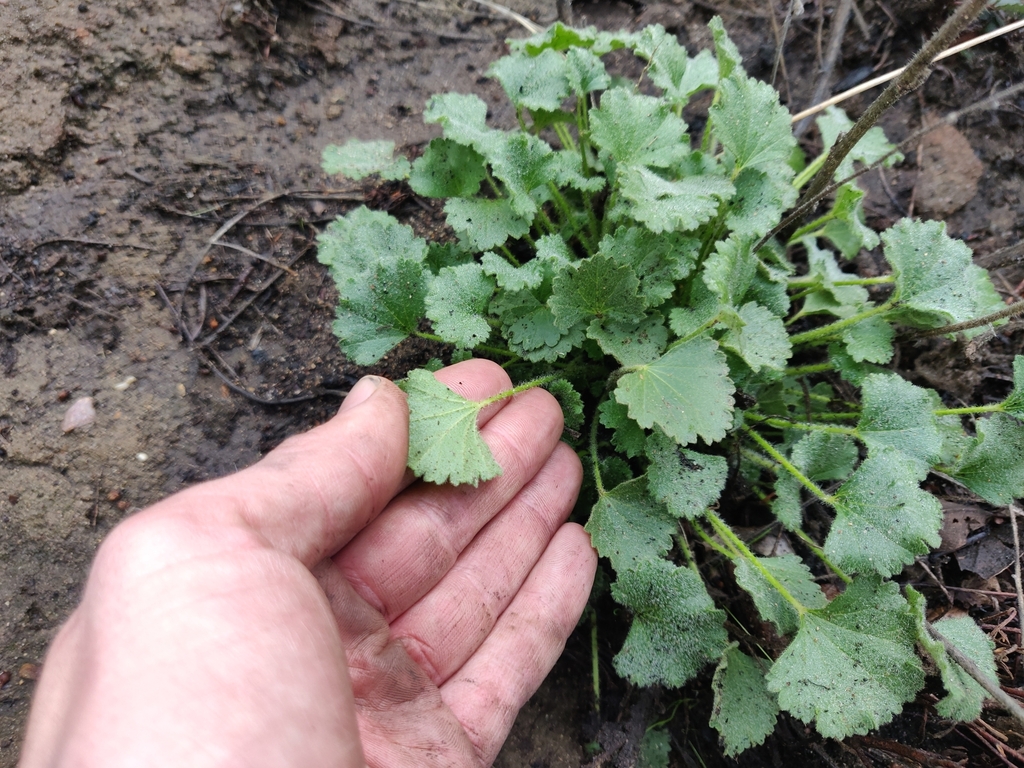
(c) Alexander Wentworth, some rights reserved (CC BY), uploaded by Alexander Wentworth · licence
Family: Malvaceae · Type: Subshrub · Native
Conservation status: CNPS 1B.2
Sidalcea hickmanii subsp. parishii (Parish's checkerbloom) is a native California subshrub in the Malvaceae family, recognized by high elevation and gray pubescence.
Parish's checkerbloom is a rare (CNPS 1B.2) California native perennial found in the Santa Barbara Mountains, Santa Rosa Mountains, and San Bernardino Mountains in chaparral, woodland, and open conifer forest at elevations of 1,000 to 2,200 meters. Flowering from June to August, this plant produces pale pink to lavender flowers with petals 1.1 to 1.3 centimeters long. Growing with few stems 40 to 80 centimeters tall, the plant is coarsely covered in gray stellate hairs that overlap and give it a distinctive fuzzy appearance. Its leaves are crenate to shallowly lobed, also covered in stellate hairs, with a textured, soft gray-green surface. The plant's delicate flowers are framed by lanceolate bracts 6 to 10 millimeters long, creating an intricate floral display characteristic of the checkerbloom genus.
Identification and appearance
Key characters: 9 sympatric species - distinguished by high elevation and gray pubescence
Habitat and range
Habitat: Chaparral, woodland, open conifer forest
Elevation: 1000-2200 m
California counties: San Bernardino, Santa Barbara, Lake, San Luis Obispo
Bloom period
Sidalcea hickmanii subsp. parishii blooms Jun-Aug.
Conservation status
CNPS 1B.2
How to tell it apart
vs Malva: Sidalcea has no bract ring below flowers and anthers in two circles; Malva has 3 bracts and scattered anthers.; vs Clarkia: Sidalcea has mallow flowers with fused stamens; Clarkia has 4 separate petals and 8 separate stamens.; vs Geranium: Sidalcea has bowl-shaped flowers with fused stamens; Geranium has 5 separate petals and long beaked fruits.; vs Malacothamnus: Sidalcea is herbaceous in meadows; Malacothamnus is a woody shrub in chaparral.; vs Calochortus: Sidalcea is a dicot with 5-petaled flowers; Calochortus is a monocot with 3-petaled flowers from bulbs.
Frequently asked questions
Is Sidalcea hickmanii subsp. parishii native to California?
Yes. Sidalcea hickmanii subsp. parishii is native to California (recorded as native).
When does Sidalcea hickmanii subsp. parishii bloom?
Sidalcea hickmanii subsp. parishii blooms Jun-Aug.
Where in California does Sidalcea hickmanii subsp. parishii grow?
Sidalcea hickmanii subsp. parishii occurs in San Bernardino, Santa Barbara, Lake, San Luis Obispo, at elevations of 1000-2200 m.
What plant family does Sidalcea hickmanii subsp. parishii belong to?
Sidalcea hickmanii subsp. parishii is in the Malvaceae family, genus Sidalcea.
Is Sidalcea hickmanii subsp. parishii rare or endangered?
Sidalcea hickmanii subsp. parishii carries California Rare Plant Rank 1B.2, state rank S2.
Related species
Other California species in the same genus, family, or bioregion.
Sources: Jepson eFlora · CNPS Rare Plant Inventory · Index of California Plant Names · CalPhotos · CDFW CNDDB
Last updated 2026-10-07
Data from The California Species Project — 14,000+ California species with verified data from CNPS, CDFW, USFWS, Cal-IPC, and more.