Sidalcea malviflora subsp. laciniata
Geranium-leaved checkerbloom, Geranium-Leaved Checkerbloom
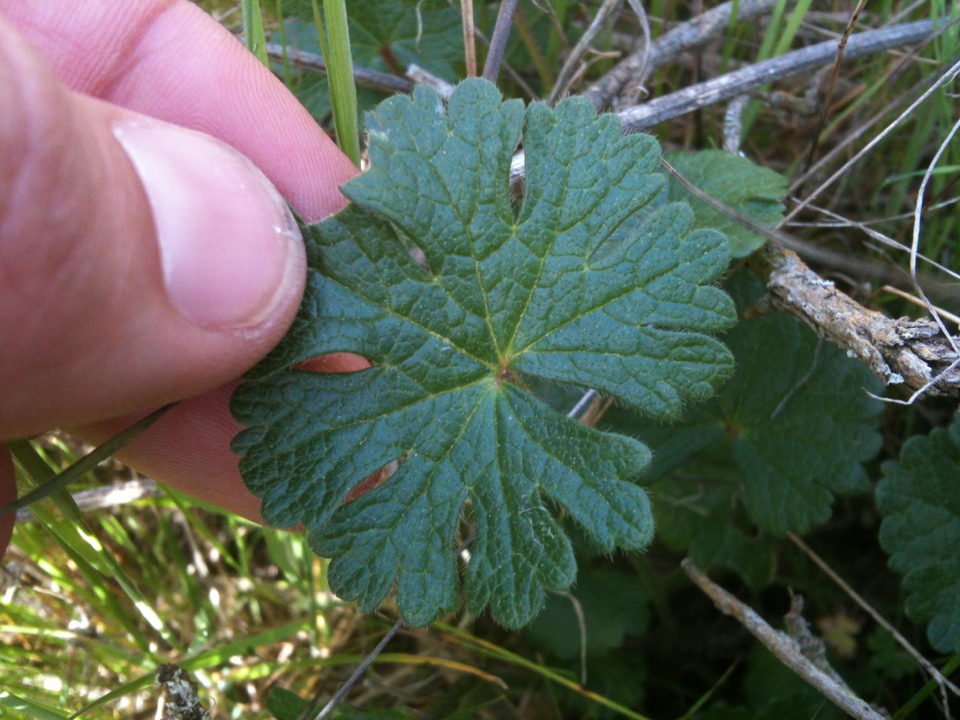
(c) Ken-ichi Ueda, some rights reserved (CC BY), uploaded by Ken-ichi Ueda · licence
Family: Malvaceae · Type: Subshrub · Native
Sidalcea malviflora subsp. laciniata (Geranium-leaved checkerbloom) is a native California subshrub in the Malvaceae family, recognized by deeply dissected upper leaves.
Geranium-leaved checkerbloom is a California native perennial found in southern North Coast Ranges and Central Western California in grasslands and open woodlands at elevations generally below 700 meters. Flowering from March to June, this plant produces pink-lavender to white flowers with white veins, generally 1 to 2.5 centimeters long. Growing with decumbent stems 20 to 80 centimeters tall that are soft-stellate hairy and often rooting at the base, it develops from a short caudex and taproot. Its distinctive leaves are deeply divided with more than 13 linear segments, the basal leaves shallowly 7-lobed and measuring 2 to 6 centimeters wide, with sparse hairs on the upper surface and denser stellate hairs underneath. The fruit segments are approximately 3.5 millimeters long, glandular-puberulent with coarsely net-veined pitting.
Identification and appearance
Key characters: 26 sympatric species; key feature is deeply dissected upper leaves
Habitat and range
Habitat: Grassland, open woodland
Elevation: generally < 700 m
California counties: Santa Clara, San Benito, Sacramento, San Luis Obispo, San Mateo, Marin, Sonoma, Monterey, Napa, Alameda, Santa Barbara, Santa Cruz, Tehama, San Bernardino, Mendocino, Contra Costa, Lake, San Francisco, Merced, Solano, San Joaquin
Bloom period
Sidalcea malviflora subsp. laciniata blooms Mar-Jun.
How to tell it apart
vs Malva: Sidalcea has no bract ring below flowers and anthers in two circles; Malva has 3 bracts and scattered anthers.; vs Clarkia: Sidalcea has mallow flowers with fused stamens; Clarkia has 4 separate petals and 8 separate stamens.; vs Geranium: Sidalcea has bowl-shaped flowers with fused stamens; Geranium has 5 separate petals and long beaked fruits.; vs Malacothamnus: Sidalcea is herbaceous in meadows; Malacothamnus is a woody shrub in chaparral.; vs Calochortus: Sidalcea is a dicot with 5-petaled flowers; Calochortus is a monocot with 3-petaled flowers from bulbs.
Frequently asked questions
Is Sidalcea malviflora subsp. laciniata native to California?
Yes. Sidalcea malviflora subsp. laciniata is native to California (recorded as native).
When does Sidalcea malviflora subsp. laciniata bloom?
Sidalcea malviflora subsp. laciniata blooms Mar-Jun.
Where in California does Sidalcea malviflora subsp. laciniata grow?
Sidalcea malviflora subsp. laciniata occurs in Santa Clara, San Benito, Sacramento, San Luis Obispo, San Mateo, Marin, Sonoma, Monterey and other counties, at elevations of generally < 700 m.
What plant family does Sidalcea malviflora subsp. laciniata belong to?
Sidalcea malviflora subsp. laciniata is in the Malvaceae family, genus Sidalcea.
What habitat does Sidalcea malviflora subsp. laciniata grow in?
Sidalcea malviflora subsp. laciniata grows in Grassland, open woodland.
Related species
Other California species in the same genus, family, or bioregion.
- Sidalcea malviflora subsp. malviflora
- Sidalcea malviflora subsp. patula — Siskiyou checkerbloom
- Sidalcea malviflora subsp. purpurea — Purple-stemmed checkerbloom
- Sidalcea malviflora subsp. rostrata — Seacliff checkerbloom
- Sidalcea multifida — Cut-leaf checkerbloom
- Sidalcea neomexicana — Salt spring checkerbloom
Sources: Jepson eFlora · Index of California Plant Names · CalPhotos
Last updated 2026-10-07
Data from The California Species Project — 14,000+ California species with verified data from CNPS, CDFW, USFWS, Cal-IPC, and more.