Sidalcea neomexicana
Salt spring checkerbloom, Salt Spring Checkerbloom
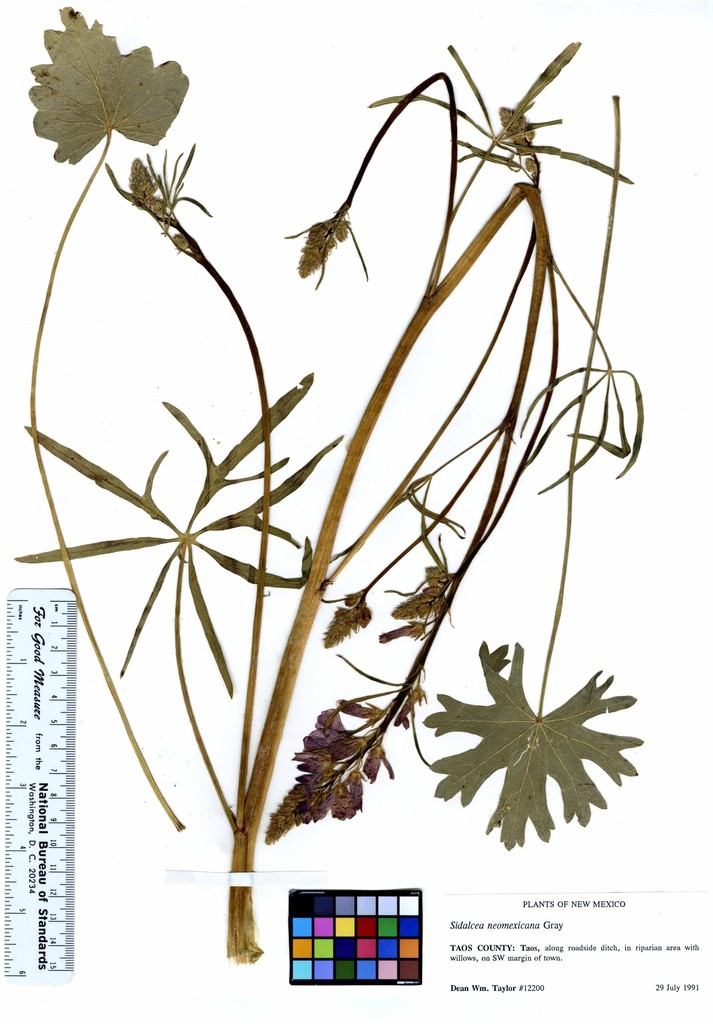
(c) Dean Wm. Taylor, some rights reserved (CC BY) · licence
Family: Malvaceae · Type: Subshrub · Native
Conservation status: CNPS 2B.2
Sidalcea neomexicana (Salt spring checkerbloom) is a native California subshrub in the Malvaceae family, recognized by alkaline habitat and small pale flowers are key.
Salt spring checkerbloom is a rare (CNPS 2B.2) California native perennial found in southern coastal, western Transverse, San Gabriel, San Bernardno, Peninsular Ranges, and southwestern Mojave Desert regions in alkaline springs and marshes at elevations generally below 1,500 meters. Flowering from April to June, this plant produces pale pink-rose flowers with white veins 6 to 18 millimeters long. Growing with 2 to 5 stems up to 50 centimeters tall, it emerges from clustered fleshy roots and displays stems that are bristly-hairy below and stellate-hairy above. Its leaves are fleshy and distinctive, with basal leaves crenate to shallowly 5-lobed and upper leaves 5-lobed, measuring 2 to 5 centimeters wide. The fruit segments are approximately 2 millimeters long with smooth to weakly net-veined sides.
Identification and appearance
Key characters: 6 sympatric species; alkaline habitat and small pale flowers are key
Habitat and range
Habitat: Alkaline springs, marshes
Elevation: generally < 1500 m
California counties: Orange, San Bernardino, Riverside, San Diego, Los Angeles, Alameda, Ventura, Merced
Outside California: to New Mexico, northern Mexico
Bloom period
Sidalcea neomexicana blooms Apr-Jun.
Conservation status
CNPS 2B.2
How to tell it apart
vs Malva: Sidalcea has no bract ring below flowers and anthers in two circles; Malva has 3 bracts and scattered anthers.; vs Clarkia: Sidalcea has mallow flowers with fused stamens; Clarkia has 4 separate petals and 8 separate stamens.; vs Geranium: Sidalcea has bowl-shaped flowers with fused stamens; Geranium has 5 separate petals and long beaked fruits.; vs Malacothamnus: Sidalcea is herbaceous in meadows; Malacothamnus is a woody shrub in chaparral.; vs Calochortus: Sidalcea is a dicot with 5-petaled flowers; Calochortus is a monocot with 3-petaled flowers from bulbs.
Frequently asked questions
Is Sidalcea neomexicana native to California?
Yes. Sidalcea neomexicana is native to California (recorded as native).
When does Sidalcea neomexicana bloom?
Sidalcea neomexicana blooms Apr-Jun.
Where in California does Sidalcea neomexicana grow?
Sidalcea neomexicana occurs in Orange, San Bernardino, Riverside, San Diego, Los Angeles, Alameda, Ventura, Merced, at elevations of generally < 1500 m.
What plant family does Sidalcea neomexicana belong to?
Sidalcea neomexicana is in the Malvaceae family, genus Sidalcea.
Is Sidalcea neomexicana rare or endangered?
Sidalcea neomexicana carries California Rare Plant Rank 2B.2, state rank S2.
Related species
Other California species in the same genus, family, or bioregion.
Sources: Jepson eFlora · CNPS Rare Plant Inventory · Index of California Plant Names · CalPhotos · CDFW CNDDB
Last updated 2026-10-07
Data from The California Species Project — 14,000+ California species with verified data from CNPS, CDFW, USFWS, Cal-IPC, and more.