Silene greenei subsp. greenei
Bell catchfly, Bell Catchfly
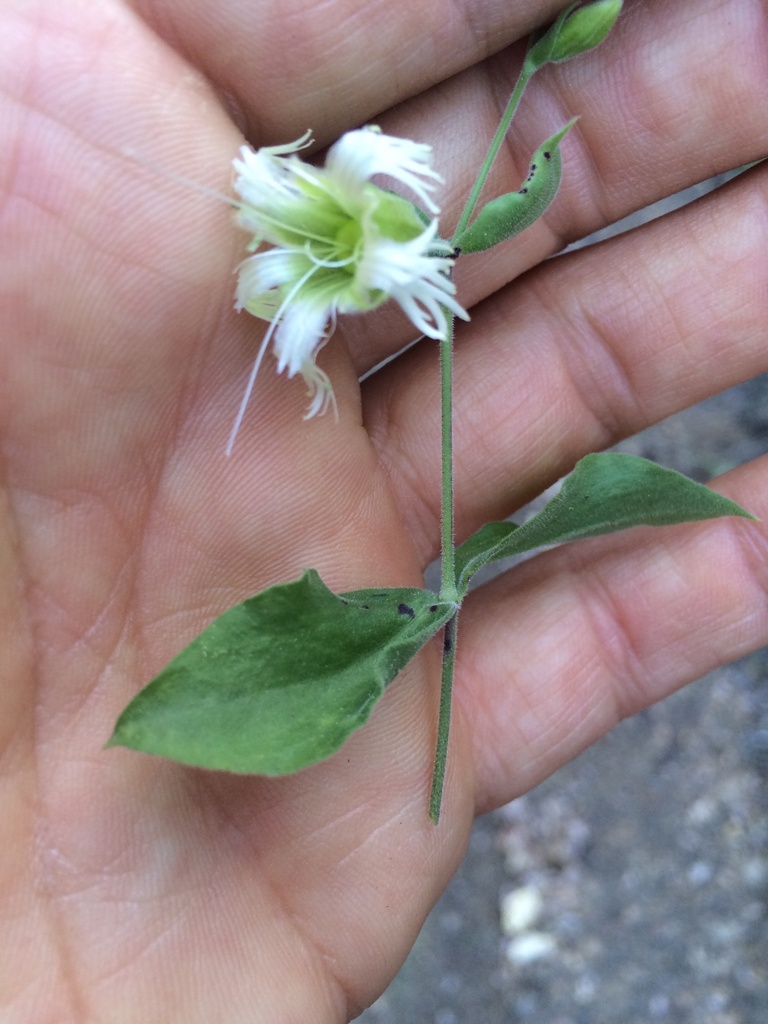
Photo: parent species Silene greenei · (c) Mark Pollock, some rights reserved (CC BY) · licence
Family: Caryophyllaceae · Type: Perennial · Native
Silene greenei subsp. greenei (Bell catchfly) is a native California perennial in the Caryophyllaceae family, recognized by . Key features: broad leaves, bell-shaped flowers, white to green petals with linear lobes.
Bell catchfly is a California native perennial found in the Klamath Ranges and northern Coast Ranges in open or shaded conifer forests at elevations of 300 to 1,900 meters. Flowering during summer, this plant produces delicate white to pale green flowers with subtle coloration. Growing 15 to 40 centimeters tall with stems that are glabrous to slightly downy and may be glandular, it forms an elegant upright habit. Its leaves are distinctive, ranging 1 to 3 centimeters long and 10 to 30 millimeters wide, with a shape varying from lanceolate to nearly round. This slender perennial blends gracefully into its forest understory environments, creating subtle botanical interest.
Identification and appearance
Key characters: 20 sympatric species. Key features: broad leaves, bell-shaped flowers, white to green petals with linear lobes.
Habitat and range
Habitat: Open or shaded areas, conifer forest
Elevation: 300-1900 m
California counties: Siskiyou, Humboldt, Del Norte, Trinity, Glenn, Lake, Mendocino, Shasta, Colusa, Tehama, Plumas
Outside California: Oregon
Bloom period
Silene greenei subsp. greenei blooms Summer.
How to tell it apart
vs Spigelia: Silene has 5 separate petals in pink family arrangement; Spigelia has tubular red flowers with 5-lobed tips.; vs Pelargonium: Silene has radially symmetric flowers with 5 equal petals; Pelargonium has bilateral flowers with unequal petals.; vs Cistanthe: Silene has a tubular calyx fused around the flower; Cistanthe has 2 separate, rounded sepals that fall off.; vs Castilleja: Silene has showy petals; Castilleja's color comes from bracts hiding tiny tubular flowers.; vs Petrorhagia: Silene has an inflated, rounded calyx tube; Petrorhagia has a narrow, cylindrical calyx with papery bracts below.
Frequently asked questions
Is Silene greenei subsp. greenei native to California?
Yes. Silene greenei subsp. greenei is native to California (recorded as native).
When does Silene greenei subsp. greenei bloom?
Silene greenei subsp. greenei blooms Summer.
Where in California does Silene greenei subsp. greenei grow?
Silene greenei subsp. greenei occurs in Siskiyou, Humboldt, Del Norte, Trinity, Glenn, Lake, Mendocino, Shasta and other counties, at elevations of 300-1900 m.
What plant family does Silene greenei subsp. greenei belong to?
Silene greenei subsp. greenei is in the Caryophyllaceae family, genus Silene.
What habitat does Silene greenei subsp. greenei grow in?
Silene greenei subsp. greenei grows in Open or shaded areas, conifer forest.
Related species
Other California species in the same genus, family, or bioregion.
Sources: Jepson eFlora · CalPhotos
Last updated 2026-10-06
Data from The California Species Project — 14,000+ California species with verified data from CNPS, CDFW, USFWS, Cal-IPC, and more.