Silene sargentii
Sargent's catchfly
no rights reserved · CC0
Family: Caryophyllaceae · Type: Herb · Native
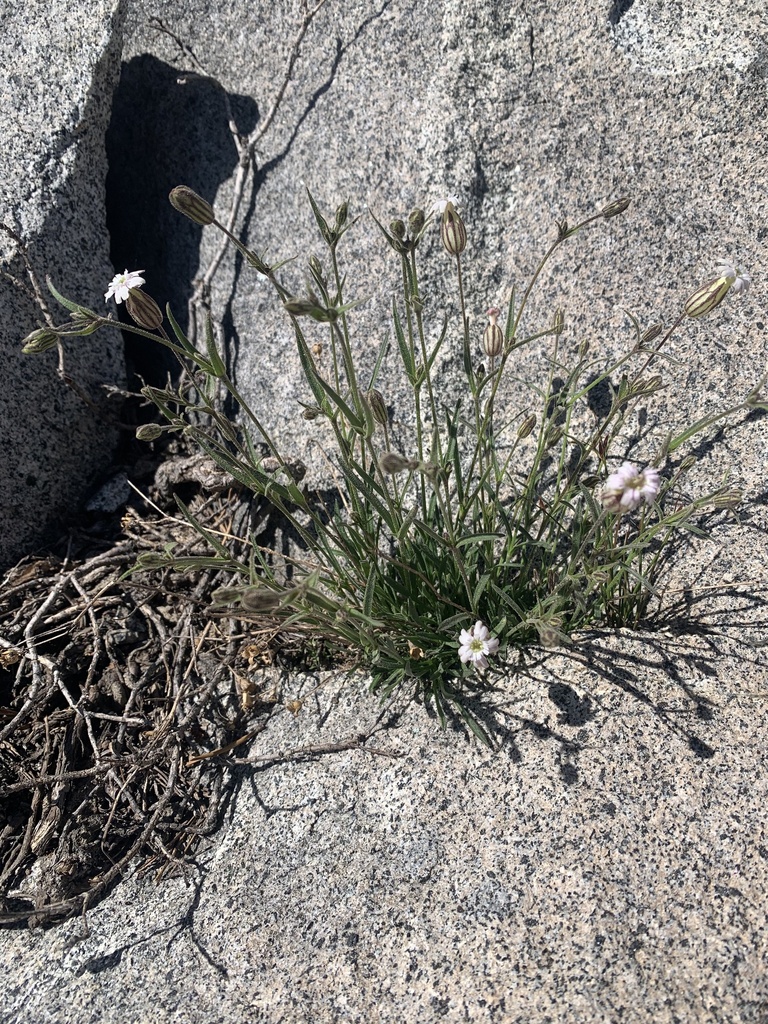
Silene sargentii (Sargent's catchfly) is a native California herb in the Caryophyllaceae family, recognized by alpine cushion form, fleshy narrow leaves, unequal petal lobes.
Sargent's catchfly is a California native perennial found in the Sierra Nevada and eastern Sierra Nevada Mountains, specifically in the Sweetwater and White Mountains, inhabiting subalpine forest and alpine areas at elevations of 2,400 to 3,800 meters. Flowering from July to August, this plant produces white to red-purple flowers with delicate petals and distinctive two-lobed outer segments. Growing with decumbent to erect stems 10 to 15 centimeters tall, it features a dense caudex with many branches and glandular-puberulent growth. Its basal leaves form dense tufts, measuring 1.5 to 3 centimeters long and 1 to 3 millimeters wide, with a fleshy oblanceolate shape that becomes increasingly linear and reduced toward the stem. The fruit is a small ovoid structure with a woolly-puberulent stalk, bearing seeds 1 to 2 millimeters long.
Identification and appearance
Key characters: 13 sympatric species; alpine cushion form, fleshy narrow leaves, unequal petal lobes
Habitat and range
Habitat: Subalpine forest, alpine
Elevation: 2400-3800 m
California counties: Fresno, Mono, Alpine, Inyo, Madera, Tulare, Tuolumne, El Dorado, Mariposa, Plumas, Sierra, Nevada, Placer
Outside California: Washington, Idaho, Nevada
Bloom period
Silene sargentii blooms Jul-Aug.
How to tell it apart
vs Spigelia: Silene has 5 separate petals in pink family arrangement; Spigelia has tubular red flowers with 5-lobed tips.; vs Pelargonium: Silene has radially symmetric flowers with 5 equal petals; Pelargonium has bilateral flowers with unequal petals.; vs Cistanthe: Silene has a tubular calyx fused around the flower; Cistanthe has 2 separate, rounded sepals that fall off.; vs Castilleja: Silene has showy petals; Castilleja's color comes from bracts hiding tiny tubular flowers.; vs Petrorhagia: Silene has an inflated, rounded calyx tube; Petrorhagia has a narrow, cylindrical calyx with papery bracts below.
Frequently asked questions
Is Silene sargentii native to California?
Yes. Silene sargentii is native to California (recorded as native).
When does Silene sargentii bloom?
Silene sargentii blooms Jul-Aug.
Where in California does Silene sargentii grow?
Silene sargentii occurs in Fresno, Mono, Alpine, Inyo, Madera, Tulare, Tuolumne, El Dorado and other counties, at elevations of 2400-3800 m.
What plant family does Silene sargentii belong to?
Silene sargentii is in the Caryophyllaceae family, genus Silene.
What habitat does Silene sargentii grow in?
Silene sargentii grows in Subalpine forest, alpine.
Related species
Other California species in the same genus, family, or bioregion.
Sources: Jepson eFlora · Index of California Plant Names · CalPhotos
Last updated 2026-10-07
Data from The California Species Project — 14,000+ California species with verified data from CNPS, CDFW, USFWS, Cal-IPC, and more.