Silene serpentinicola
Serpentine catchfly
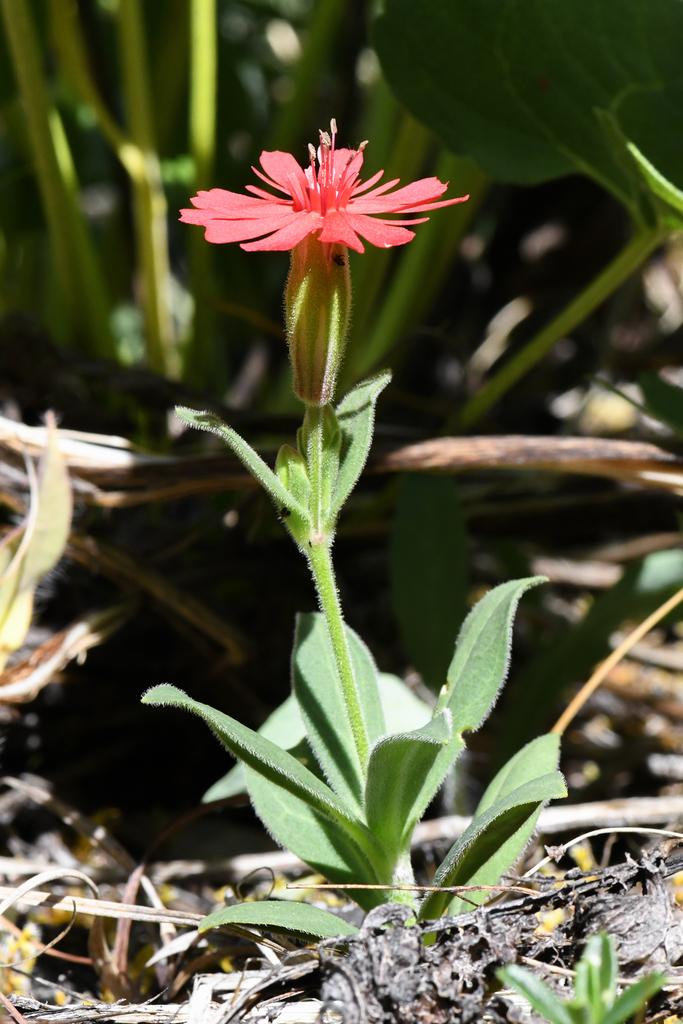
(c) Trevor Van Loon, some rights reserved (CC BY), uploaded by Trevor Van Loon · licence
Family: Caryophyllaceae · Type: Perennial · Native
Conservation status: CNPS 1B.2
Silene serpentinicola (Serpentine catchfly) is a native California perennial in the Caryophyllaceae family, recognized by bright red flowers, densely canescent, serpentine endemic.
Serpentine catchfly is a rare California native (CNPS 1B.2) perennial found in the Klamath Ranges on serpentine soils in chaparral and conifer forest at elevations of 100 to 800 meters. Flowering in early summer, this plant produces bright red flowers with distinctive petal lobes emerging from a densely glandular-hairy calyx. Growing with a thin branching rhizome from a deep taproot, it forms an erect, canescent stem 4 to 10 centimeters tall. Its leaves are oblanceolate to obovate, gradually reduced upward and measuring 2.5 to 4.5 centimeters long, with a unique spoon-shaped appearance. The plant produces small ovoid fruits and contains dark brown seeds approximately 1.8 to 2 millimeters long.
Identification and appearance
Key characters: 17 sympatric species; bright red flowers, densely canescent, serpentine endemic
Habitat and range
Habitat: Serpentine soils, chaparral, conifer forest
Elevation: 100-800 m
California counties: Del Norte
Outside California: Oregon
Bloom period
Silene serpentinicola blooms Early summer.
Conservation status
CNPS 1B.2
How to tell it apart
vs Spigelia: Silene has 5 separate petals in pink family arrangement; Spigelia has tubular red flowers with 5-lobed tips.; vs Pelargonium: Silene has radially symmetric flowers with 5 equal petals; Pelargonium has bilateral flowers with unequal petals.; vs Cistanthe: Silene has a tubular calyx fused around the flower; Cistanthe has 2 separate, rounded sepals that fall off.; vs Castilleja: Silene has showy petals; Castilleja's color comes from bracts hiding tiny tubular flowers.; vs Petrorhagia: Silene has an inflated, rounded calyx tube; Petrorhagia has a narrow, cylindrical calyx with papery bracts below.
Frequently asked questions
Is Silene serpentinicola native to California?
Yes. Silene serpentinicola is native to California (recorded as native).
When does Silene serpentinicola bloom?
Silene serpentinicola blooms Early summer.
Where in California does Silene serpentinicola grow?
Silene serpentinicola occurs in Del Norte, at elevations of 100-800 m.
What plant family does Silene serpentinicola belong to?
Silene serpentinicola is in the Caryophyllaceae family, genus Silene.
Is Silene serpentinicola rare or endangered?
Silene serpentinicola carries California Rare Plant Rank 1B.2, state rank S3.
Related species
Other California species in the same genus, family, or bioregion.
Sources: Jepson eFlora · CNPS Rare Plant Inventory · Index of California Plant Names · CalPhotos · CDFW CNDDB
Last updated 2026-09-30
Data from The California Species Project — 14,000+ California species with verified data from CNPS, CDFW, USFWS, Cal-IPC, and more.