Simmondsia chinensis
Jojoba; goatnut
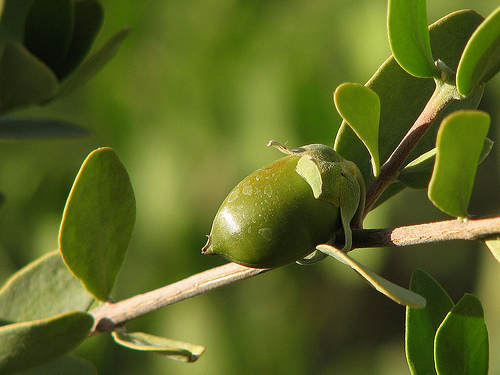
(c) Katja Schulz, some rights reserved (CC BY) · licence
Family: Simmondsiaceae · Type: Shrub · Native
Simmondsia chinensis (Jojoba; goatnut) is a native California shrub in the Simmondsiaceae family, recognized by Only member of the Simmondsiaceae family in California, representing a relict lineage with unique liquid wax chemistry.
Jojoba is a native shrub found in southern California Coastal, Peninsular Ranges, southern Desert Mojave, and Sonoran Desert regions in creosote-bush scrub, desert wash scrub, chaparral, and coastal scrub at elevations up to 1,350 meters. Flowering from March to May, this plant produces yellow-green flowers with staminate sepals 3 to 4 millimeters long and distinctive yellow anthers. Growing 1 to 2 meters tall with stiff branches and short, dense appressed hairs that become less dense with age, it develops a distinctive structure. Its oblong-ovate leaves are 2 to 4 centimeters long, dull green, and nearly stalkless. The fruit is a tough, leathery nut-like structure 1 to 2.5 centimeters long, containing large seeds rich in liquid wax.
Identification and appearance
Key characters: Only member of the Simmondsiaceae family in California, representing a relict lineage with unique liquid wax chemistry
Habitat and range
Habitat: Creosote-bush scrub, desert wash scrub, chaparral, coastal scrub
Elevation: < 1350 m
California counties: Riverside, Imperial, San Diego, San Bernardino, Los Angeles, Santa Barbara, Alameda, Kern, Sonoma
Outside California: northern Mexico
Bloom period
Simmondsia chinensis blooms Generally Mar-May.
How to tell it apart
vs Larrea: Simmondsia has simple, entire, dull gray-green leaves with no resin; creosote bush (Larrea) has sticky, resinous, deeply 2-lobed compound leaflets and yellow flowers.; vs Garrya: Simmondsia bears small clustered flowers and a leathery acorn-like nut; silktassel (Garrya) has its flowers in long, hanging, catkin-like tassels.; vs Atriplex: Simmondsia leaves are thick and leathery with a fine appressed pubescence; saltbush (Atriplex) leaves are gray and mealy-scurfy.; vs Coleogyne: Simmondsia has broad oblong leaves 2-4 cm on unarmed twigs; blackbush (Coleogyne) has tiny narrow leaves on rigid, spine-tipped twigs.; vs Rhus: Simmondsia has strictly opposite leaves and a dry, wax-filled nut; Rhus has alternate leaves and a fleshy reddish drupe.
Frequently asked questions
Is Simmondsia chinensis native to California?
Yes. Simmondsia chinensis is native to California (recorded as native).
When does Simmondsia chinensis bloom?
Simmondsia chinensis blooms Generally Mar-May.
Where in California does Simmondsia chinensis grow?
Simmondsia chinensis occurs in Riverside, Imperial, San Diego, San Bernardino, Los Angeles, Santa Barbara, Alameda, Kern and other counties, at elevations of < 1350 m.
What plant family does Simmondsia chinensis belong to?
Simmondsia chinensis is in the Simmondsiaceae family, genus Simmondsia.
What habitat does Simmondsia chinensis grow in?
Simmondsia chinensis grows in Creosote-bush scrub, desert wash scrub, chaparral, coastal scrub.
Related species
Other California species in the same genus, family, or bioregion.
Sources: Jepson eFlora · Index of California Plant Names · CalPhotos
Last updated 2026-10-07
Data from The California Species Project — 14,000+ California species with verified data from CNPS, CDFW, USFWS, Cal-IPC, and more.