Sinapis arvensis
Charlock, Charlock
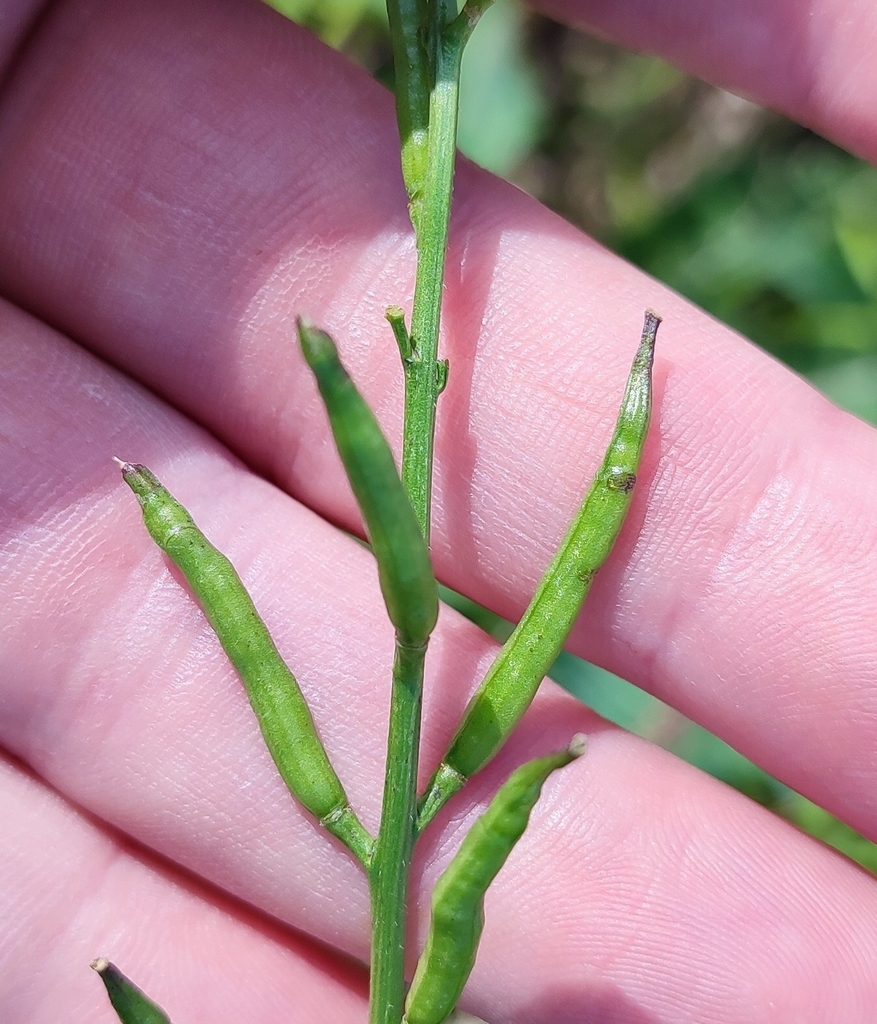
(c) Yurii Basov, some rights reserved (CC BY), uploaded by Yurii Basov · licence
Family: Brassicaceae · Type: Herb · Not Native
Conservation status: Cal-IPC Yes
Sinapis arvensis (Charlock) is a non-native California herb in the Brassicaceae family, recognized by key differences in petal color intensity and fruit width.
Charlock is a naturalized perennial found in California's Foothill Populations (except Sierra Nevada Highlands) in disturbed areas at elevations below 1,800 meters. Flowering from March to October, this plant produces bright yellow flowers 9 to 12 millimeters long. Growing with branched stems 20 to 100 centimeters tall covered in spreading or reflexed hairs, it has a robust and sprawling habit. Its basal leaves are pinnately lobed, 4 to 18 centimeters long, with 1 to 4 pairs of dentate lateral lobes. The fruit is a distinctive elongated pod 2 to 4.5 centimeters long, creating distinctive seed clusters in disturbed landscapes.
Identification and appearance
Key characters: 1 sympatric species; key differences in petal color intensity and fruit width
Habitat and range
Habitat: Disturbed areas
Elevation: < 1800 m
California counties: Los Angeles, Colusa, Contra Costa, Fresno, Orange, Riverside, San Luis Obispo, Santa Barbara, Santa Clara, Stanislaus, Yolo, Alameda, Tulare, Kings, San Bernardino, Ventura, San Mateo, Kern, Calaveras, Sutter, Glenn, Solano, Napa, Plumas, Sonoma, San Francisco, Nevada, San Benito, Monterey, San Diego, Butte, Tuolumne, Yuba, El Dorado, San Joaquin, Santa Cruz, Sacramento, Siskiyou, Modoc, Merced, Humboldt, Amador, Trinity, Placer, Del Norte, Mariposa
Outside California: widespread North America, native to Eurasia
Bloom period
Sinapis arvensis blooms Mar-Oct.
Conservation status
Cal-IPC Yes
How to tell it apart
vs Hirschfeldia: Sinapis pods angle outward from stem; Hirschfeldia pods press flat against stem like they're glued.; vs Raphanus: Sinapis pods clearly two-segmented with multiple veins; Raphanus pods fat and sausage-like without segmentation.; vs Rorippa: Sinapis has large yellow flowers with reflexed sepals; Rorippa has tiny flowers and slim cylindrical pods.
Frequently asked questions
Is Sinapis arvensis native to California?
No. Sinapis arvensis is not native to California (recorded as not native).
When does Sinapis arvensis bloom?
Sinapis arvensis blooms Mar-Oct.
Where in California does Sinapis arvensis grow?
Sinapis arvensis occurs in Los Angeles, Colusa, Contra Costa, Fresno, Orange, Riverside, San Luis Obispo, Santa Barbara and other counties, at elevations of < 1800 m.
What plant family does Sinapis arvensis belong to?
Sinapis arvensis is in the Brassicaceae family, genus Sinapis.
Is Sinapis arvensis invasive in California?
Sinapis arvensis is listed by Cal-IPC with an invasiveness rating of Yes.
Related species
Other California species in the same genus, family, or bioregion.
Sources: Jepson eFlora · Index of California Plant Names · CalPhotos
Last updated 2026-10-07
Data from The California Species Project — 14,000+ California species with verified data from CNPS, CDFW, USFWS, Cal-IPC, and more.