Sisymbrium orientale
Indian hedge mustard
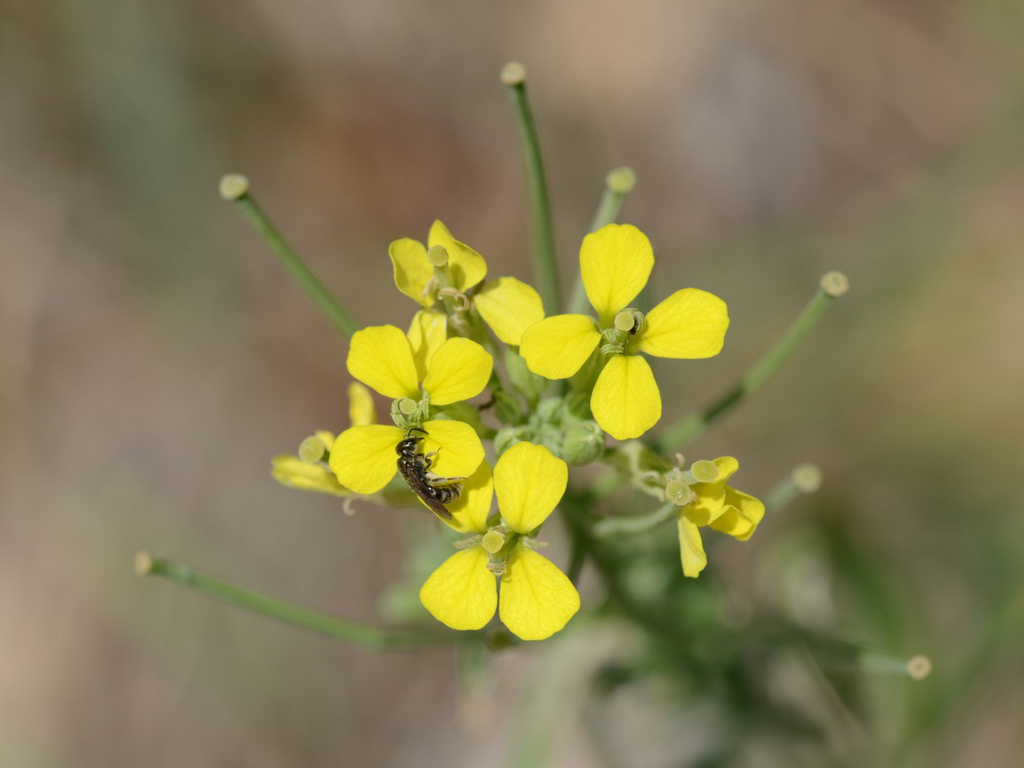
(c) Radio Tonreg, some rights reserved (CC BY) · licence
Family: Brassicaceae · Type: Herb · Not Native
Sisymbrium orientale (Indian hedge mustard) is a non-native California herb in the Brassicaceae family, recognized by hastate upper leaves, large flowers, and very long fruits.
Indian hedge mustard is a naturalized perennial found in the Central Valley, Central Western, Southwestern, and Mojave Desert regions in disturbed areas, fields, and roadsides at elevations below 1,300 meters. Flowering from May to June, this plant produces small pale yellow to white flowers about 7 to 9 millimeters wide. Growing with soft-hairy stems 20 to 70 centimeters tall that become smoother towards the top, it develops an upright, branching habit. Its leaves are broadly oblanceolate with 2 to 5 pairs of lateral lobes, featuring a larger terminal lobe and upper leaves that are narrow and lance-shaped. The slender fruits are linear, measuring 6 to 10 centimeters long and just 1 to 1.5 millimeters wide.
Identification and appearance
Key characters: 4 sympatric species; distinguished by hastate upper leaves, large flowers, and very long fruits
Habitat and range
Habitat: Disturbed areas, fields, roadsides
Elevation: < 1300 m
California counties: Kern, San Diego, San Bernardino, Los Angeles, Monterey, Riverside, San Francisco, San Luis Obispo, Santa Barbara, Tulare, Imperial, Santa Clara, Fresno, Ventura, Inyo, Mono, Orange, Lassen, San Mateo, Merced, San Benito, Solano, Stanislaus, Contra Costa, Marin, Sacramento, Butte, Tehama, Glenn, Modoc, Colusa, Alameda, Yolo, Napa, Santa Cruz
Outside California: to Washington, Texas, Baja California, native to Eurasia
Bloom period
Sisymbrium orientale blooms May-Jun.
How to tell it apart
vs Hirschfeldia: Sisymbrium pods are unsegmented; shortpod has segmented pods with beaded appearance.; vs Brassica: Sisymbrium pod valves have 3 veins; mustard pod valves have 1 vein.; vs Descurainia: Sisymbrium has undivided leaves on stem; tansy mustard has finely dissected feathery leaves.; vs Caulanthus: Sisymbrium petals are flat; jewelflower petals are crinkled or wavy.; vs Mutarda: Sisymbrium has 3-veined pod valves; check pod surface for vein count.
Frequently asked questions
Is Sisymbrium orientale native to California?
No. Sisymbrium orientale is not native to California (recorded as not native).
When does Sisymbrium orientale bloom?
Sisymbrium orientale blooms May-Jun.
Where in California does Sisymbrium orientale grow?
Sisymbrium orientale occurs in Kern, San Diego, San Bernardino, Los Angeles, Monterey, Riverside, San Francisco, San Luis Obispo and other counties, at elevations of < 1300 m.
What plant family does Sisymbrium orientale belong to?
Sisymbrium orientale is in the Brassicaceae family, genus Sisymbrium.
What habitat does Sisymbrium orientale grow in?
Sisymbrium orientale grows in Disturbed areas, fields, roadsides.
Related species
Other California species in the same genus, family, or bioregion.
Sources: Jepson eFlora · Index of California Plant Names · CalPhotos
Last updated 2026-10-07
Data from The California Species Project — 14,000+ California species with verified data from CNPS, CDFW, USFWS, Cal-IPC, and more.