Sisyrinchium californicum
Golden-eyed-grass, Golden-Eyed-Grass
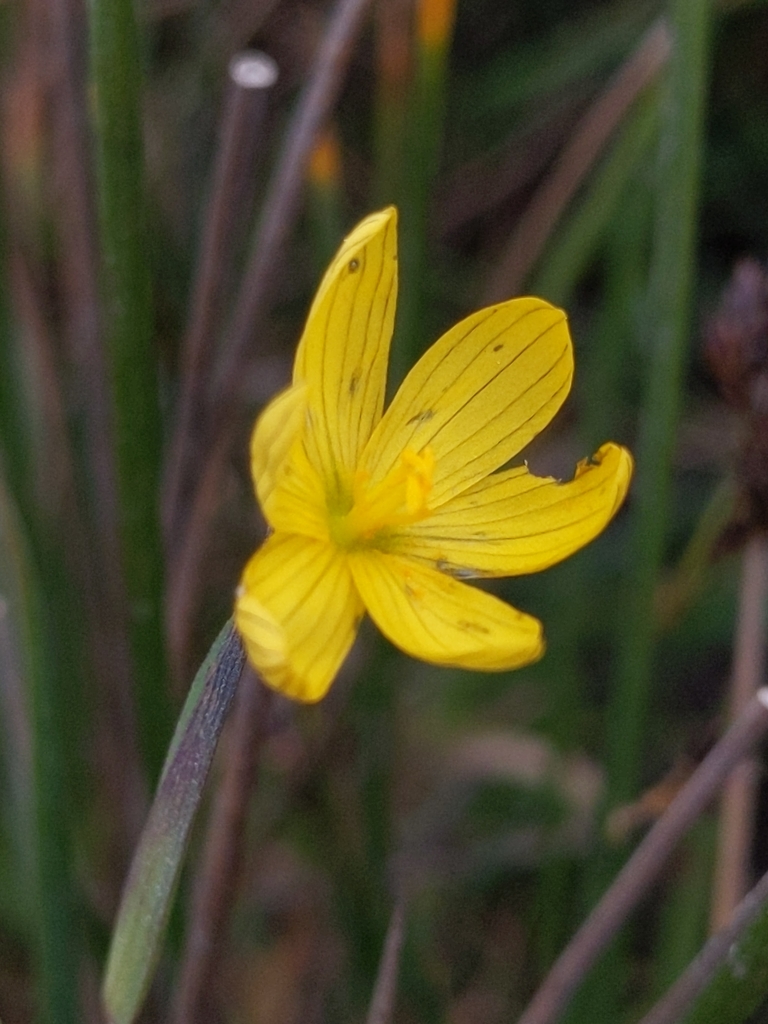
(c) Ken-ichi Ueda, some rights reserved (CC BY) · licence
Family: Iridaceae · Type: Herb · Native
Sisyrinchium californicum (Golden-eyed-grass) is a native California herb in the Iridaceae family, recognized by unique yellow flowers provide clear distinction.
Golden-eyed-grass is a California native perennial found in northern coastal regions, Klamath Ranges, northern Sierra Nevada, and San Francisco Bay Area in generally moist coastal places at elevations below 1,220 meters. Flowering from spring to late summer, this plant produces bright yellow flowers with brown-tinged veins 11 to 18 millimeters long. Growing in dense tufts with slender stems 2 to 7 millimeters wide and reaching up to 62 centimeters tall, the plant has dull green stems that dry to nearly black. Its leaves are distinctive, emerging without leaf-bearing nodes and surrounded by translucent bracts that widen toward the flower tip. The plant forms compact clusters with delicate, sun-bright yellow blossoms characteristic of its grasslike appearance.
Identification and appearance
Key characters: 6 sympatric species; unique yellow flowers provide clear distinction
Habitat and range
Habitat: Generally moist places near coast
Elevation: generally < 1220 m
California counties: Del Norte, Monterey, Mendocino, San Mateo, Marin, Humboldt, Sonoma, San Francisco, San Luis Obispo, Trinity, Lake, El Dorado, Napa, Madera, Kern, Santa Cruz
Outside California: to British Columbia
Bloom period
Sisyrinchium californicum blooms Spring-late summer.
How to tell it apart
vs Erodium: Sisyrinchium has iris-like flowers with 6 equal petals; Erodium has 5-petaled geranium flowers.; vs Dipterostemon: Sisyrinchium has flattened winged stems; Dipterostemon has round stems and lily-like flowers.; vs Solanum: Sisyrinchium has 6 petals and grass-like leaves; Solanum has 5 petals and broad leaves.; vs Iris: Sisyrinchium has tiny flowers (<18mm) in clusters; Iris has large showy flowers with distinctive falls.; vs Romulea: Sisyrinchium has flattened winged stems; Romulea has round or 4-angled grooved stems.
Frequently asked questions
Is Sisyrinchium californicum native to California?
Yes. Sisyrinchium californicum is native to California (recorded as native).
When does Sisyrinchium californicum bloom?
Sisyrinchium californicum blooms Spring-late summer.
Where in California does Sisyrinchium californicum grow?
Sisyrinchium californicum occurs in Del Norte, Monterey, Mendocino, San Mateo, Marin, Humboldt, Sonoma, San Francisco and other counties, at elevations of generally < 1220 m.
What plant family does Sisyrinchium californicum belong to?
Sisyrinchium californicum is in the Iridaceae family, genus Sisyrinchium.
What habitat does Sisyrinchium californicum grow in?
Sisyrinchium californicum grows in Generally moist places near coast.
Related species
Other California species in the same genus, family, or bioregion.
- Sisyrinchium elmeri — Elmer's blue-eyed-grass
- Sisyrinchium funereum — Death valley blue-eyed-grass
- Sisyrinchium halophilum — Nevada blue-eyed-grass
- Sisyrinchium hitchcockii — Hitchcock's blue-eyed-grass
- Sisyrinchium idahoense — Idaho blue-eyed-grass
- Sisyrinchium idahoense var. idahoense — Idaho blue eyed grass
Sources: Jepson eFlora · Index of California Plant Names · CalPhotos
Last updated 2026-10-07
Data from The California Species Project — 14,000+ California species with verified data from CNPS, CDFW, USFWS, Cal-IPC, and more.