Sisyrinchium halophilum
Nevada blue-eyed-grass
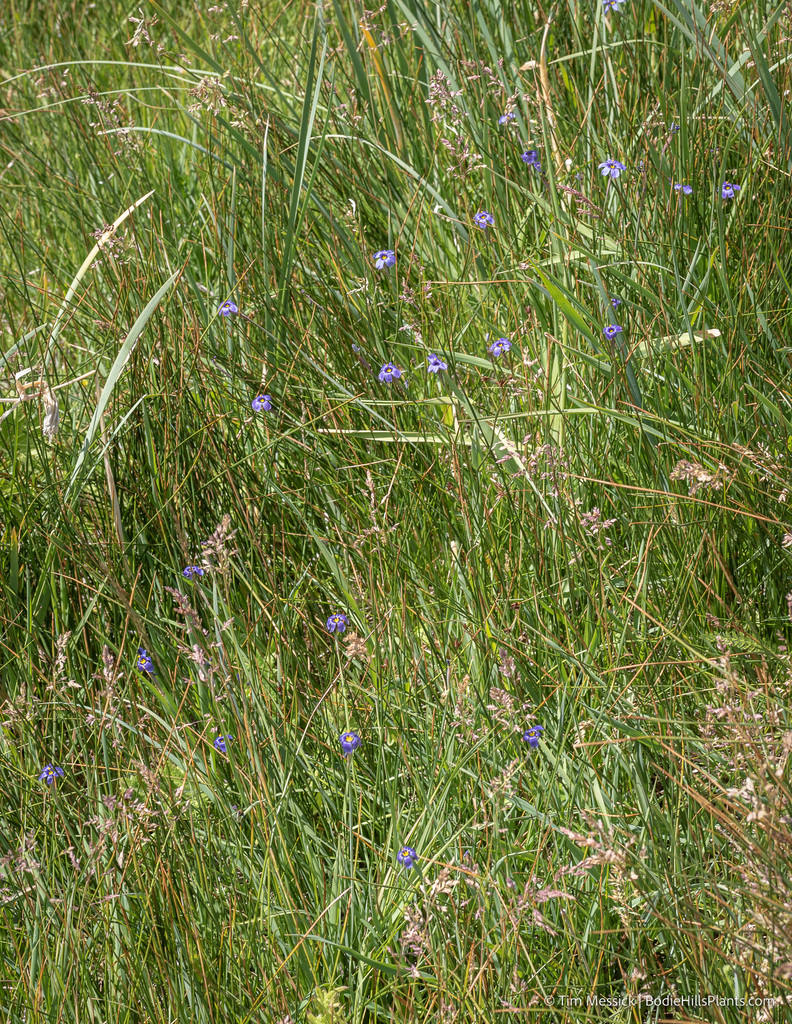
(c) Tim Messick, some rights reserved (CC BY) · licence
Family: Iridaceae · Type: Herb · Native
Sisyrinchium halophilum (Nevada blue-eyed-grass) is a native California herb in the Iridaceae family, recognized by glaucous stems and flower shape distinguish from similar species.
Nevada blue-eyed-grass is a California native perennial found in northern Sierra Nevada Mountains, Great Basin, and adjacent Mojave Desert regions in moist, alkaline meadows at elevations below 2,600 meters. Flowering from May to June, this plant produces medium violet-blue flowers with yellow bases, approximately 9 to 12 millimeters long with truncate tips. Growing in tight tufts less than 40 centimeters tall, it features distinctively glaucous stems with no leaf-bearing nodes. Its flowers have translucent bracts with inner margins widest at the tip, extending above as two rounded teeth. This delicate blue-eyed-grass thrives in alkaline environments, creating small clusters of distinctive violet-blue blooms.
Identification and appearance
Key characters: 4 sympatric species; glaucous stems and flower shape distinguish from similar species
Habitat and range
Habitat: Generally moist, alkaline meadows
Elevation: < 2600 m
California counties: Inyo, Mono, San Bernardino, Kern, Modoc, Tulare, Placer, Plumas, Sierra, Madera
Outside California: to Utah
Bloom period
Sisyrinchium halophilum blooms May-Jun.
How to tell it apart
vs Erodium: Sisyrinchium has iris-like flowers with 6 equal petals; Erodium has 5-petaled geranium flowers.; vs Dipterostemon: Sisyrinchium has flattened winged stems; Dipterostemon has round stems and lily-like flowers.; vs Solanum: Sisyrinchium has 6 petals and grass-like leaves; Solanum has 5 petals and broad leaves.; vs Iris: Sisyrinchium has tiny flowers (<18mm) in clusters; Iris has large showy flowers with distinctive falls.; vs Romulea: Sisyrinchium has flattened winged stems; Romulea has round or 4-angled grooved stems.
Frequently asked questions
Is Sisyrinchium halophilum native to California?
Yes. Sisyrinchium halophilum is native to California (recorded as native).
When does Sisyrinchium halophilum bloom?
Sisyrinchium halophilum blooms May-Jun.
Where in California does Sisyrinchium halophilum grow?
Sisyrinchium halophilum occurs in Inyo, Mono, San Bernardino, Kern, Modoc, Tulare, Placer, Plumas and other counties, at elevations of < 2600 m.
What plant family does Sisyrinchium halophilum belong to?
Sisyrinchium halophilum is in the Iridaceae family, genus Sisyrinchium.
What habitat does Sisyrinchium halophilum grow in?
Sisyrinchium halophilum grows in Generally moist, alkaline meadows.
Related species
Other California species in the same genus, family, or bioregion.
Sources: Jepson eFlora · Index of California Plant Names · CalPhotos
Last updated 2026-10-07
Data from The California Species Project — 14,000+ California species with verified data from CNPS, CDFW, USFWS, Cal-IPC, and more.