Sisyrinchium idahoense var. occidentale
Idaho blue eyed grass
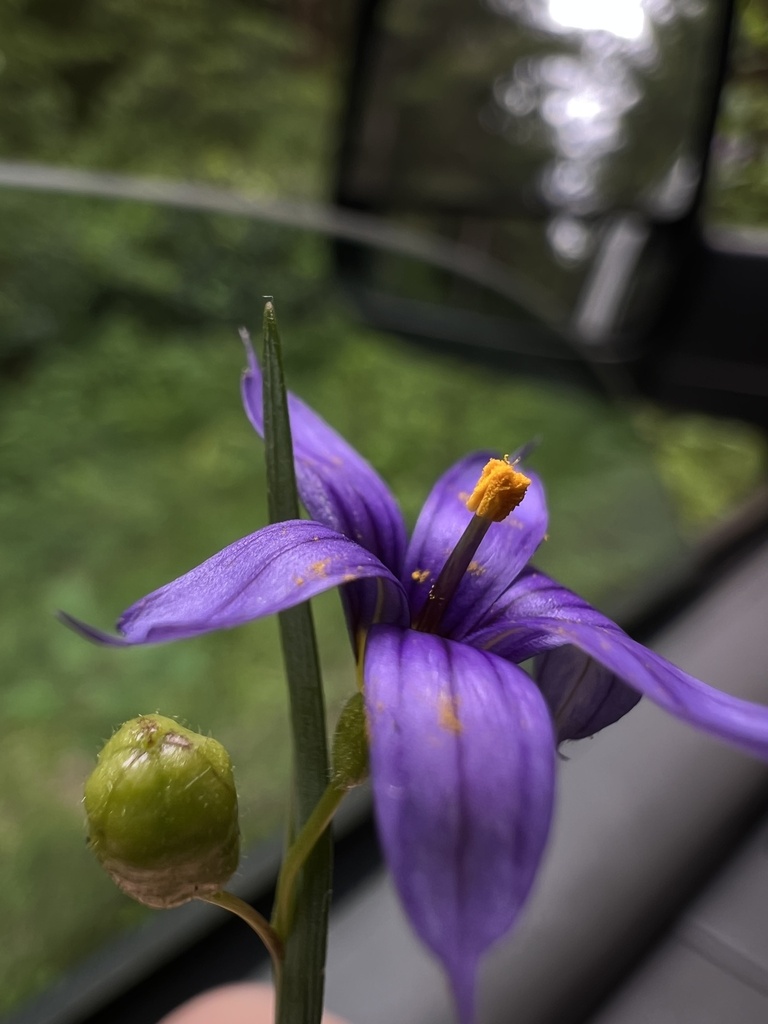
Photo: parent species Sisyrinchium idahoense · (c) Cameron Christopher Dunn, some rights reserved (CC BY-SA) · licence
Family: Iridaceae · Type: Herb · Native
Sisyrinchium idahoense var. occidentale (Idaho blue eyed grass) is a native California herb in the Iridaceae family, recognized by smaller flowers and less bract fusion.
Idaho blue eyed grass is a California native perennial found in the Sierra Nevada and eastern Sierra Nevada in open, moist, grassy places at elevations of 100 to 2,850 meters. Flowering from June to August, this plant produces blue to purple flowers in small clusters with outer perianth parts 8 to 13 millimeters long. Growing with slender stems 10 to 40 centimeters tall, it forms delicate clumps with distinctively fan-like leaves. Its leaves are narrow and grass-like, emerging in a flat plane from the base of the plant. The flower bracts have margins fused in their lower 3 to 6 millimeters, giving the plant a distinctive structural detail.
Identification and appearance
Key characters: 4 sympatric species; distinguished by smaller flowers and less bract fusion
Habitat and range
Habitat: Open, moist, grassy places
Elevation: 100-2850 m
California counties: Mono, Los Angeles, Kern, San Bernardino, Nevada, Inyo, Mariposa, Tuolumne, Tehama, El Dorado, Santa Barbara, Alpine, Plumas
Outside California: to eastern Washington, southwestern Montana, Colorado, New Mexico
Bloom period
Sisyrinchium idahoense var. occidentale blooms Jun-Aug.
How to tell it apart
vs Erodium: Sisyrinchium has iris-like flowers with 6 equal petals; Erodium has 5-petaled geranium flowers.; vs Dipterostemon: Sisyrinchium has flattened winged stems; Dipterostemon has round stems and lily-like flowers.; vs Solanum: Sisyrinchium has 6 petals and grass-like leaves; Solanum has 5 petals and broad leaves.; vs Iris: Sisyrinchium has tiny flowers (<18mm) in clusters; Iris has large showy flowers with distinctive falls.; vs Romulea: Sisyrinchium has flattened winged stems; Romulea has round or 4-angled grooved stems.
Frequently asked questions
Is Sisyrinchium idahoense var. occidentale native to California?
Yes. Sisyrinchium idahoense var. occidentale is native to California (recorded as native).
When does Sisyrinchium idahoense var. occidentale bloom?
Sisyrinchium idahoense var. occidentale blooms Jun-Aug.
Where in California does Sisyrinchium idahoense var. occidentale grow?
Sisyrinchium idahoense var. occidentale occurs in Mono, Los Angeles, Kern, San Bernardino, Nevada, Inyo, Mariposa, Tuolumne and other counties, at elevations of 100-2850 m.
What plant family does Sisyrinchium idahoense var. occidentale belong to?
Sisyrinchium idahoense var. occidentale is in the Iridaceae family, genus Sisyrinchium.
What habitat does Sisyrinchium idahoense var. occidentale grow in?
Sisyrinchium idahoense var. occidentale grows in Open, moist, grassy places.
Related species
Other California species in the same genus, family, or bioregion.
- Sisyrinchium longipes — Timberland blue-eyed-grass
- Sisyrinchium sp.
- Sisyrinchium bellum — Western blue-eyed-grass
- Sisyrinchium californicum — Golden-eyed-grass
- Sisyrinchium elmeri — Elmer's blue-eyed-grass
- Sisyrinchium funereum — Death valley blue-eyed-grass
- Sparaxis grandiflora — Butter cup
- Sparaxis sp. — Sparaxis
Sources: Jepson eFlora · Index of California Plant Names · CalPhotos
Last updated 2026-10-07
Data from The California Species Project — 14,000+ California species with verified data from CNPS, CDFW, USFWS, Cal-IPC, and more.