Solanum dulcamara
Bittersweet nightshade
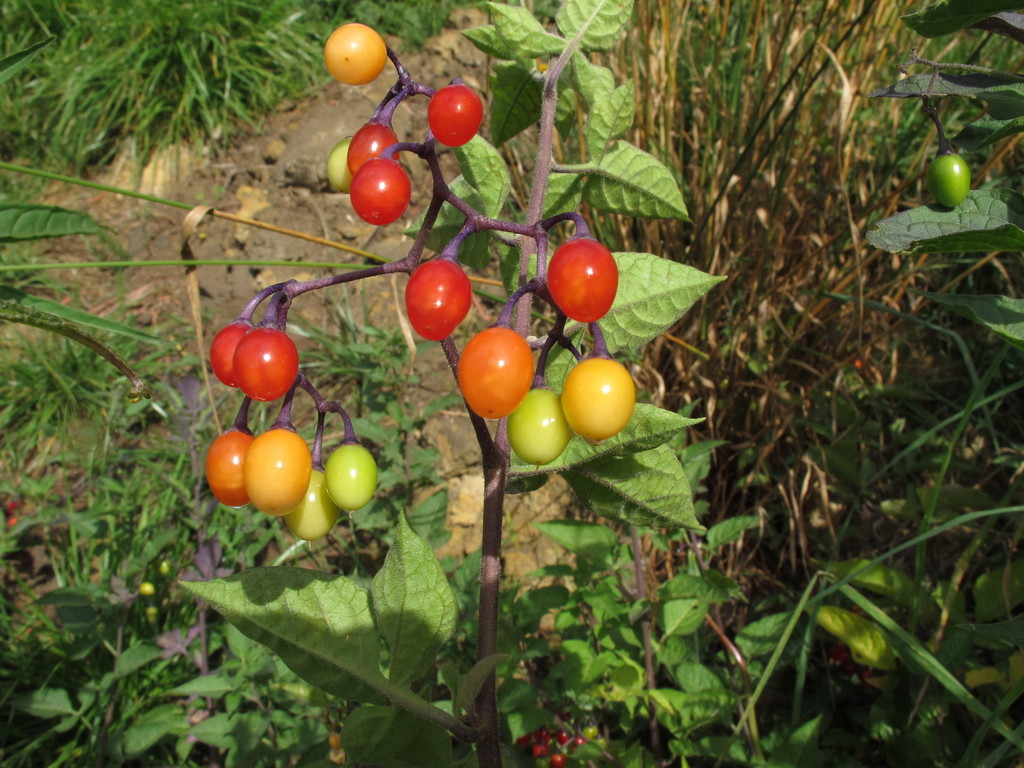
(c) John Barkla, some rights reserved (CC BY), uploaded by John Barkla · licence
Family: Solanaceae · Type: Subshrub · Not Native
Solanum dulcamara (Bittersweet nightshade) is a non-native California subshrub in the Solanaceae family, recognized by . Distinguished by climbing habit, red fruits, and moist habitat.
Bittersweet nightshade is a naturalized perennial vine found in coastal California, San Francisco Bay Area, and North Coast Ranges in moist disturbed places, marshes, and riparian areas at elevations below 1,425 meters. Flowering from June to September, this plant produces purple to violet flowers with white-margined green spots at the base of each lobe, creating a distinctive dark purple throat. Growing as a sprawling or climbing vine up to 5 meters tall, it has somewhat woody stems that are glabrous to softly hairy. Its leaves are 5 to 12 centimeters long, ovate to heart-shaped, with occasional deep lobes near the base and a pointed tip. The fruit is a small ellipsoid berry that ripens to bright red, forming clusters that attract local wildlife.
Identification and appearance
Key characters: 22 sympatric species. Distinguished by climbing habit, red fruits, and moist habitat.
Habitat and range
Habitat: Moist disturbed places, marshes, riparian areas
Elevation: < 1425 m
Outside California: to Canada, eastern United States, native to northern Eurasia
Bloom period
Solanum dulcamara blooms Jun-Sep.
How to tell it apart
vs Lycianthes: Solanum anthers open by pores at tips; Lycianthes anthers split lengthwise.; vs Physalis: Solanum lacks papery lantern around fruit; Physalis has distinctive inflated calyx covering the berry.; vs Phacelia: Solanum has yellow anther cone; Phacelia has protruding stamens and coiled flower clusters.; vs Capsicum: Solanum has rotate star flowers; Capsicum has flowers with spreading petals not forming flat star.; vs Salvia: Solanum has 5 stamens forming yellow cone; Salvia has 2 stamens and square stems.
Frequently asked questions
Is Solanum dulcamara native to California?
No. Solanum dulcamara is not native to California (recorded as not native).
When does Solanum dulcamara bloom?
Solanum dulcamara blooms Jun-Sep.
What plant family does Solanum dulcamara belong to?
Solanum dulcamara is in the Solanaceae family, genus Solanum.
What habitat does Solanum dulcamara grow in?
Solanum dulcamara grows in Moist disturbed places, marshes, riparian areas.
Related species
Other California species in the same genus, family, or bioregion.
Sources: Jepson eFlora · CalPhotos
Last updated 2026-10-07
Data from The California Species Project — 14,000+ California species with verified data from CNPS, CDFW, USFWS, Cal-IPC, and more.