Solanum rostratum
Buffalobur
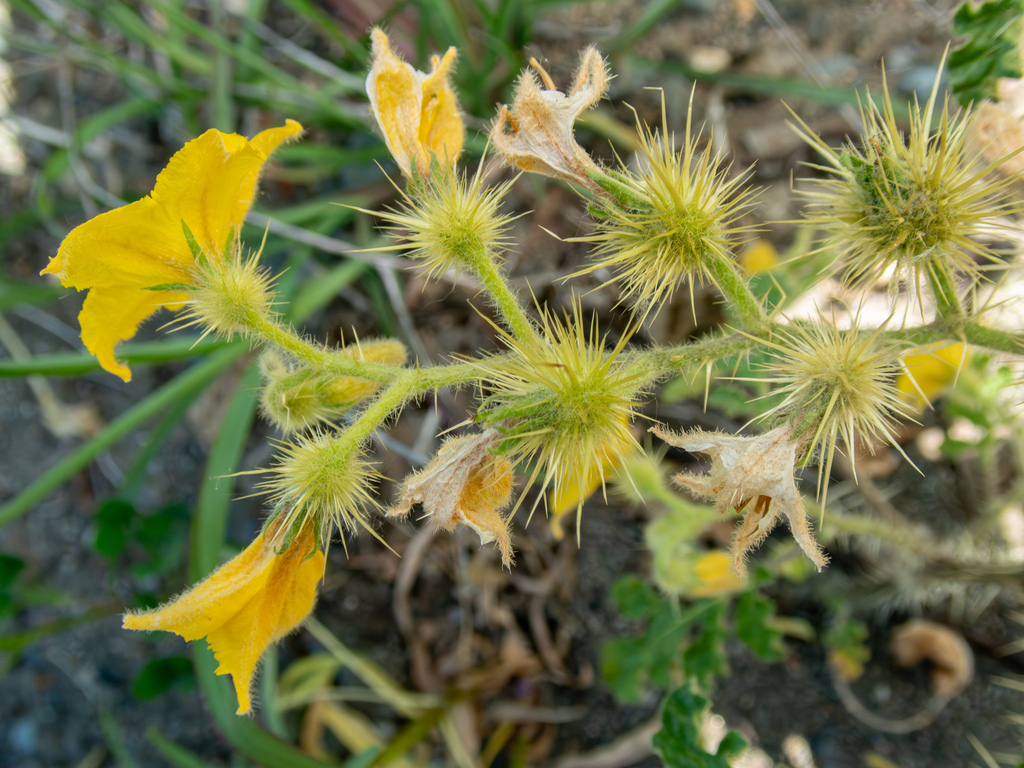
(c) Don Loarie, some rights reserved (CC BY), uploaded by Don Loarie · licence
Family: Solanaceae · Type: Herb · Not Native
Solanum rostratum (Buffalobur) is a non-native California herb in the Solanaceae family, recognized by . Distinguished by dense prickles, yellow flowers, and unequal anthers.
Buffalobur is a naturalized annual plant found in southern North Coast Ranges, California Rockies, Central Valley, Central Coast, southern South Coast Ranges, Southern California, and Modoc Plateau in disturbed places, roadsides, and fields at elevations below 1,400 meters. Flowering from May to September, this plant produces bright yellow flowers with a diameter of 15 to 35 millimeters, forming clusters of 5 to 12 blossoms. Growing with dense, straight prickles up to 12 millimeters long and reaching 1 to 7 decimeters tall, it has stellate hairs with 6 to 10 rays. Its leaves are 5 to 15 centimeters long, deeply lobed or divided nearly to the midrib, creating a complex and textured appearance. The fruit is brown, 9 to 12 millimeters long, and contains 33 to 80 small seeds measuring 2 to 3 millimeters.
Identification and appearance
Key characters: 22 sympatric species. Distinguished by dense prickles, yellow flowers, and unequal anthers.
Habitat and range
Habitat: Disturbed places, roadsides, fields
Elevation: < 1400 m
California counties: Los Angeles, Kern, Santa Barbara, Napa, San Diego, Orange, San Bernardino, Riverside, Inyo, Tehama, San Luis Obispo, Marin, Sonoma, Sacramento, Del Norte, Kings, Alameda, Contra Costa, Butte, Madera, Sutter, Yolo, Glenn, Colusa, Placer, Lake, Siskiyou, Monterey, Ventura, Tulare, Stanislaus, San Benito, Santa Cruz, Mendocino
Outside California: to eastern United States, Mexico, native to Great Plains
Bloom period
Solanum rostratum blooms May-Sep.
How to tell it apart
vs Lycianthes: Solanum anthers open by pores at tips; Lycianthes anthers split lengthwise.; vs Physalis: Solanum lacks papery lantern around fruit; Physalis has distinctive inflated calyx covering the berry.; vs Phacelia: Solanum has yellow anther cone; Phacelia has protruding stamens and coiled flower clusters.; vs Capsicum: Solanum has rotate star flowers; Capsicum has flowers with spreading petals not forming flat star.; vs Salvia: Solanum has 5 stamens forming yellow cone; Salvia has 2 stamens and square stems.
Frequently asked questions
Is Solanum rostratum native to California?
No. Solanum rostratum is not native to California (recorded as not native).
When does Solanum rostratum bloom?
Solanum rostratum blooms May-Sep.
Where in California does Solanum rostratum grow?
Solanum rostratum occurs in Los Angeles, Kern, Santa Barbara, Napa, San Diego, Orange, San Bernardino, Riverside and other counties, at elevations of < 1400 m.
What plant family does Solanum rostratum belong to?
Solanum rostratum is in the Solanaceae family, genus Solanum.
What habitat does Solanum rostratum grow in?
Solanum rostratum grows in Disturbed places, roadsides, fields.
Related species
Other California species in the same genus, family, or bioregion.
Sources: Jepson eFlora · Index of California Plant Names · CalPhotos
Last updated 2026-10-07
Data from The California Species Project — 14,000+ California species with verified data from CNPS, CDFW, USFWS, Cal-IPC, and more.