Solanum triflorum
Cutleaf nightshade
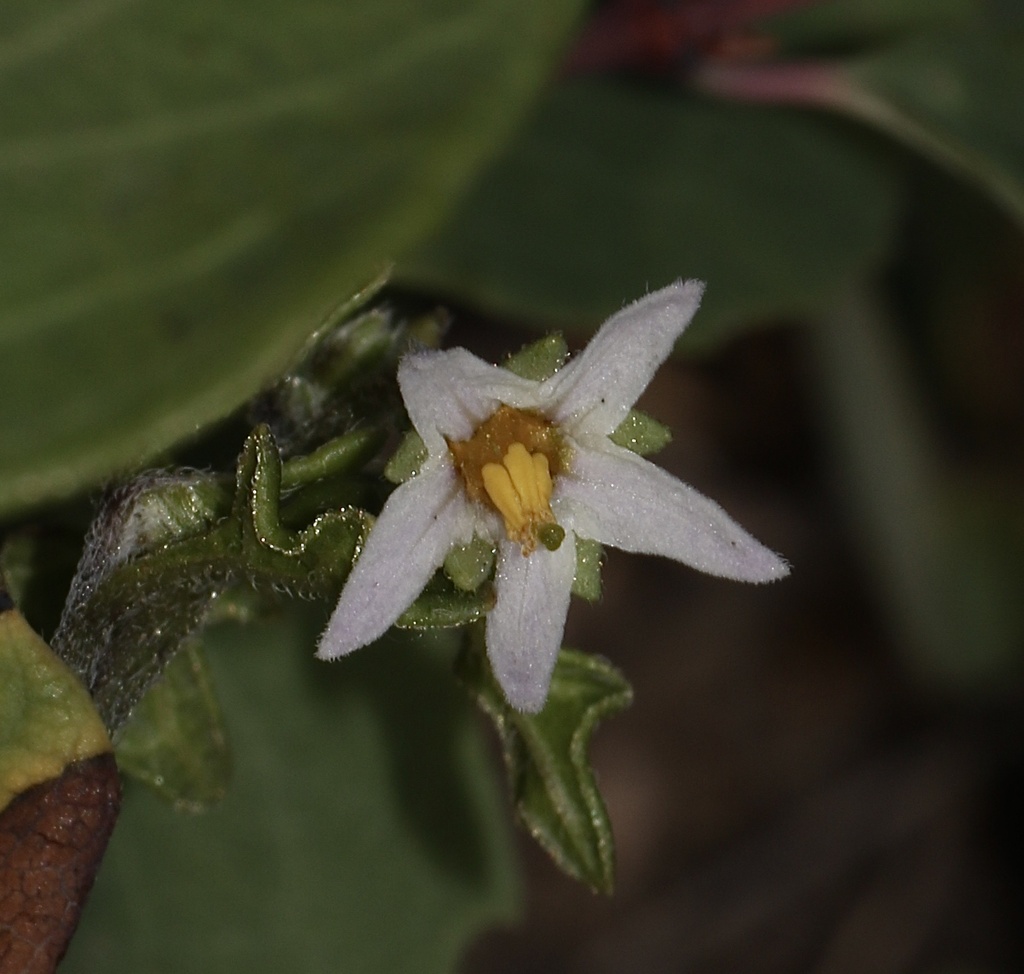
(c) Dustin Snider, some rights reserved (CC BY) · licence
Family: Solanaceae · Type: Herb · Not Native
Solanum triflorum (Cutleaf nightshade) is a non-native California herb in the Solanaceae family, recognized by . Distinguished by deeply divided fleshy leaves and many stone cell clusters.
Cutleaf nightshade is a naturalized annual plant found in northern and southern Sierra Nevada (eastern slope), Southern California coastal areas, Great Basin, and northern Mojave Desert regions in dry scrub, juniper woodland, and conifer forest at elevations of 100 to 2,300 meters. Flowering from June to September, this plant produces white flowers with a greenish-yellow throat, approximately 7 to 9 millimeters in diameter, arranged in small clusters of 1 to 6 blossoms. Growing with decumbent stems 10 to 50 centimeters long, the plant is covered in fine, curved, spreading hairs that give it a soft, delicate appearance. Its leaves are fleshy and deeply lobed, measuring 2 to 5 centimeters long, with an oblong to ovate shape that appears somewhat shiny and nearly hairless on the upper surface. The fruit develops as a green structure 8 to 12 millimeters long, containing numerous yellow seeds and distinctive clusters of stone cells.
Identification and appearance
Key characters: 19 sympatric species. Distinguished by deeply divided fleshy leaves and many stone cell clusters.
Habitat and range
Habitat: Dry scrub, juniper woodland, conifer forest
Elevation: 100-2300 m
California counties: Los Angeles, Siskiyou, Lassen, Mono, Riverside, San Bernardino, Kern, Modoc, Inyo, Sierra, Nevada, Humboldt, San Joaquin, Shasta, San Diego
Outside California: to central United States, native to South America
Bloom period
Solanum triflorum blooms Jun-Sep.
How to tell it apart
vs Lycianthes: Solanum anthers open by pores at tips; Lycianthes anthers split lengthwise.; vs Physalis: Solanum lacks papery lantern around fruit; Physalis has distinctive inflated calyx covering the berry.; vs Phacelia: Solanum has yellow anther cone; Phacelia has protruding stamens and coiled flower clusters.; vs Capsicum: Solanum has rotate star flowers; Capsicum has flowers with spreading petals not forming flat star.; vs Salvia: Solanum has 5 stamens forming yellow cone; Salvia has 2 stamens and square stems.
Frequently asked questions
Is Solanum triflorum native to California?
No. Solanum triflorum is not native to California (recorded as not native).
When does Solanum triflorum bloom?
Solanum triflorum blooms Jun-Sep.
Where in California does Solanum triflorum grow?
Solanum triflorum occurs in Los Angeles, Siskiyou, Lassen, Mono, Riverside, San Bernardino, Kern, Modoc and other counties, at elevations of 100-2300 m.
What plant family does Solanum triflorum belong to?
Solanum triflorum is in the Solanaceae family, genus Solanum.
What habitat does Solanum triflorum grow in?
Solanum triflorum grows in Dry scrub, juniper woodland, conifer forest.
Related species
Other California species in the same genus, family, or bioregion.
- Solanum umbelliferum — Blue witch nightshade
- Solanum umbelliferum var. clokeyi — Clokey's nightshade
- Solanum umbelliferum var. glabrescens — Bald blue-witch nightshade
- Solanum umbelliferum var. hoffmannii — Hoffmann's nightshade
- Solanum umbelliferum var. incanum — White-stemmed nightshade
- Solanum umbelliferum var. obispoense — Obispo nightshade
Sources: Jepson eFlora · Index of California Plant Names · CalPhotos
Last updated 2026-10-07
Data from The California Species Project — 14,000+ California species with verified data from CNPS, CDFW, USFWS, Cal-IPC, and more.