Solidago altissima subsp. altissima
Late goldenrod, Late Goldenrod
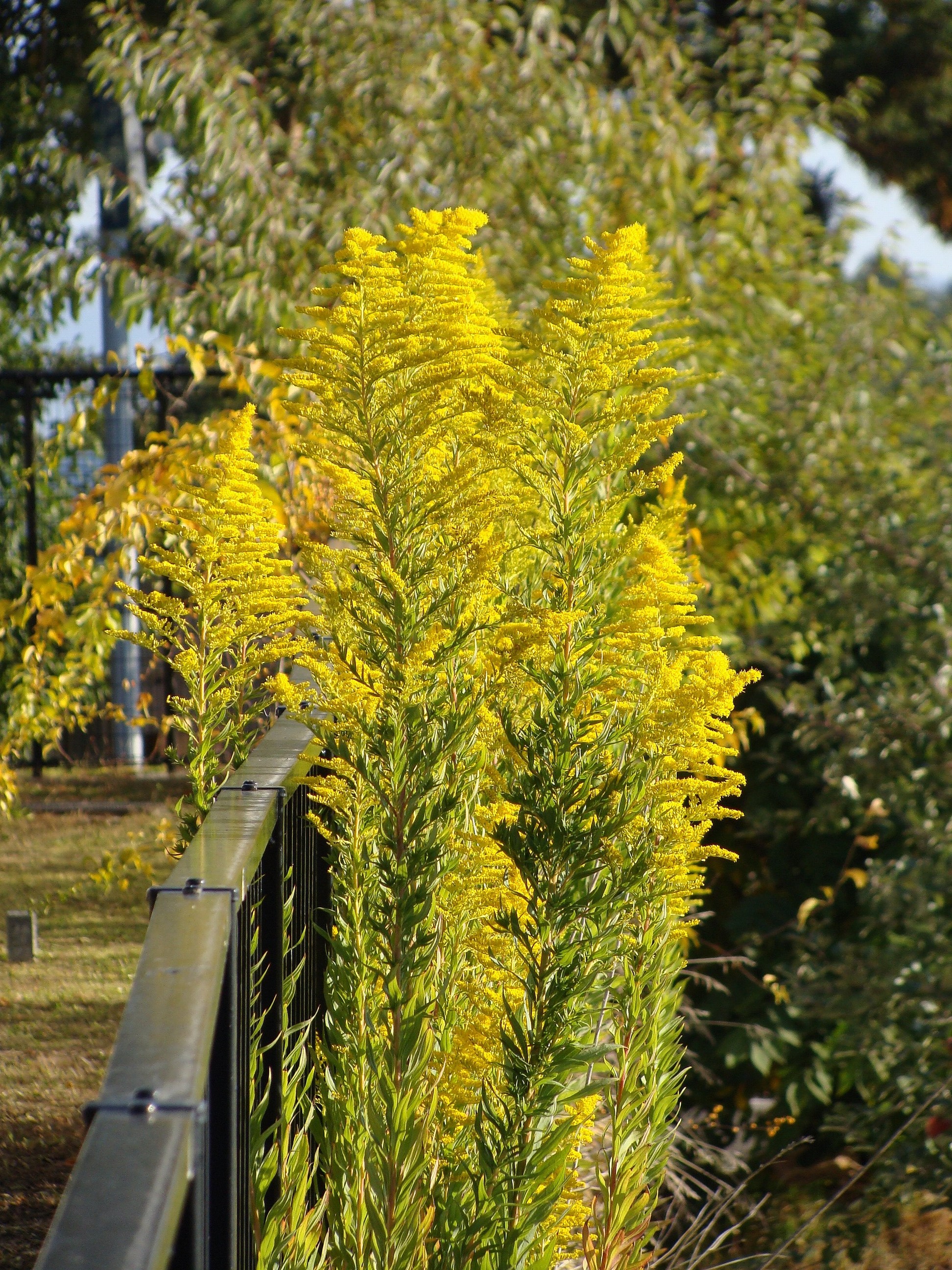
Aomorikuma (via Wikimedia Commons) · CC BY-SA
Family: Asteraceae · Type: Perennial · Not Native
Solidago altissima subsp. altissima (Late goldenrod) is a non-native California perennial in the Asteraceae family, recognized by non-native status, strongly 3-veined scabrous leaves, large pyramid inflorescence.
Late goldenrod is a naturalized perennial found in northwestern California, the Cascade Range, Sierra Nevada, central western California, and Great Basin regions in disturbed sites at elevations below 2,800 meters. Flowering from October to November, this plant produces yellow flowers in dense, pyramid-shaped clusters with heads containing 10 to 15 small ray flowers. Growing with hairy stems 20 to 150 centimeters tall emerging from underground rhizomes, it has a robust and spreading growth habit. Its leaves are distinctively lance-shaped, 4 to 15 centimeters long, with three prominent veins and a rough, short-hairy surface that becomes larger toward the middle of the stem. The small fruits are approximately 1 to 1.5 millimeters long and slightly strigose.
Identification and appearance
Key characters: 10 sympatric species; key features are non-native status, strongly 3-veined scabrous leaves, large pyramid inflorescence
Habitat and range
Habitat: Uncommon. Disturbed sites
Elevation: < 2800 m
California counties: Placer, El Dorado, Alpine, Santa Barbara, Ventura
Outside California: native to central and eastern North America, widely cultivated, escaped elsewhere
Bloom period
Solidago altissima subsp. altissima blooms Oct-Nov.
How to tell it apart
vs Euthamia: Solidago flowers cluster one-sided on branches; Euthamia flowers form flat-topped clusters.; vs Isocoma: Solidago has small yellow ray petals; Isocoma completely lacks ray petals (disk flowers only).; vs Senecio: Solidago heads in one-sided clusters; Senecio heads in flat or rounded clusters, never one-sided.; vs Eriophyllum: Solidago foliage is green and smooth; Eriophyllum foliage is densely white-woolly.; vs Artemisia: Solidago has showy yellow ray petals; Artemisia has tiny inconspicuous rayless heads.
Frequently asked questions
Is Solidago altissima subsp. altissima native to California?
No. Solidago altissima subsp. altissima is not native to California (recorded as not native).
When does Solidago altissima subsp. altissima bloom?
Solidago altissima subsp. altissima blooms Oct-Nov.
Where in California does Solidago altissima subsp. altissima grow?
Solidago altissima subsp. altissima occurs in Placer, El Dorado, Alpine, Santa Barbara, Ventura, at elevations of < 2800 m.
What plant family does Solidago altissima subsp. altissima belong to?
Solidago altissima subsp. altissima is in the Asteraceae family, genus Solidago.
What habitat does Solidago altissima subsp. altissima grow in?
Solidago altissima subsp. altissima grows in Uncommon. Disturbed sites.
Related species
Other California species in the same genus, family, or bioregion.
Sources: Jepson eFlora · Index of California Plant Names · CalPhotos
Last updated 2026-09-30
Data from The California Species Project — 14,000+ California species with verified data from CNPS, CDFW, USFWS, Cal-IPC, and more.