Sorghum halepense
Johnson grass
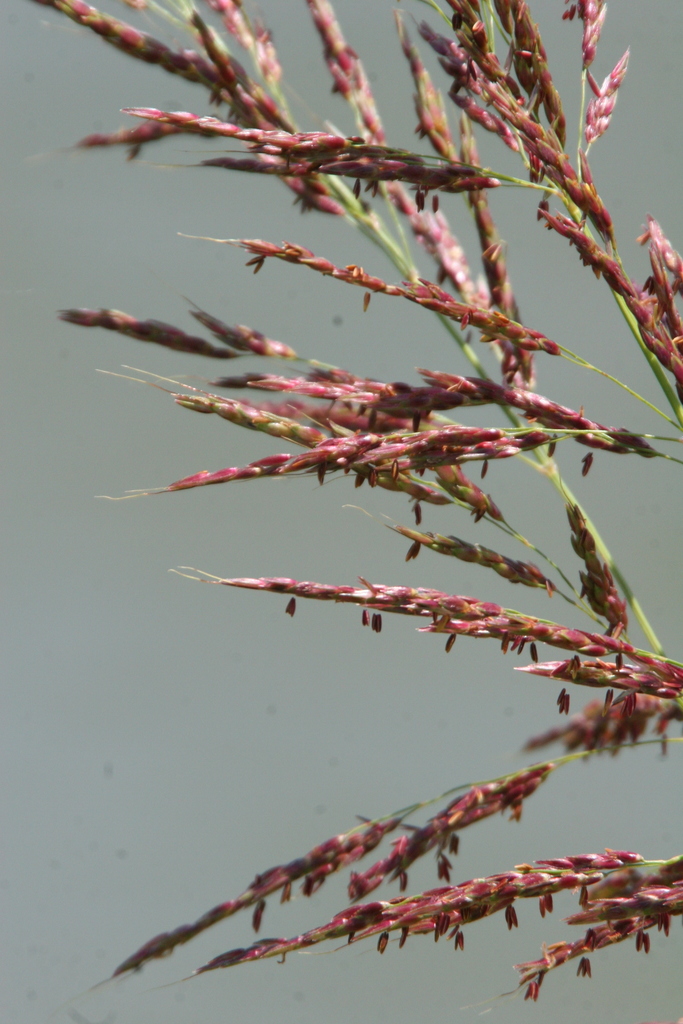
(c) L. K. Holt, some rights reserved (CC BY), uploaded by L. K. Holt · licence
Family: Poaceae · Type: Grass · Not Native
Sorghum halepense (Johnson grass) is a non-native California grass in the Poaceae family, recognized by (S. bicolor). Key differences in inflorescence structure and ligule length.
Johnson grass is a naturalized perennial found in northwestern California, the Sierra Nevada Foothills, Sierra Nevada, Central Valley, central western California, southwestern California, and desert regions in disturbed areas, ditch banks, and roadsides at elevations below 1,160 meters. Flowering from May to August, this plant produces pale green to whitish flowers in large, spreading panicles 5 to 25 centimeters wide. Growing with robust erect stems 50 to 200 centimeters tall, it forms dense clumps with multiple branching stems. Its long, wide leaves measure 5 to 90 centimeters in length and 0.5 to 4 centimeters across, with a distinctive ligule 2 to 6 millimeters long. The plant can spread aggressively through both seeds and rhizomes, making it a persistent invasive species in many disturbed habitats.
Identification and appearance
Key characters: 1 sympatric species (S. bicolor). Key differences in inflorescence structure and ligule length.
Habitat and range
Habitat: Disturbed areas, ditch banks, roadsides
Elevation: < 1160 m
California counties: Los Angeles, Orange, Alameda, Butte, Stanislaus, Tulare, Fresno, Colusa, Lake, Merced, San Luis Obispo, Nevada, Calaveras, Riverside, Glenn, San Diego, Humboldt, San Bernardino, Kings, Ventura, Imperial, Yolo, Sutter, Placer, Yuba, Sacramento, Amador, Marin, Lassen, Madera, Kern, Plumas, Santa Clara, Santa Cruz, Shasta, Solano, Trinity, Monterey, Napa, San Francisco, San Mateo, Santa Barbara, Sonoma, San Joaquin, Contra Costa, Tehama, El Dorado, Inyo, Siskiyou
Outside California: widespread in United States, native to Mediterranean
Bloom period
Sorghum halepense blooms May-Aug.
How to tell it apart
vs Zea: Sorghum has terminal three-spikelet clusters in open panicles; corn has separate male tassels and female ears.; vs Echinochloa: Sorghum has three-spikelet groups at branch tips; barnyard grass has single spikelets and no ligule.; vs Panicum: Sorghum has three-spikelet terminal clusters; panicgrass has single spikelets throughout the panicle.; vs Rumex: Sorghum is a grass with three-spikelet clusters; dock has broad leaves and papery winged fruits.; vs Phyllostachys: Sorghum has soft herbaceous stems and three-spikelet clusters; bamboo has hard woody stems.
Frequently asked questions
Is Sorghum halepense native to California?
No. Sorghum halepense is not native to California (recorded as not native).
When does Sorghum halepense bloom?
Sorghum halepense blooms May-Aug.
Where in California does Sorghum halepense grow?
Sorghum halepense occurs in Los Angeles, Orange, Alameda, Butte, Stanislaus, Tulare, Fresno, Colusa and other counties, at elevations of < 1160 m.
What plant family does Sorghum halepense belong to?
Sorghum halepense is in the Poaceae family, genus Sorghum.
What habitat does Sorghum halepense grow in?
Sorghum halepense grows in Disturbed areas, ditch banks, roadsides.
Related species
Other California species in the same genus, family, or bioregion.
Sources: Jepson eFlora · Index of California Plant Names · CalPhotos
Last updated 2026-10-07
Data from The California Species Project — 14,000+ California species with verified data from CNPS, CDFW, USFWS, Cal-IPC, and more.