Sparganium eurycarpum var. eurycarpum
Broadfruit bur reed
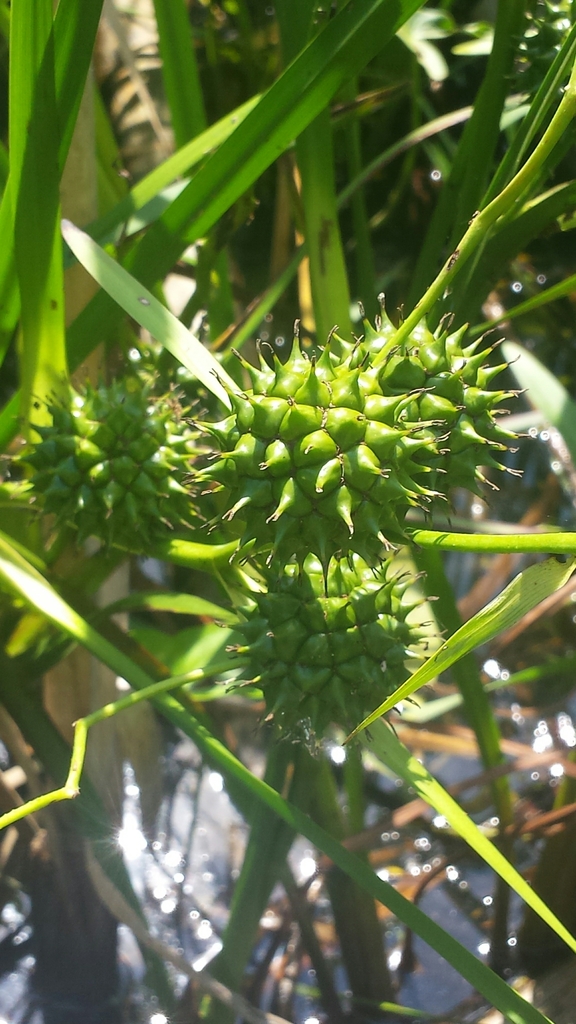
Photo: parent species Sparganium eurycarpum · (c) Tom Norton, some rights reserved (CC BY) · licence
Family: Typhaceae · Type: Perennial · Native
Sparganium eurycarpum var. eurycarpum (Broadfruit bur reed) is a native California perennial in the Typhaceae family, recognized by robust size, branched inflorescence, and large angular fruits.
Broadfruit bur reed is a California native perennial found in coastal and central California regions, including the North Coast, northern Sierra Nevada, San Joaquin Valley, and San Francisco Bay Area in marshes, lakes, ponds, and along streams at elevations below 2,400 meters. Flowering from June to August, this plant produces distinctive spherical flower heads with white to greenish flowers up to 3 centimeters in diameter. Growing up to 1.5 meters tall with firm, thick stems that have triangular cross-sections, it forms dense clusters in wet habitats. Its leaves are distinctive, with thick blades that are strongly three-angled, creating a robust and architectural presence in aquatic environments. The fruit is rounded and slightly truncate, measuring 8 to 9 millimeters long and 5 to 7 millimeters wide.
Identification and appearance
Key characters: 4 sympatric species; key features are robust size, branched inflorescence, and large angular fruits
Habitat and range
Habitat: Marshes, lakes, ponds, along streams
Elevation: < 2400 m
California counties: San Diego, Santa Barbara, San Luis Obispo, Lassen, Marin, Merced, Alameda, Sonoma, Plumas, San Mateo, Butte, Kern, Riverside, Santa Clara, Mendocino, Sacramento
Outside California: temperate and low-latitude boreal North America
Bloom period
Sparganium eurycarpum var. eurycarpum blooms Jun-Aug.
How to tell it apart
vs Typha: Sparganium has round spiky balls along the stem; Typha has cylindrical brown 'hot dog' spikes.; vs Ruppia: Sparganium has dense spherical flower heads; Ruppia has inconspicuous flowers on thread-like stems.; vs Myriophyllum: Sparganium has undivided ribbon-like leaves; Myriophyllum has feathery, finely-divided leaves.; vs Najas: Sparganium has spherical flower clusters on stems; Najas has tiny flowers hidden in leaf axils.; vs Callitriche: Sparganium has spherical flower heads on tall stems; Callitriche forms small rosettes at water surface.
Frequently asked questions
Is Sparganium eurycarpum var. eurycarpum native to California?
Yes. Sparganium eurycarpum var. eurycarpum is native to California (recorded as native).
When does Sparganium eurycarpum var. eurycarpum bloom?
Sparganium eurycarpum var. eurycarpum blooms Jun-Aug.
Where in California does Sparganium eurycarpum var. eurycarpum grow?
Sparganium eurycarpum var. eurycarpum occurs in San Diego, Santa Barbara, San Luis Obispo, Lassen, Marin, Merced, Alameda, Sonoma and other counties, at elevations of < 2400 m.
What plant family does Sparganium eurycarpum var. eurycarpum belong to?
Sparganium eurycarpum var. eurycarpum is in the Typhaceae family, genus Sparganium.
What habitat does Sparganium eurycarpum var. eurycarpum grow in?
Sparganium eurycarpum var. eurycarpum grows in Marshes, lakes, ponds, along streams.
Related species
Other California species in the same genus, family, or bioregion.
Sources: Jepson eFlora · Index of California Plant Names · CalPhotos
Last updated 2026-09-30
Data from The California Species Project — 14,000+ California species with verified data from CNPS, CDFW, USFWS, Cal-IPC, and more.