Spergula arvensis
Stickwort, starwort, Starwort
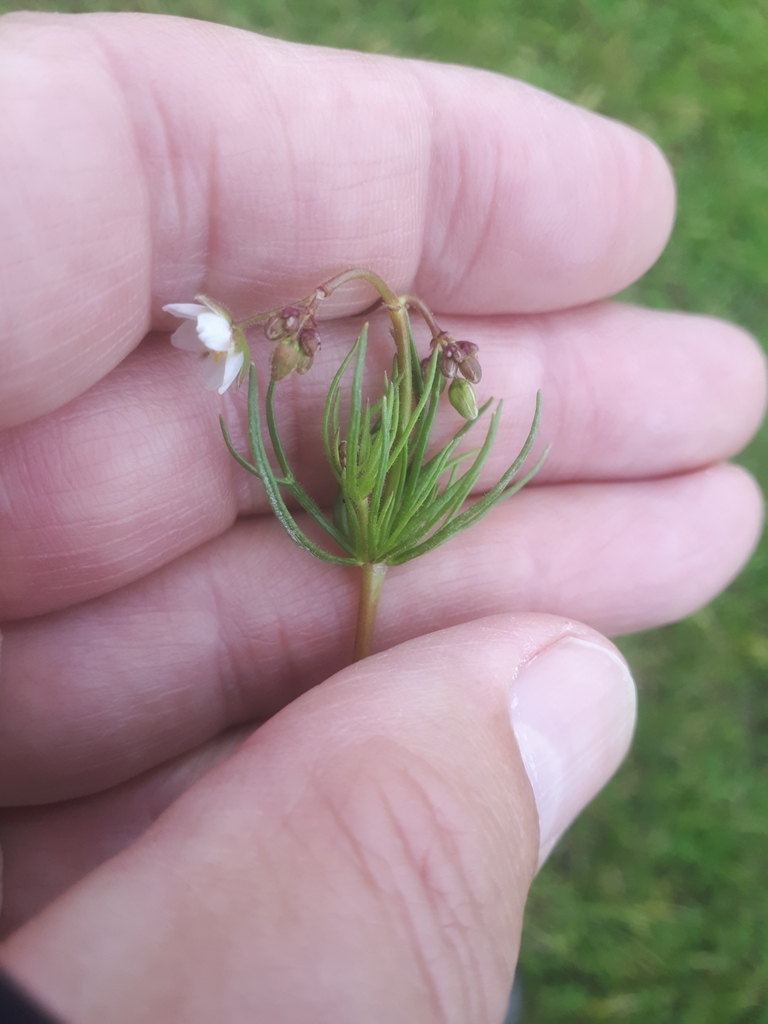
(c) Simon, some rights reserved (CC BY) · licence
Family: Caryophyllaceae · Type: Herb · Not Native
Spergula arvensis (Stickwort) is a non-native California herb in the Caryophyllaceae family, recognized by European introduction with distinctive seed ornamentation, sporadic distribution reflecting limited establishment success.
Stickwort is a naturalized annual found in northern California coastal regions, northern Sierra Nevada foothills, Central Valley, Central Western California, and southern coastal areas in open slopes, pine woodland, sand dunes, and disturbed areas at elevations below 200 meters. Flowering from spring to early summer, this plant produces white to pale pink flowers with ovate petals that persist after flowering. Growing with slender stems 10 to 40 centimeters tall that are sometimes glandular-hairy, it spreads with a branched base and delicate structure. Its linear leaves are 1 to 5 centimeters long with blunt or pointed tips, often with margins strongly rolled underneath. Seeds are small, approximately 1 to 1.5 millimeters in diameter, with distinctive white club-shaped papillae that give the plant its distinctive texture.
Identification and appearance
Key characters: European introduction with distinctive seed ornamentation, sporadic distribution reflecting limited establishment success
Habitat and range
Habitat: Open slopes, pine woodland, sand dunes, fields, disturbed areas
Elevation: < 200 m
California counties: San Luis Obispo, Santa Barbara, Los Angeles, Santa Cruz, Alameda, Butte, Contra Costa, Fresno, Humboldt, Lake, Marin, Mendocino, Monterey, Napa, Orange, Riverside, Sacramento, San Bernardino, San Diego, San Francisco, San Mateo, Santa Clara, Sonoma, Ventura, Solano, Placer, El Dorado, Amador, Calaveras, Del Norte, Nevada, San Benito, Sutter, San Joaquin, Siskiyou, Plumas, Stanislaus, Yolo, Tuolumne
Outside California: scattered in North America, native to Europe
Bloom period
Spergula arvensis blooms Spring-early summer.
How to tell it apart
vs Spergularia: Spergula has whorl-like clusters of 16-30 leaves per node; Spergularia has simple opposite leaves.; vs Sabulina: Spergula has whorled clusters of smooth needles; Sabulina has simple opposite thread-like leaves.; vs Minuartia: Spergula has whorled needle clusters creating bottlebrush look; Minuartia has simple opposite awl-shaped leaves.; vs Sagina: Spergula has dense whorls of 16-30 needles per node; Sagina has simple opposite linear leaves.; vs Polycarpon: Spergula has whorls of needle-like leaves; Polycarpon has opposite spoon-shaped leaves.
Frequently asked questions
Is Spergula arvensis native to California?
No. Spergula arvensis is not native to California (recorded as not native).
When does Spergula arvensis bloom?
Spergula arvensis blooms Spring-early summer.
Where in California does Spergula arvensis grow?
Spergula arvensis occurs in San Luis Obispo, Santa Barbara, Los Angeles, Santa Cruz, Alameda, Butte, Contra Costa, Fresno and other counties, at elevations of < 200 m.
What plant family does Spergula arvensis belong to?
Spergula arvensis is in the Caryophyllaceae family, genus Spergula.
What habitat does Spergula arvensis grow in?
Spergula arvensis grows in Open slopes, pine woodland, sand dunes, fields, disturbed areas.
Related species
Other California species in the same genus, family, or bioregion.
Sources: Jepson eFlora · Index of California Plant Names · CalPhotos
Last updated 2026-10-07
Data from The California Species Project — 14,000+ California species with verified data from CNPS, CDFW, USFWS, Cal-IPC, and more.