Spergularia bocconi
Boccone's sand-spurrey
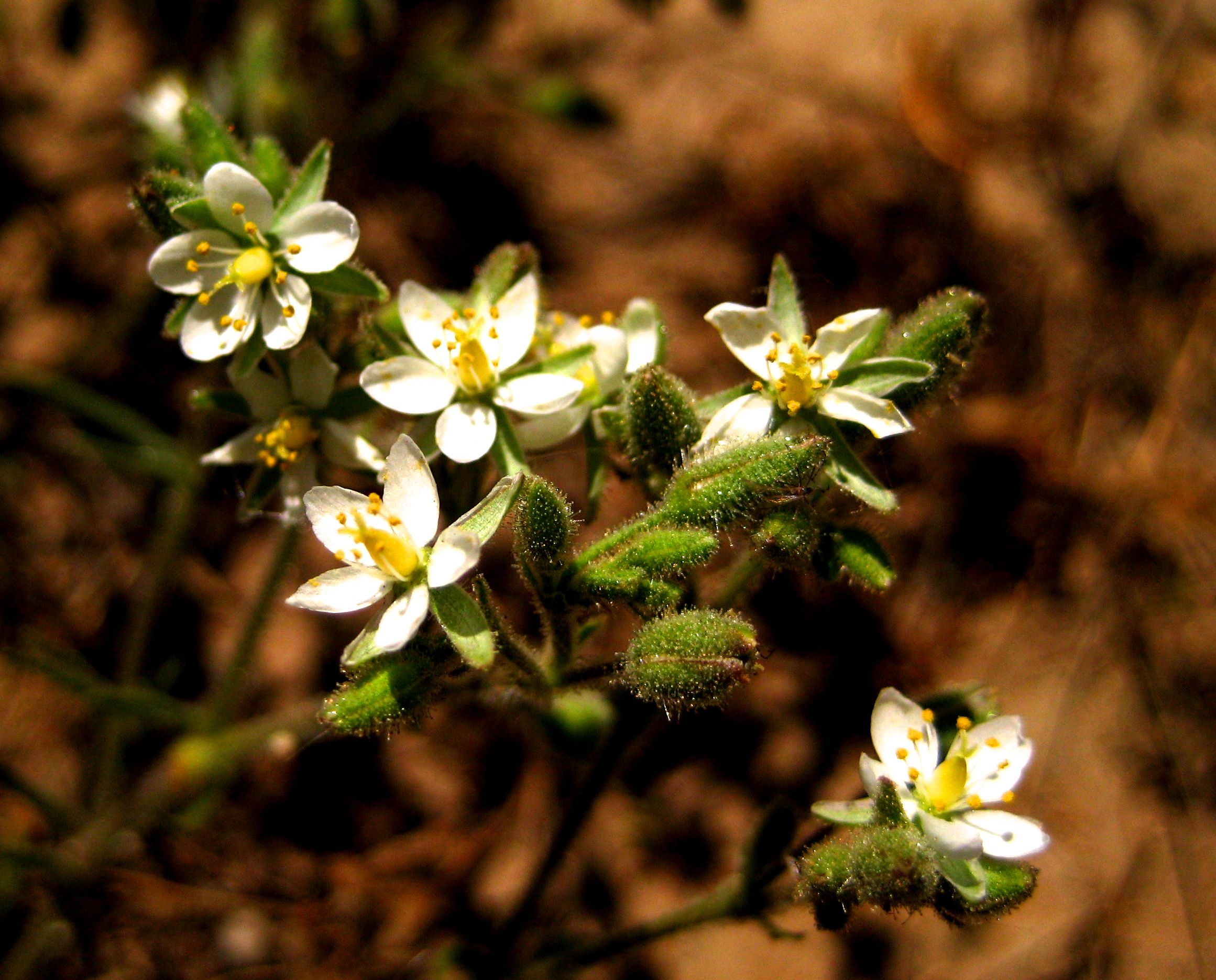
Photo by Chez Brungraber
Family: Caryophyllaceae · Type: Herb · Not Native
Spergularia bocconi (Boccone's sand-spurrey) is a non-native California herb in the Caryophyllaceae family, recognized by flowers clustered on one side of branches.
Boccone's sand-spurrey is a naturalized annual found in the Klamath Ranges, central Sierra Nevada Foothills, Central Valley, Central Coast, southern California Coast, southern Channel Islands, and Mojave Desert in salt marshes, alkaline areas, and sandy soils at elevations below 400 meters. Flowering in spring, this delicate plant produces white or pink to rosy flowers with petals nestled among glandular-hairy branching clusters. Growing with slender stems less than 1 millimeter in diameter, it forms a compact and fragile structure. Its leaves are slightly fleshy with small, inconspicuous white to tan stipules, typically occurring in sparse 0-2 clusters per axil. The fruit is small, measuring 2.7 to 5.3 millimeters long, with light brown seeds that are minutely textured.
Identification and appearance
Key characters: 9 sympatric species; flowers clustered on one side of branches
Habitat and range
Habitat: Salt marshes, alkaline areas, sandy soils
Elevation: < 400 m
California counties: San Diego, Los Angeles, Riverside, Fresno, Inyo, Sacramento, San Bernardino, San Mateo, Santa Barbara, Ventura, Butte, Contra Costa, Marin, Merced, Monterey, Orange, San Francisco, San Luis Obispo, Tuolumne, Yolo, Kern, Solano, Imperial, Calaveras, Madera, Alameda, Colusa, Placer, Santa Cruz, Santa Clara, Sonoma, Tulare, San Benito, Sutter, Napa, Tehama, Glenn, Yuba, Humboldt, Mendocino, Shasta, Stanislaus
Outside California: Oregon, native to southwestern Europe, Mediterranean
Bloom period
Spergularia bocconi blooms Spring.
How to tell it apart
vs Spergula: Spergularia has simple opposite leaves at nodes; Spergula has whorl-like clusters of 16-30 leaves per node.; vs Erodium: Spergularia has tiny pink/white flowers with round capsules; Erodium has purple flowers with long-beaked stork's-bill fruits.; vs Sabulina: Spergularia has fleshy leaves and triangular stipules; Sabulina has thread-like leaves without stipules.; vs Cakile: Spergularia has opposite fleshy leaves with pink flowers; Cakile has alternate fleshy leaves with 4-petaled mustard flowers.; vs Calandrinia: Spergularia has 5 tiny petals and triangular stipules; Calandrinia has 3-7 showy petals and no stipules.
Frequently asked questions
Is Spergularia bocconi native to California?
No. Spergularia bocconi is not native to California (recorded as not native).
When does Spergularia bocconi bloom?
Spergularia bocconi blooms Spring.
Where in California does Spergularia bocconi grow?
Spergularia bocconi occurs in San Diego, Los Angeles, Riverside, Fresno, Inyo, Sacramento, San Bernardino, San Mateo and other counties, at elevations of < 400 m.
What plant family does Spergularia bocconi belong to?
Spergularia bocconi is in the Caryophyllaceae family, genus Spergularia.
What habitat does Spergularia bocconi grow in?
Spergularia bocconi grows in Salt marshes, alkaline areas, sandy soils.
Related species
Other California species in the same genus, family, or bioregion.
- Spergularia canadensis var. occidentalis — Western sand-spurrey
- Spergularia macrotheca — Sticky sand-spurrey
- Spergularia macrotheca var. leucantha — Sticky sandspurry
- Spergularia macrotheca var. longistyla — Long styled sand spurrey
- Spergularia macrotheca var. macrotheca — Sand spurrey
- Spergularia marina — Saltmarsh sand-spurrey
Sources: Jepson eFlora · Index of California Plant Names · CalPhotos
Last updated 2026-10-07
Data from The California Species Project — 14,000+ California species with verified data from CNPS, CDFW, USFWS, Cal-IPC, and more.