Spergularia rubra
Red sand-spurrey, Red Sand-Spurrey
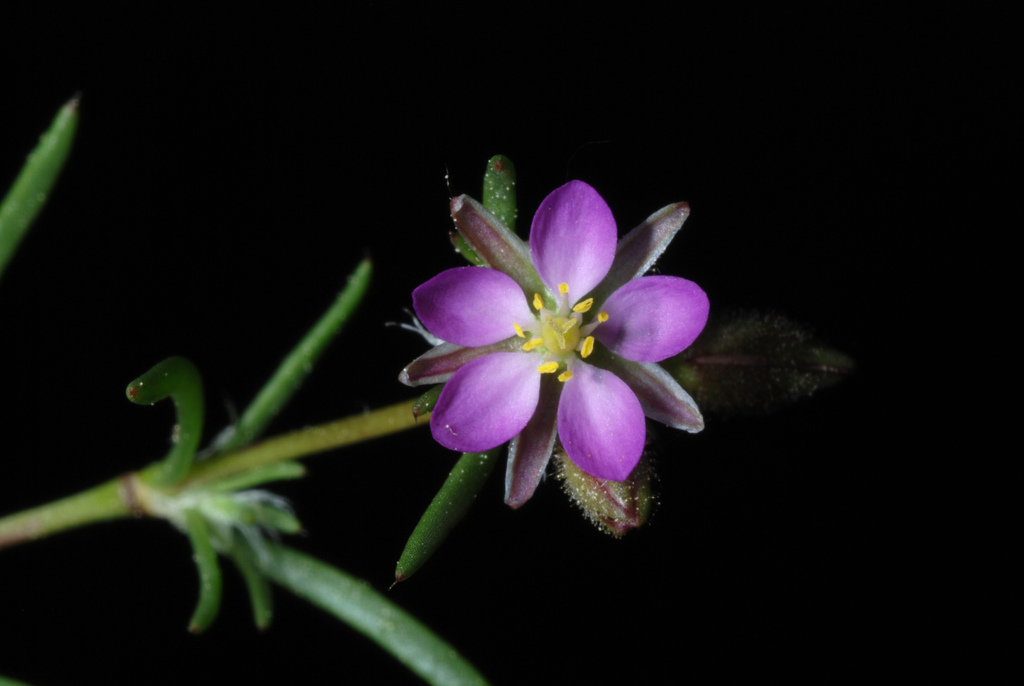
(c) Douglas Goldman, some rights reserved (CC BY-SA), uploaded by Douglas Goldman · licence
Family: Caryophyllaceae · Type: Herb · Not Native
Spergularia rubra (Red sand-spurrey) is a non-native California herb in the Caryophyllaceae family, recognized by pink flowers and shiny white stipules diagnostic.
Red sand-spurrey is a naturalized perennial herb found in northwestern California, northern and central Sierra Nevada, central Valley, central and southern coastal regions, and desert mountains in open forests, gravelly glades, meadows, and disturbed areas at elevations below 2,400 meters. Flowering from spring to fall, this delicate plant produces pink flowers with white-tipped lanceolate stipules and glandular-hairy inflorescences. Growing with slender stems less than 0.5 millimeters in diameter, it forms low, spreading clusters with barely fleshy leaves. Its leaves grow in small clusters of two to four per axil, with conspicuous white, shiny stipules that have long-pointed tips. The small fruits measure 3.5 to 5 millimeters long, containing reddish-brown seeds with a distinctive worm-like surface texture.
Identification and appearance
Key characters: 10 sympatric species; pink flowers and shiny white stipules diagnostic
Habitat and range
Habitat: Open forest, gravelly glades, meadows, mud flats, disturbed areas
Elevation: < 2400 m
California counties: Fresno, San Luis Obispo, San Diego, Amador, Tuolumne, Riverside, Orange, Los Angeles, San Bernardino, Santa Barbara, Kern, Santa Cruz, Santa Clara, Butte, Contra Costa, Humboldt, Lake, Marin, Mendocino, Modoc, Mono, Nevada, Plumas, San Francisco, Shasta, Siskiyou, Sonoma, Tehama, Tulare, San Joaquin, Placer, Alpine, Monterey, San Mateo, El Dorado, Yuba, Calaveras, Glenn, Lassen, Madera, Napa, Solano, Sutter, Trinity, Ventura, Mariposa, Sierra, Sacramento, Alameda, Del Norte, Inyo, Yolo, Merced
Outside California: to Yukon Territory, Montana, Colorado, New Mexico, eastern North America, South America, native to Mediterranean, Asia
Bloom period
Spergularia rubra blooms Spring-fall.
How to tell it apart
vs Spergula: Spergularia has simple opposite leaves at nodes; Spergula has whorl-like clusters of 16-30 leaves per node.; vs Erodium: Spergularia has tiny pink/white flowers with round capsules; Erodium has purple flowers with long-beaked stork's-bill fruits.; vs Sabulina: Spergularia has fleshy leaves and triangular stipules; Sabulina has thread-like leaves without stipules.; vs Cakile: Spergularia has opposite fleshy leaves with pink flowers; Cakile has alternate fleshy leaves with 4-petaled mustard flowers.; vs Calandrinia: Spergularia has 5 tiny petals and triangular stipules; Calandrinia has 3-7 showy petals and no stipules.
Frequently asked questions
Is Spergularia rubra native to California?
No. Spergularia rubra is not native to California (recorded as not native).
When does Spergularia rubra bloom?
Spergularia rubra blooms Spring-fall.
Where in California does Spergularia rubra grow?
Spergularia rubra occurs in Fresno, San Luis Obispo, San Diego, Amador, Tuolumne, Riverside, Orange, Los Angeles and other counties, at elevations of < 2400 m.
What plant family does Spergularia rubra belong to?
Spergularia rubra is in the Caryophyllaceae family, genus Spergularia.
What habitat does Spergularia rubra grow in?
Spergularia rubra grows in Open forest, gravelly glades, meadows, mud flats, disturbed areas.
Related species
Other California species in the same genus, family, or bioregion.
- Spergularia sp. — Sand-spurrey
- Spergularia villosa — Hairy sand-spurrey
- Spergularia atrosperma — Black seed sand-spurrey
- Spergularia bocconi — Boccone's sand-spurrey
- Spergularia canadensis var. occidentalis — Western sand-spurrey
- Spergularia macrotheca — Sticky sand-spurrey
- Stellaria borealis subsp. sitchana — Sitka starwort
- Stellaria calycantha — Northern starwort
Sources: Jepson eFlora · Index of California Plant Names · CalPhotos
Last updated 2026-10-07
Data from The California Species Project — 14,000+ California species with verified data from CNPS, CDFW, USFWS, Cal-IPC, and more.