Sphaeralcea grossulariifolia
Gooseberry-leaved globemallow
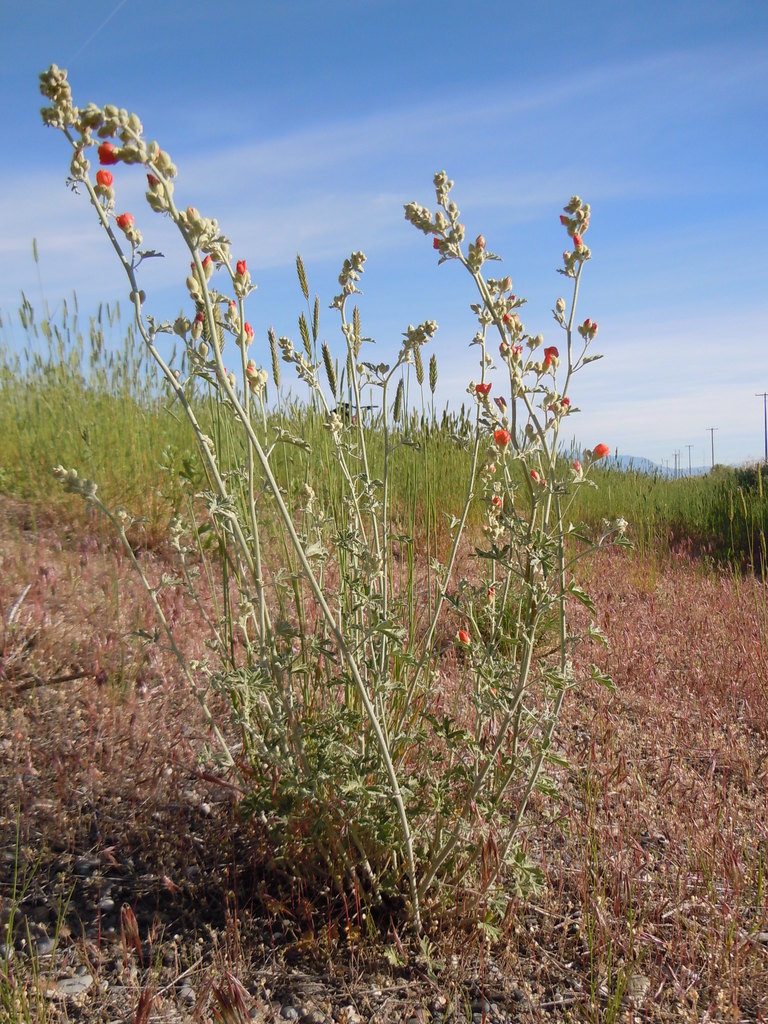
(c) Matt Lavin, some rights reserved (CC BY-SA) · licence
Family: Malvaceae · Type: Subshrub · Native
Conservation status: CNPS 2B.3
Sphaeralcea grossulariifolia (Gooseberry-leaved globemallow) is a native California subshrub in the Malvaceae family, recognized by distinctive deeply lobed leaves.
Gooseberry-leaved globemallow is a rare (CNPS 2B.3) California native shrub found in southeastern Modoc Plateau in Lassen County on dry, volcanic soils at elevations below 1,700 meters. Flowering from May to June, this plant produces vibrant red-orange flowers approximately 11 millimeters long with yellow anthers. Growing with erect white-canescent stems 60 to 100 centimeters tall that have a woody base, it develops a distinctive branching structure. Its leaves have distinctive three-lobed blades 17 to 35 millimeters long, colored green to gray-green with a cordate base and deeply divided lobes that can be rounded or pointed. The fruit develops in segments 2.5 millimeters wide, with each segment containing a single gray seed.
Identification and appearance
Key characters: Geographically isolated; distinctive deeply lobed leaves
Habitat and range
Habitat: Dry, volcanic soils
Elevation: < 1700 m
California counties: Mono, Lassen, Santa Barbara, Los Angeles
Outside California: to Washington, Idaho, Utah
Bloom period
Sphaeralcea grossulariifolia blooms May-Jun.
Conservation status
CNPS 2B.3
How to tell it apart
vs Malacothamnus: Sphaeralcea flowers face outward in open panicles; Malacothamnus flowers are tucked closer to stems in denser clusters.; vs Abutilon: Sphaeralcea has 1-3 small bracts (even if fallen); Abutilon completely lacks any bracts beneath flowers.; vs Malva: Sphaeralcea has salmon-orange flowers and net-veined fruit base; Malva has pink-purple flowers and smooth fruits throughout.; vs Hibiscus: Sphaeralcea has small flowers and inconspicuous bracts; Hibiscus has very large flowers and prominent persistent bracts.; vs Eriogonum: Sphaeralcea has typical mallow flowers with fused stamen column; Eriogonum has tiny flowers in heads with papery bracts.
Frequently asked questions
Is Sphaeralcea grossulariifolia native to California?
Yes. Sphaeralcea grossulariifolia is native to California (recorded as native).
When does Sphaeralcea grossulariifolia bloom?
Sphaeralcea grossulariifolia blooms May-Jun.
Where in California does Sphaeralcea grossulariifolia grow?
Sphaeralcea grossulariifolia occurs in Mono, Lassen, Santa Barbara, Los Angeles, at elevations of < 1700 m.
What plant family does Sphaeralcea grossulariifolia belong to?
Sphaeralcea grossulariifolia is in the Malvaceae family, genus Sphaeralcea.
Is Sphaeralcea grossulariifolia rare or endangered?
Sphaeralcea grossulariifolia carries California Rare Plant Rank 2B.3, state rank S2.
Related species
Other California species in the same genus, family, or bioregion.
Sources: Jepson eFlora · CNPS Rare Plant Inventory · Index of California Plant Names · CalPhotos · CDFW CNDDB
Last updated 2026-10-07
Data from The California Species Project — 14,000+ California species with verified data from CNPS, CDFW, USFWS, Cal-IPC, and more.