Sporobolus airoides
Alkali sacaton
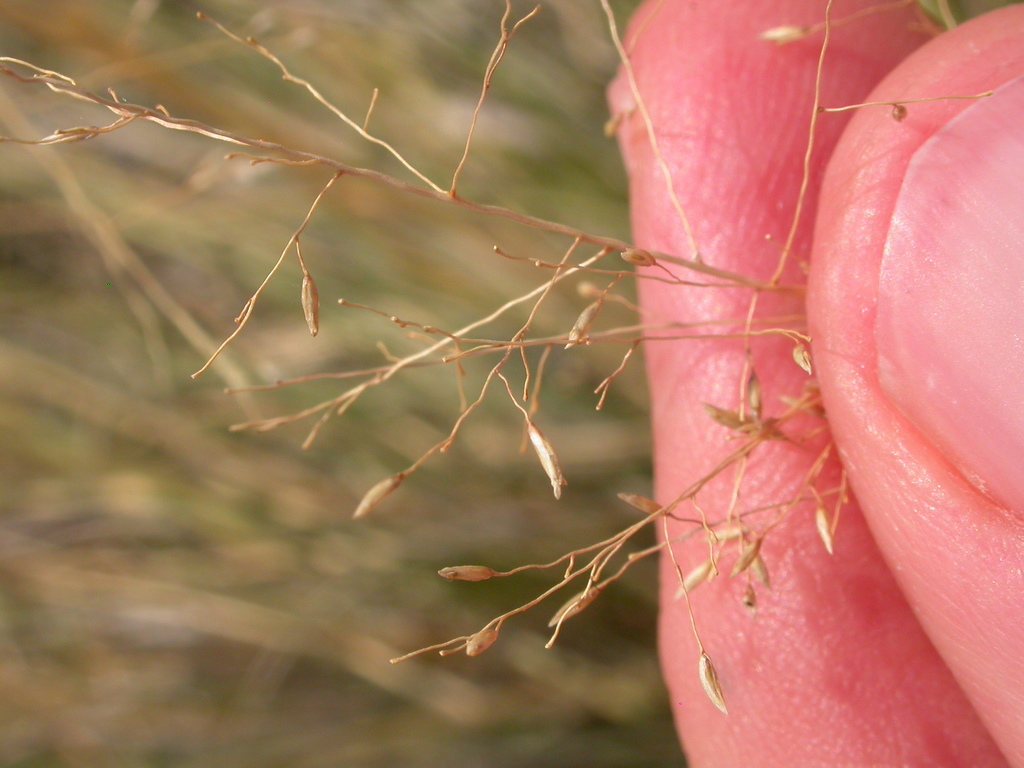
(c) Matt Lavin, some rights reserved (CC BY-SA) · licence
Family: Poaceae · Type: Grass · Native
Sporobolus airoides (Alkali sacaton) is a native California grass in the Poaceae family, recognized by pyramid inflorescence, shiny leaf bases, small spikelets.
Alkali sacaton is a California native perennial grass found in the Sierra Nevada Foothills, southern San Joaquin Valley, southwestern California, Great Basin, and desert regions in seasonally moist, alkaline areas at elevations below 2,100 meters. Flowering from April to October, this grass produces green to purple spikelets in a widely spreading, pyramid-shaped inflorescence. Growing in dense tufts with erect stems 30 to 100 centimeters tall, it features shiny, straw-colored leaf bases and narrow blades 10 to 40 centimeters long. Its leaves have a distinctive glabrous or sparsely hairy collar with tiny fringe hairs up to 2 millimeters long. The fruit is a small ellipsoid seed 1 to 1.4 millimeters long, reddish-brown with fine striations.
Identification and appearance
Key characters: 10 sympatric species; key features are pyramid inflorescence, shiny leaf bases, small spikelets
Habitat and range
Habitat: Seasonally moist, alkaline areas
Elevation: < 2100 m
California counties: San Bernardino, Inyo, Orange, Mono, Kern, Riverside, San Joaquin, Los Angeles, San Diego, Tulare, Imperial, Ventura, Alameda, Santa Barbara, Merced, San Luis Obispo, Amador, Fresno, Stanislaus, Marin, Lassen, Contra Costa, Sacramento, Solano, Madera, Yolo, Kings
Outside California: to British Columbia, central and southern United States, northern and central Mexico
Bloom period
Sporobolus airoides blooms Apr-Oct.
How to tell it apart
vs Typha: Typha (cattails) has thick, sausage-like brown flower spikes and wide strap-like leaves, not grass flowers.; vs Distichlis: Distichlis forms stiff colonies in salt marshes with distinctly two-ranked leaves, lacking ciliate sheaths.; vs Muhlenbergia: Sporobolus has fringed hairs on leaf sheath margins; Muhlenbergia sheaths are smooth.; vs Leymus: Leymus has spike-like inflorescences with spikelets in pairs, not the open panicles of Sporobolus.; vs Oloptum: Oloptum has prominent bent awns and plumose hairs; Sporobolus is awnless with ciliate sheaths.
Frequently asked questions
Is Sporobolus airoides native to California?
Yes. Sporobolus airoides is native to California (recorded as native).
When does Sporobolus airoides bloom?
Sporobolus airoides blooms Apr-Oct.
Where in California does Sporobolus airoides grow?
Sporobolus airoides occurs in San Bernardino, Inyo, Orange, Mono, Kern, Riverside, San Joaquin, Los Angeles and other counties, at elevations of < 2100 m.
What plant family does Sporobolus airoides belong to?
Sporobolus airoides is in the Poaceae family, genus Sporobolus.
What habitat does Sporobolus airoides grow in?
Sporobolus airoides grows in Seasonally moist, alkaline areas.
Related species
Other California species in the same genus, family, or bioregion.
Sources: Jepson eFlora · Index of California Plant Names · CalPhotos
Last updated 2026-10-07
Data from The California Species Project — 14,000+ California species with verified data from CNPS, CDFW, USFWS, Cal-IPC, and more.