Sporobolus alopecuroides
Foxtail prickle grass
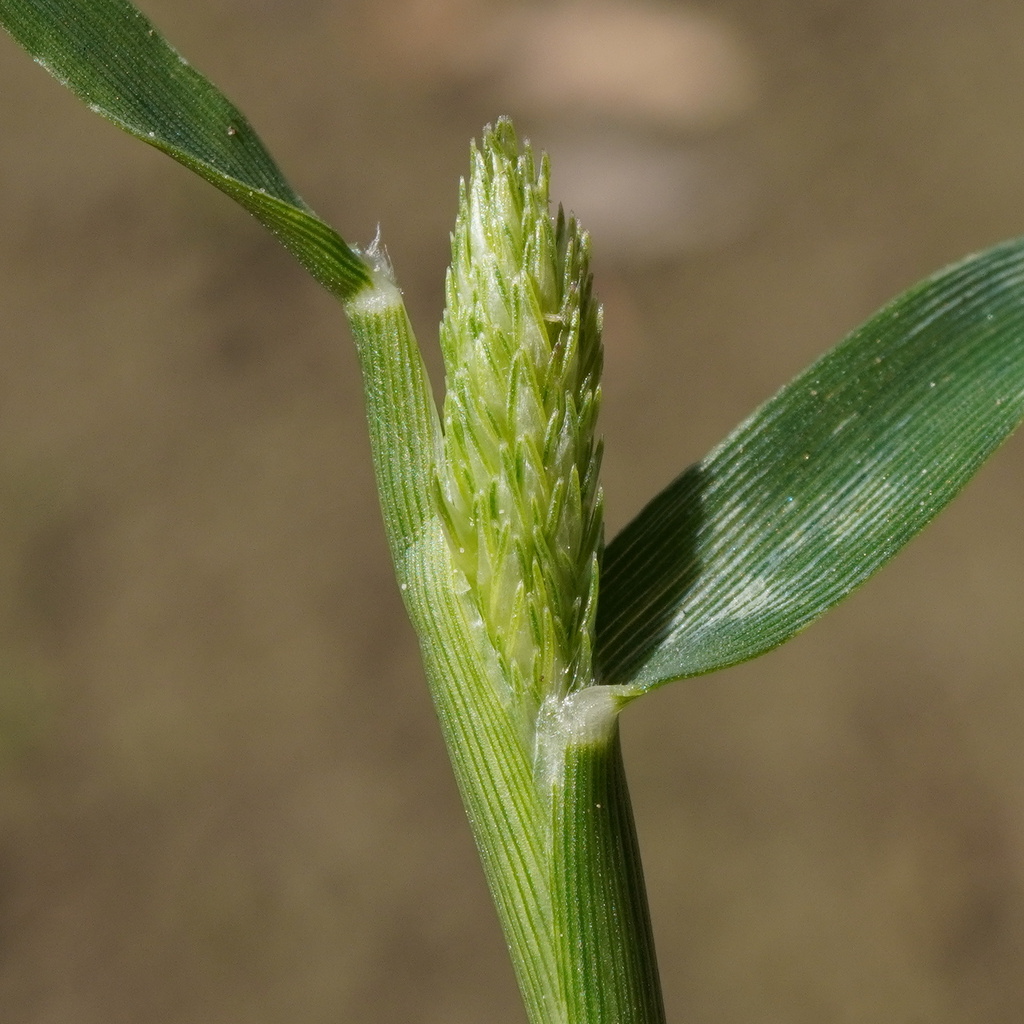
(c) Patrick Hacker, some rights reserved (CC BY) · licence
Family: Poaceae · Type: Grass · Not Native
Sporobolus alopecuroides (Foxtail prickle grass) is a non-native California grass in the Poaceae family, recognized by narrow exserted inflorescence and purple-black plant color.
Foxtail prickle grass is a naturalized annual grass found in northern California bioregions including the Klamath Ranges, northern Sierra Nevada, and coastal counties, typically growing in bottomland and river margins at elevations below 1,700 meters. Flowering from June to September, this grass produces green to purple-black inflorescences with cylindric spikes 15 to 65 millimeters long. Growing with ascending stems 5 to 75 centimeters tall and few branches, the plant has a distinctive purple to black coloration. Its leaf blades extend 5 to 12 centimeters, appearing green or slightly bluish-gray, with smooth sheath margins. The grass produces small spikelet structures 1.8 to 2.5 millimeters long, with hairy glume keels and delicate anthers.
Identification and appearance
Key characters: 12 sympatric species; key features are narrow exserted inflorescence and purple-black plant color
Habitat and range
Habitat: Bottomland, reservoir and river margins
Elevation: < 1700 m
California counties: Glenn, Butte, Mendocino, Plumas, Tehama, Kern, Del Norte, Marin, Alpine, Yuba, Modoc, Colusa, Placer, Mono, Shasta, Yolo
Outside California: western United States, Pennsylvania, native to Europe
Bloom period
Sporobolus alopecuroides blooms Jun-Sep.
How to tell it apart
vs Typha: Typha (cattails) has thick, sausage-like brown flower spikes and wide strap-like leaves, not grass flowers.; vs Distichlis: Distichlis forms stiff colonies in salt marshes with distinctly two-ranked leaves, lacking ciliate sheaths.; vs Muhlenbergia: Sporobolus has fringed hairs on leaf sheath margins; Muhlenbergia sheaths are smooth.; vs Leymus: Leymus has spike-like inflorescences with spikelets in pairs, not the open panicles of Sporobolus.; vs Oloptum: Oloptum has prominent bent awns and plumose hairs; Sporobolus is awnless with ciliate sheaths.
Frequently asked questions
Is Sporobolus alopecuroides native to California?
No. Sporobolus alopecuroides is not native to California (recorded as not native).
When does Sporobolus alopecuroides bloom?
Sporobolus alopecuroides blooms Jun-Sep.
Where in California does Sporobolus alopecuroides grow?
Sporobolus alopecuroides occurs in Glenn, Butte, Mendocino, Plumas, Tehama, Kern, Del Norte, Marin and other counties, at elevations of < 1700 m.
What plant family does Sporobolus alopecuroides belong to?
Sporobolus alopecuroides is in the Poaceae family, genus Sporobolus.
What habitat does Sporobolus alopecuroides grow in?
Sporobolus alopecuroides grows in Bottomland, reservoir and river margins.
Related species
Other California species in the same genus, family, or bioregion.
Sources: Jepson eFlora · Index of California Plant Names · CalPhotos
Last updated 2026-10-07
Data from The California Species Project — 14,000+ California species with verified data from CNPS, CDFW, USFWS, Cal-IPC, and more.