Sporobolus hookerianus
Alkali cord grass
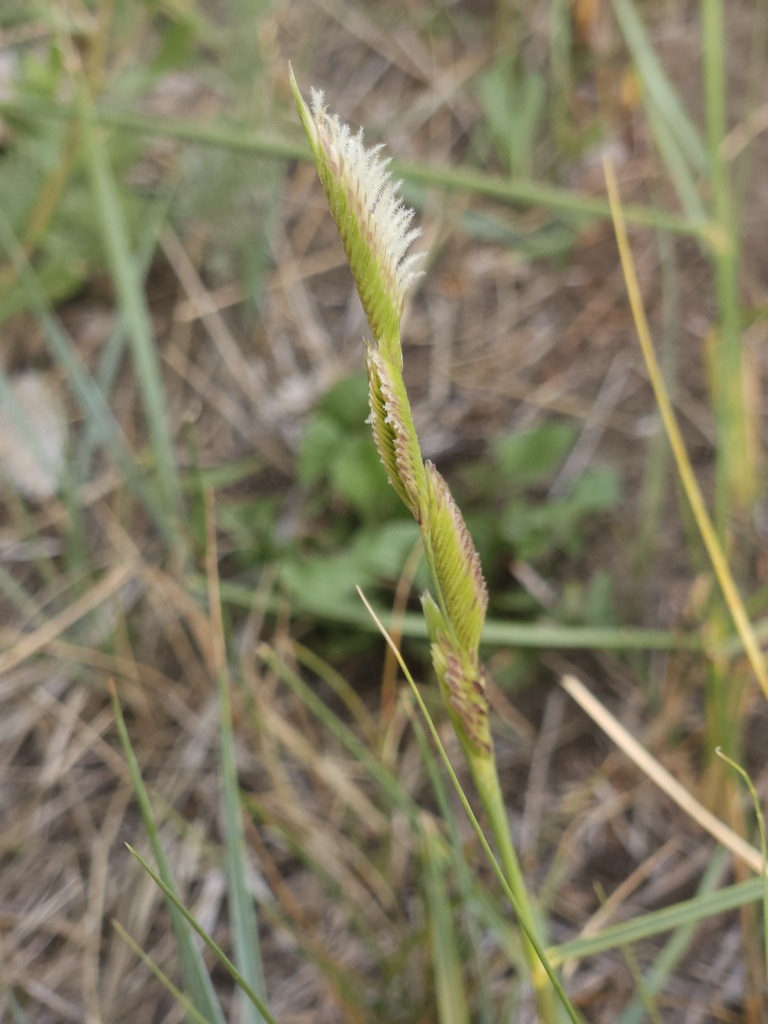
(c) Solomiya, some rights reserved (CC BY), uploaded by Solomiya · licence
Family: Poaceae · Type: Grass · Native
Conservation status: CNPS 4.2
Sporobolus hookerianus (Alkali cord grass) is a native California grass in the Poaceae family, recognized by high elevation, separated lower branches, ciliate keels.
Alkali cord grass is a native perennial found in the northern Mojave Desert and eastern Sierra Nevada in alkaline lake shores, streambanks, meadows, and marshes at elevations of 1,000 to 2,100 meters. Flowering from June to August, this grass produces delicate, compact inflorescences 4 to 25 centimeters long with overlapping branches. Growing with slender stems 1.8 to 10 decimeters tall and a thin rhizomatous base, it forms dense clumps in wet, alkaline environments. Its leaf blades are 15 to 27 centimeters long, typically inrolled when fresh, with approximately five ridges per millimeter on the upper surface. The grass produces small spikelets 6 to 11 millimeters long, with ciliate glume and lemma keels featuring fine hairs near the tips.
Identification and appearance
Key characters: 6 sympatric species; key features are high elevation, separated lower branches, ciliate keels
Habitat and range
Habitat: Alkaline lake shores, streambanks, meadows, marshes
Elevation: 1000-2100 m
California counties: Inyo, Mono, San Diego, Siskiyou, Modoc
Outside California: to northern and eastern Canada, Kansas, New Mexico
Bloom period
Sporobolus hookerianus blooms Jun-Aug.
Conservation status
CNPS 4.2
How to tell it apart
vs Typha: Typha (cattails) has thick, sausage-like brown flower spikes and wide strap-like leaves, not grass flowers.; vs Distichlis: Distichlis forms stiff colonies in salt marshes with distinctly two-ranked leaves, lacking ciliate sheaths.; vs Muhlenbergia: Sporobolus has fringed hairs on leaf sheath margins; Muhlenbergia sheaths are smooth.; vs Leymus: Leymus has spike-like inflorescences with spikelets in pairs, not the open panicles of Sporobolus.; vs Oloptum: Oloptum has prominent bent awns and plumose hairs; Sporobolus is awnless with ciliate sheaths.
Frequently asked questions
Is Sporobolus hookerianus native to California?
Yes. Sporobolus hookerianus is native to California (recorded as native).
When does Sporobolus hookerianus bloom?
Sporobolus hookerianus blooms Jun-Aug.
Where in California does Sporobolus hookerianus grow?
Sporobolus hookerianus occurs in Inyo, Mono, San Diego, Siskiyou, Modoc, at elevations of 1000-2100 m.
What plant family does Sporobolus hookerianus belong to?
Sporobolus hookerianus is in the Poaceae family, genus Sporobolus.
Is Sporobolus hookerianus rare or endangered?
Sporobolus hookerianus carries California Rare Plant Rank 4.2, state rank S3.
Related species
Other California species in the same genus, family, or bioregion.
Sources: Jepson eFlora · CNPS Rare Plant Inventory · Index of California Plant Names · CalPhotos · CDFW CNDDB
Last updated 2026-10-07
Data from The California Species Project — 14,000+ California species with verified data from CNPS, CDFW, USFWS, Cal-IPC, and more.