Sporobolus niliacus
Modest prickle grass, Modest Prickle Grass
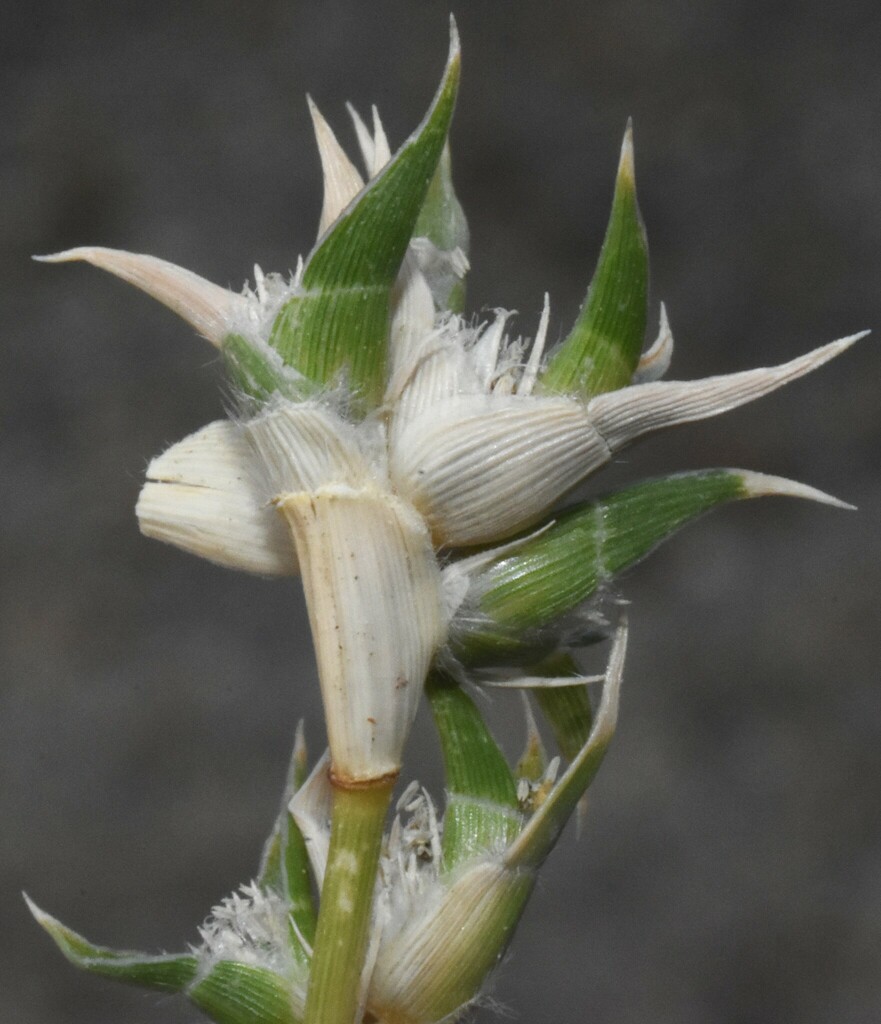
(c) Gabriel Campbell-Martinez, some rights reserved (CC BY), uploaded by Gabriel Campbell-Martinez · licence
Family: Poaceae · Type: Grass · Not Native
Sporobolus niliacus (Modest prickle grass) is a non-native California grass in the Poaceae family, recognized by green color, short brittle leaves, hairy sheath margins.
Modest prickle grass is a naturalized annual grass found in northern California regions including the Coast Ranges, Cascade Range, northern Sierra Nevada foothills, Central Valley, southern Coast Ranges, southwestern California, and Mojave Province in wet soils, lake margins, and vernal pools at elevations below 1,280 meters. Flowering from June to September, this grass produces small greenish spikelets in compact ovoid clusters 3 to 15 millimeters long. Growing as a low, prostrate plant generally forming mat-like patches, it spreads with multiple branches less than 30 centimeters long. Its leaves are rigid and short, measuring 1 to 5 centimeters long, with distinctive hairy sheath margins that break easily. The plant features nearly equal glumes and lemmas, with tiny anthers measuring 0.5 to 0.9 millimeters long.
Identification and appearance
Key characters: 7 sympatric species; key features are green color, short brittle leaves, hairy sheath margins
Habitat and range
Habitat: Wet soils, lake margins, vernal pools
Elevation: < 1280 m
California counties: Butte, Colusa, Contra Costa, Lake, Los Angeles, Merced, Riverside, San Diego, San Joaquin, San Luis Obispo, Santa Clara, Solano, Stanislaus, Fresno, Lassen, Siskiyou, Ventura, Modoc, Sutter, Sacramento, Mendocino, Marin, El Dorado, Kern, Plumas, Sonoma, Tehama, Alameda, Glenn, Yuba, Humboldt, Shasta, San Benito, Napa, San Mateo, Monterey, Amador, Yolo, Santa Cruz, Santa Barbara
Outside California: Oregon, Idaho, native to Eurasia
Bloom period
Sporobolus niliacus blooms Jun-Sep.
How to tell it apart
vs Typha: Typha (cattails) has thick, sausage-like brown flower spikes and wide strap-like leaves, not grass flowers.; vs Distichlis: Distichlis forms stiff colonies in salt marshes with distinctly two-ranked leaves, lacking ciliate sheaths.; vs Muhlenbergia: Sporobolus has fringed hairs on leaf sheath margins; Muhlenbergia sheaths are smooth.; vs Leymus: Leymus has spike-like inflorescences with spikelets in pairs, not the open panicles of Sporobolus.; vs Oloptum: Oloptum has prominent bent awns and plumose hairs; Sporobolus is awnless with ciliate sheaths.
Frequently asked questions
Is Sporobolus niliacus native to California?
No. Sporobolus niliacus is not native to California (recorded as not native).
When does Sporobolus niliacus bloom?
Sporobolus niliacus blooms Jun-Sep.
Where in California does Sporobolus niliacus grow?
Sporobolus niliacus occurs in Butte, Colusa, Contra Costa, Lake, Los Angeles, Merced, Riverside, San Diego and other counties, at elevations of < 1280 m.
What plant family does Sporobolus niliacus belong to?
Sporobolus niliacus is in the Poaceae family, genus Sporobolus.
What habitat does Sporobolus niliacus grow in?
Sporobolus niliacus grows in Wet soils, lake margins, vernal pools.
Related species
Other California species in the same genus, family, or bioregion.
Sources: Jepson eFlora · Index of California Plant Names · CalPhotos
Last updated 2026-10-07
Data from The California Species Project — 14,000+ California species with verified data from CNPS, CDFW, USFWS, Cal-IPC, and more.