Stanleya pinnata var. pinnata
Desert princesplume
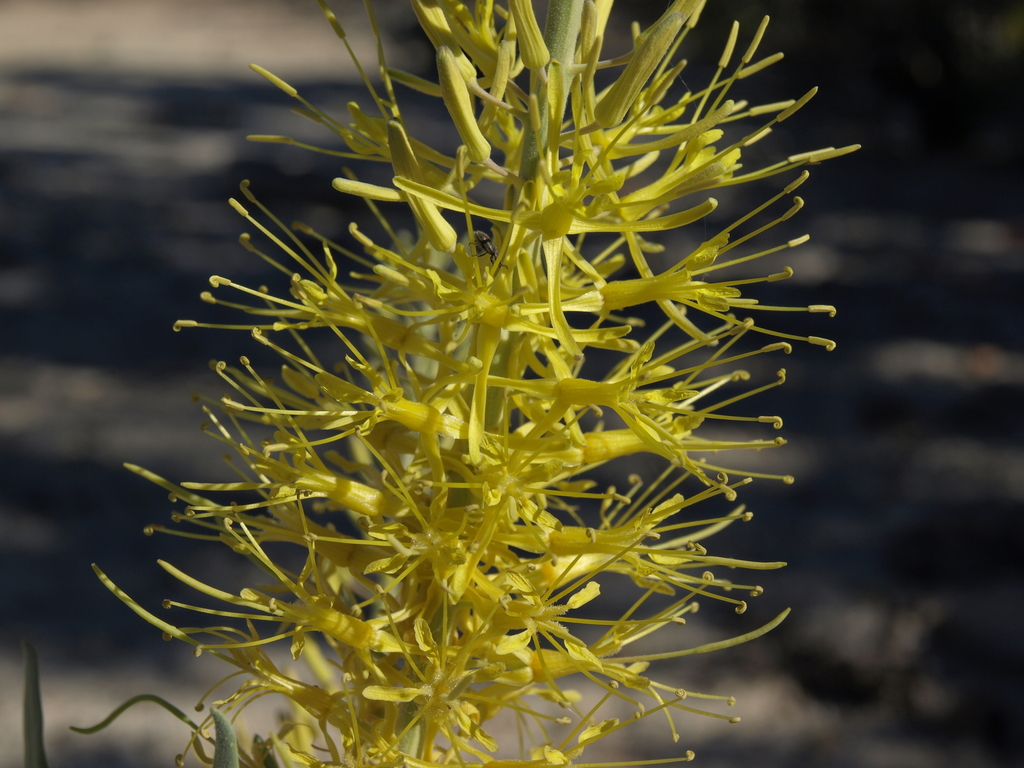
(c) Jim Morefield, some rights reserved (CC BY) · licence
Family: Brassicaceae · Type: Subshrub · Native
Stanleya pinnata var. pinnata (Desert princesplume) is a native California subshrub in the Brassicaceae family, recognized by . Pinnately lobed leaves are diagnostic vs entire leaves of other species.
Desert princesplume is a California native perennial found in southern Sierra Nevada foothills, San Joaquin Valley, South Coast Ranges, southern California, western Transverse Ranges, San Gabriel Mountains, Peninsular Ranges, Great Basin, and Mojave Desert regions in chaparral, open sites, slopes, canyons, desert scrub, woodland, and dunes at elevations up to 2,900 meters. Flowering from April to September, this plant produces bright yellow flowers 8 to 20 millimeters long with distinctive densely hairy petal claws. Growing 1.2 to 4 meters tall with a woody, branched base and glaucous stems, it develops a robust and striking appearance. Its leaves are primarily pinnately lobed, with basal and lower cauline leaves 3 to 15 centimeters long, ranging from oblanceolate to wide-lanceolate in shape. The fruit develops 3 to 9 centimeters long, containing 28 to 38 oblong seeds, each 2.5 to 4.5 millimeters in length.
Identification and appearance
Key characters: 2 sympatric species. Pinnately lobed leaves are diagnostic vs entire leaves of other species
Habitat and range
Habitat: Chaparral, open sites, slopes, canyons, desert scrub, woodland, dunes
Elevation: < 2900 m
California counties: San Bernardino, Inyo, Kern, Los Angeles, Mono, Riverside, San Luis Obispo, Lassen, Kings, Santa Barbara, Ventura, San Diego
Outside California: to Oregon, Montana, Kansas, New Mexico
Bloom period
Stanleya pinnata var. pinnata blooms Apr-Sep.
How to tell it apart
vs Thelypodium: Flower stalks are dramatically longer (quarter-inch plus) versus barely visible in Thelypodium.; vs Caulanthus: Petals are large (over 1 inch) and yellow-white versus smaller and purple-white in Caulanthus.; vs Barbarea: Tall desert perennial with bottlebrush flower spikes versus streambank plant with angular stems.; vs Rorippa: Large showy flowers on long stalks versus tiny flowers on short stalks in wet habitats.; vs Conringia: Dramatic bottlebrush flower spikes versus compact flower clusters with clasping leaves.
Frequently asked questions
Is Stanleya pinnata var. pinnata native to California?
Yes. Stanleya pinnata var. pinnata is native to California (recorded as native).
When does Stanleya pinnata var. pinnata bloom?
Stanleya pinnata var. pinnata blooms Apr-Sep.
Where in California does Stanleya pinnata var. pinnata grow?
Stanleya pinnata var. pinnata occurs in San Bernardino, Inyo, Kern, Los Angeles, Mono, Riverside, San Luis Obispo, Lassen and other counties, at elevations of < 2900 m.
What plant family does Stanleya pinnata var. pinnata belong to?
Stanleya pinnata var. pinnata is in the Brassicaceae family, genus Stanleya.
What habitat does Stanleya pinnata var. pinnata grow in?
Stanleya pinnata var. pinnata grows in Chaparral, open sites, slopes, canyons, desert scrub, woodland, dunes.
Related species
Other California species in the same genus, family, or bioregion.
Sources: Jepson eFlora · Index of California Plant Names · CalPhotos
Last updated 2026-10-07
Data from The California Species Project — 14,000+ California species with verified data from CNPS, CDFW, USFWS, Cal-IPC, and more.