Stanleya viridiflora
Green-flowered prince's plume
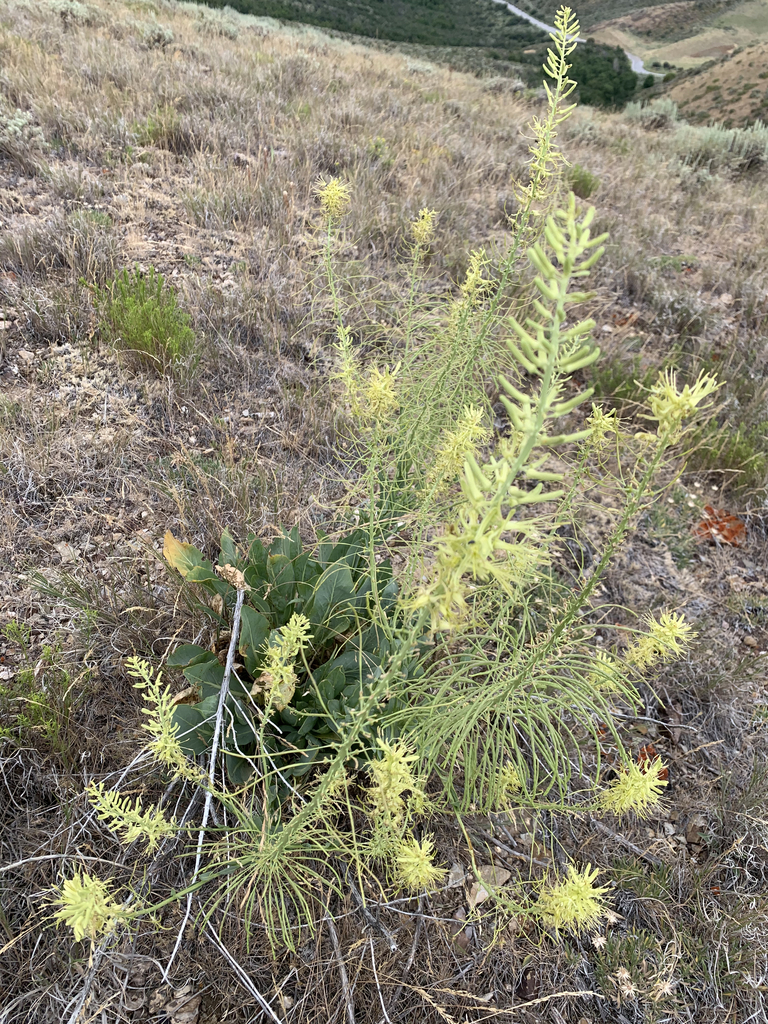
(c) mark-groeneveld, some rights reserved (CC BY) · licence
Family: Brassicaceae · Type: Herb · Native
Conservation status: CNPS 2B.3
Stanleya viridiflora (Green-flowered prince's plume) is a native California herb in the Brassicaceae family, recognized by but geographically separated in different regions. Sagittate leaf bases are distinctive.
Green-flowered prince's plume is a rare (CNPS 2B.3) California native perennial found in southern Modoc Plateau in steep habitats including cliffs, shale, clay knolls, and white ash deposits at elevations of 1,300 to 2,700 meters. Flowering from May to July, this plant produces lemon-yellow to white flowers on slender stems 13 to 48 centimeters tall. Growing with glaucous, glabrous stems that are simple or branched toward the top, it forms an elegant upright structure. Its basal leaves are large and distinctive, ranging from 5 to 18 centimeters long, varying from lanceolate to oblanceolate with entire or occasionally toothed edges. The fruit develops as an elongated pod 3 to 6 centimeters long, containing 28 to 50 small oblong seeds.
Identification and appearance
Key characters: 1 sympatric species but geographically separated in different regions. Sagittate leaf bases are distinctive
Habitat and range
Habitat: Cliffs, shale, clay knolls, steep bluffs, white ash deposits
Elevation: 1300-2700 m
Outside California: to Idaho, Montana, Colorado, Utah
Bloom period
Stanleya viridiflora blooms May-Jul.
Conservation status
CNPS 2B.3
How to tell it apart
vs Thelypodium: Flower stalks are dramatically longer (quarter-inch plus) versus barely visible in Thelypodium.; vs Caulanthus: Petals are large (over 1 inch) and yellow-white versus smaller and purple-white in Caulanthus.; vs Barbarea: Tall desert perennial with bottlebrush flower spikes versus streambank plant with angular stems.; vs Rorippa: Large showy flowers on long stalks versus tiny flowers on short stalks in wet habitats.; vs Conringia: Dramatic bottlebrush flower spikes versus compact flower clusters with clasping leaves.
Frequently asked questions
Is Stanleya viridiflora native to California?
Yes. Stanleya viridiflora is native to California (recorded as native).
When does Stanleya viridiflora bloom?
Stanleya viridiflora blooms May-Jul.
What plant family does Stanleya viridiflora belong to?
Stanleya viridiflora is in the Brassicaceae family, genus Stanleya.
Is Stanleya viridiflora rare or endangered?
Stanleya viridiflora carries California Rare Plant Rank 2B.3, state rank S2?.
What habitat does Stanleya viridiflora grow in?
Stanleya viridiflora grows in Cliffs, shale, clay knolls, steep bluffs, white ash deposits.
Related species
Other California species in the same genus, family, or bioregion.
- Stanleya elata — Panamint princesplume
- Stanleya pinnata var. pinnata — Desert princesplume
- Stanleya sp. — Prince's plume
- Streptanthella longirostris — Long beaked twist flower
- Streptanthella sp.
- Streptanthus albidus ssp. peramoenus — most beautiful jewelflower
- Streptanthus anomalus — Mount burdell jewelflower
Sources: Jepson eFlora · CalPhotos · CDFW CNDDB
Last updated 2026-10-07
Data from The California Species Project — 14,000+ California species with verified data from CNPS, CDFW, USFWS, Cal-IPC, and more.