Stebbinsoseris heterocarpa
Grassland silverpuffs, Grassland Silverpuffs
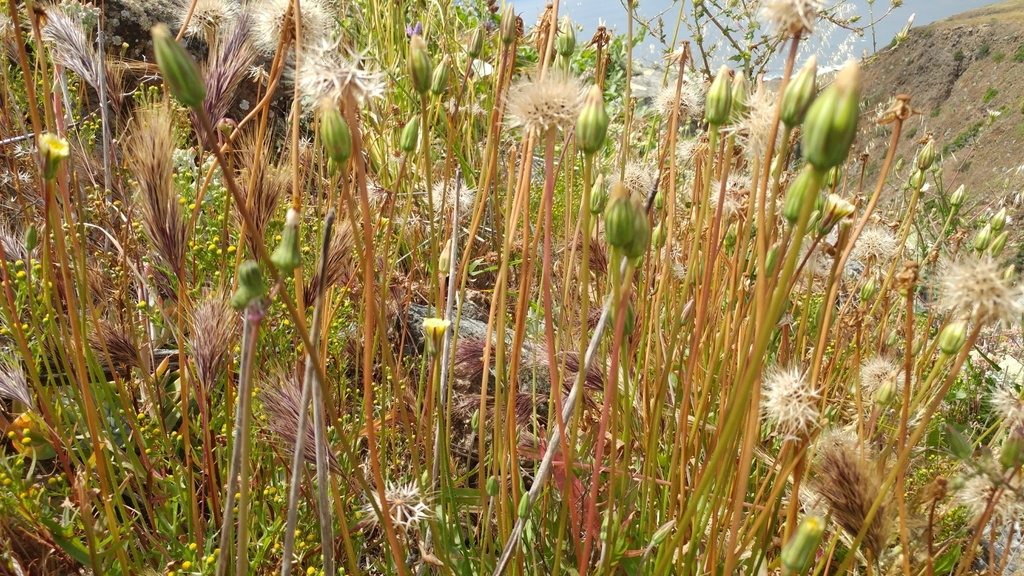
(c) Casey H. Richart, some rights reserved (CC BY) · licence
Family: Asteraceae · Type: Herb · Native
Stebbinsoseris heterocarpa (Grassland silverpuffs) is a native California herb in the Asteraceae family.
Grassland silverpuffs is a California native annual found in the North Coast Ranges, Sierra Nevada Foothills, Central Valley, Central Western California, Southern California Coast, Channel Islands, Western Transverse Ranges, and Peninsular Ranges in open, sometimes disturbed sites with rocky to clay soils at elevations below 1,700 meters. Flowering from April to June, this plant produces yellow or white ray flowers in delicate heads 6 to 30 millimeters long. Growing with slender stems 8 to 60 centimeters tall, it spreads across open landscapes with a graceful, airy structure. Its leaves reach 5 to 35 centimeters long, varying from basal to cauline with a delicate, spreading arrangement. The fruit features a distinctive pappus with scales that can be shorter or longer than the fruit itself, topped with a 3 to 8 millimeter bristle arising from a notched scale tip.
Identification and appearance
Key characters: 0 sympatric species; geographically isolated to inland regions with wide distribution
Habitat and range
Habitat: Open, sometimes disturbed sites, rocky to clay soils, generally inland except SCo
Elevation: < 1700 m
California counties: Orange, San Luis Obispo, Santa Barbara, Alameda, Los Angeles, Contra Costa, Kern, San Diego, Ventura, Riverside, Butte, Colusa, Sacramento, San Benito, San Bernardino, San Joaquin, San Mateo, Sonoma, Yolo, Marin, Monterey, Santa Clara, Merced, Napa, Santa Cruz, Stanislaus, Amador, Madera, San Francisco, Solano, Fresno
Outside California: northern Mexico, southeastern Arizona
Bloom period
Stebbinsoseris heterocarpa blooms Apr-Jun.
How to tell it apart
vs Uropappus: Count the pappus scales - Uropappus always has exactly 5 silvery scales, Stebbinsoseris has more than 5.; vs Microseris: Check buds - Microseris buds nod downward, Stebbinsoseris buds stay erect.; vs Tragopogon: Tragopogon is much larger with grass-like leaves and huge seed heads like giant dandelions.; vs Agoseris: Agoseris has simple bristle pappus (like dandelions), not the notched silvery scales of Stebbinsoseris.; vs Chaetadelpha: Chaetadelpha has spine-tipped phyllaries and grows in desert washes, not grasslands.
Frequently asked questions
Is Stebbinsoseris heterocarpa native to California?
Yes. Stebbinsoseris heterocarpa is native to California (recorded as native).
When does Stebbinsoseris heterocarpa bloom?
Stebbinsoseris heterocarpa blooms Apr-Jun.
Where in California does Stebbinsoseris heterocarpa grow?
Stebbinsoseris heterocarpa occurs in Orange, San Luis Obispo, Santa Barbara, Alameda, Los Angeles, Contra Costa, Kern, San Diego and other counties, at elevations of < 1700 m.
What plant family does Stebbinsoseris heterocarpa belong to?
Stebbinsoseris heterocarpa is in the Asteraceae family, genus Stebbinsoseris.
What habitat does Stebbinsoseris heterocarpa grow in?
Stebbinsoseris heterocarpa grows in Open, sometimes disturbed sites, rocky to clay soils, generally inland except SCo.
Related species
Other California species in the same genus, family, or bioregion.
Sources: Jepson eFlora · Index of California Plant Names · CalPhotos
Last updated 2026-10-07
Data from The California Species Project — 14,000+ California species with verified data from CNPS, CDFW, USFWS, Cal-IPC, and more.