Stellaria crispa
Crisp starwort, Crisp Starwort
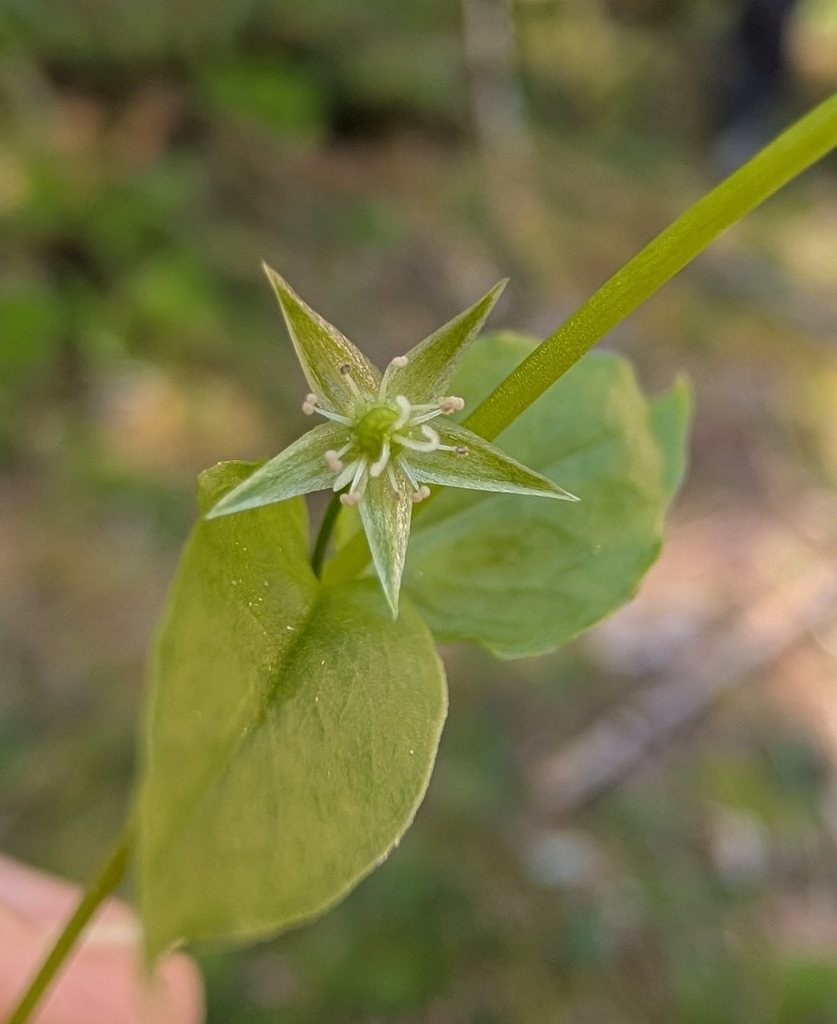
(c) John A Haskins, some rights reserved (CC BY) · licence
Family: Caryophyllaceae · Type: Herb · Native
Stellaria crispa (Crisp starwort) is a native California herb in the Caryophyllaceae family, recognized by single axillary flowers and lack of petals.
Crisp starwort is a California native perennial found in northern coastal California, Klamath Ranges, high Cascade Range, northern Sierra Nevada, and central Coast Ranges in shaded, damp areas at elevations below 1,700 meters. Flowering during summer, this plant produces white to pale flowers in small axillary clusters with delicate, ascending pedicels. Growing prostrate to trailing with slender white rhizomes, the plant spreads 10 to 40 centimeters across in soft, generally glabrous stems. Its leaves are approximately ovate, 8 to 20 millimeters long, with slightly wavy margins that appear shiny and smooth. The plant produces tiny red-brown seeds with low, elongate tubercles, characteristic of its delicate starwort form.
Identification and appearance
Key characters: 10 sympatric species; key features are single axillary flowers and lack of petals
Habitat and range
Habitat: Shaded, damp areas
Elevation: < 1700 m
California counties: San Bernardino, Plumas, Amador, Glenn, Humboldt, Lake, Mendocino, Siskiyou, Kern, Fresno, Butte, Tehama, Shasta, Lassen, Nevada, Sierra, Madera, Marin, Del Norte, Mono, Mariposa, El Dorado, Placer, Tulare, Tuolumne, Inyo
Outside California: to Alaska, Montana
Bloom period
Stellaria crispa blooms Summer.
How to tell it apart
vs Cerastium: Stellaria has smooth to lightly hairy leaves; Cerastium is densely hairy and grayish-fuzzy throughout.; vs Parietaria: Stellaria has white flowers with visible petals; Parietaria has tiny greenish flowers hidden in leaf clusters.; vs Euphorbia: Stellaria has separate white flowers; Euphorbia has cup-like cyathia with milky sap when stems break.; vs Claytonia: Stellaria has deeply split petals creating star shape; Claytonia has unlobed rounded petals.; vs Polycarpon: Stellaria has stalkless pointed leaves; Polycarpon has spoon-shaped leaves with obvious stalks.
Frequently asked questions
Is Stellaria crispa native to California?
Yes. Stellaria crispa is native to California (recorded as native).
When does Stellaria crispa bloom?
Stellaria crispa blooms Summer.
Where in California does Stellaria crispa grow?
Stellaria crispa occurs in San Bernardino, Plumas, Amador, Glenn, Humboldt, Lake, Mendocino, Siskiyou and other counties, at elevations of < 1700 m.
What plant family does Stellaria crispa belong to?
Stellaria crispa is in the Caryophyllaceae family, genus Stellaria.
What habitat does Stellaria crispa grow in?
Stellaria crispa grows in Shaded, damp areas.
Related species
Other California species in the same genus, family, or bioregion.
Sources: Jepson eFlora · Index of California Plant Names · CalPhotos
Last updated 2026-10-07
Data from The California Species Project — 14,000+ California species with verified data from CNPS, CDFW, USFWS, Cal-IPC, and more.