Stellaria nitens
Shining chickweed
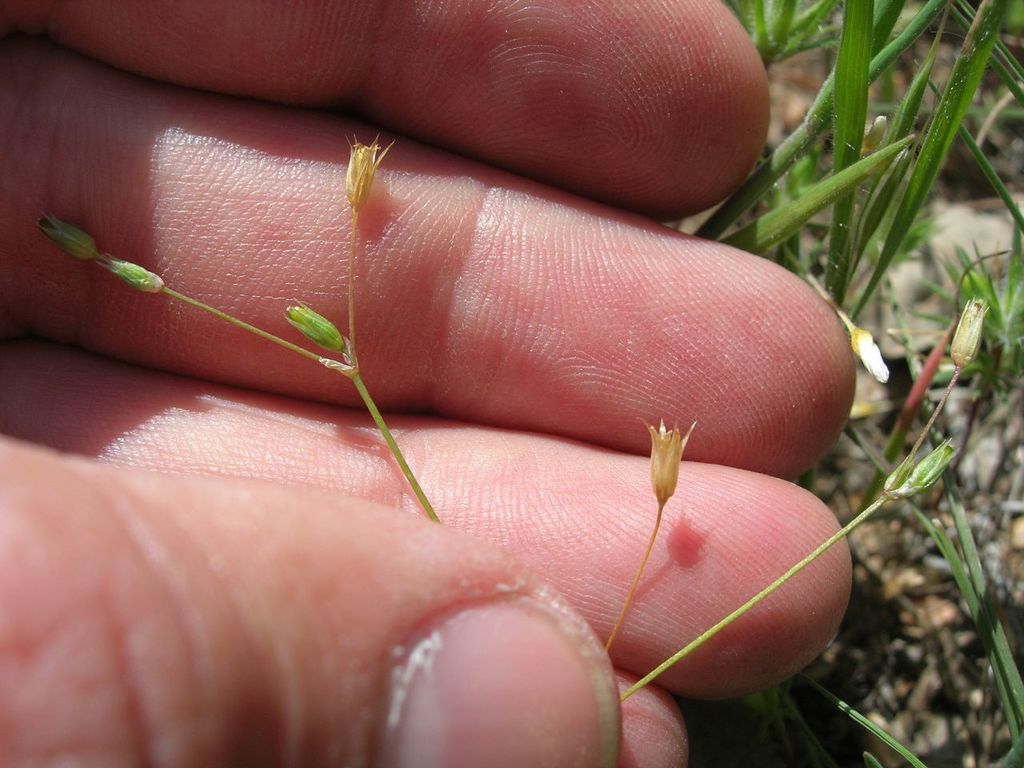
(c) Joe Decruyenaere, some rights reserved (CC BY-SA) · licence
Family: Caryophyllaceae · Type: Herb · Native
Stellaria nitens (Shining chickweed) is a native California herb in the Caryophyllaceae family, recognized by leaves crowded at base, different leaf shapes on same plant, minute or absent petals.
Shining chickweed is a California native annual found in northwestern California, the northern Sierra Nevada Forest, Sierra Nevada, Sutter Buttes, San Joaquin Valley, central western, and southwestern California in sand dunes, streambanks, open woodlands, and disturbed areas at elevations below 1,500 meters. Flowering in spring, this plant produces small white to pale flowers in delicate terminal clusters. Growing with ascending to erect stems 3 to 25 centimeters tall, it has a thread-like taproot and appears glabrous or sparsely hairy. Its leaves are distinctive, crowded near the base, with shiny blades 5 to 15 millimeters long, ranging from oblanceolate to obovate at the lower stem and becoming lance-linear toward the top, often with ciliate margins. Seeds are tiny, brown, and less than one millimeter long with minute surface tubercles.
Identification and appearance
Key characters: 11 sympatric species; key features are leaves crowded at base, different leaf shapes on same plant, minute or absent petals
Habitat and range
Habitat: Sand dunes, streambanks, open woodland, beneath boulders, disturbed areas
Elevation: < 1500 m
California counties: Humboldt, San Bernardino, Kern, San Diego, Orange, Ventura, Los Angeles, Santa Barbara, Alameda, Tehama, Lake, Madera, Marin, Mariposa, Mendocino, Placer, Riverside, Sacramento, San Joaquin, San Luis Obispo, Siskiyou, Stanislaus, Trinity, Tulare, Tuolumne, San Benito, Amador, Modoc, Sonoma, Contra Costa, Fresno, Napa, Monterey, Nevada, Santa Clara, Shasta, Solano, Sutter, Butte, Calaveras, El Dorado, Plumas, San Francisco, San Mateo, Santa Cruz, Colusa, Glenn, Del Norte, Merced, Yolo
Outside California: to British Columbia, Montana, Arizona, Mexico
Bloom period
Stellaria nitens blooms Spring.
How to tell it apart
vs Cerastium: Stellaria has smooth to lightly hairy leaves; Cerastium is densely hairy and grayish-fuzzy throughout.; vs Parietaria: Stellaria has white flowers with visible petals; Parietaria has tiny greenish flowers hidden in leaf clusters.; vs Euphorbia: Stellaria has separate white flowers; Euphorbia has cup-like cyathia with milky sap when stems break.; vs Claytonia: Stellaria has deeply split petals creating star shape; Claytonia has unlobed rounded petals.; vs Polycarpon: Stellaria has stalkless pointed leaves; Polycarpon has spoon-shaped leaves with obvious stalks.
Frequently asked questions
Is Stellaria nitens native to California?
Yes. Stellaria nitens is native to California (recorded as native).
When does Stellaria nitens bloom?
Stellaria nitens blooms Spring.
Where in California does Stellaria nitens grow?
Stellaria nitens occurs in Humboldt, San Bernardino, Kern, San Diego, Orange, Ventura, Los Angeles, Santa Barbara and other counties, at elevations of < 1500 m.
What plant family does Stellaria nitens belong to?
Stellaria nitens is in the Caryophyllaceae family, genus Stellaria.
What habitat does Stellaria nitens grow in?
Stellaria nitens grows in Sand dunes, streambanks, open woodland, beneath boulders, disturbed areas.
Related species
Other California species in the same genus, family, or bioregion.
Sources: Jepson eFlora · Index of California Plant Names · CalPhotos
Last updated 2026-10-07
Data from The California Species Project — 14,000+ California species with verified data from CNPS, CDFW, USFWS, Cal-IPC, and more.