Stenotaphrum secundatum
Saint augustine grass, Saint Augustine Grass
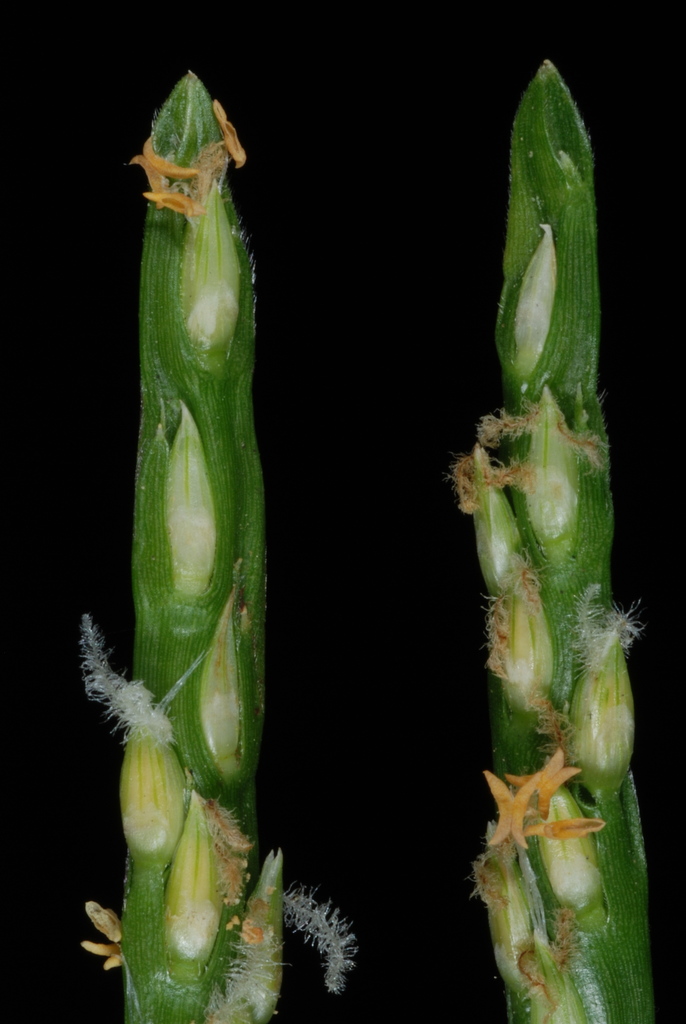
(c) Douglas Goldman, some rights reserved (CC BY-SA), uploaded by Douglas Goldman · licence
Family: Poaceae · Type: Grass · Not Native
Stenotaphrum secundatum (Saint augustine grass) is a non-native California grass in the Poaceae family, recognized by Tropical/subtropical grass naturalized in coastal areas, distinguished by unique inflorescence structure with embedded spikelets.
Saint augustine grass is a naturalized perennial grass found in coastal California regions including central and southern coastal areas in fields and roadsides at elevations below 150 meters. Flowering from July to September, this grass produces pale green to greenish-white flower spikes in compact clusters. Growing with distinctively prostrate stems that spread through long runners, it forms dense ground-covering mats 1 to 4 decimeters tall with broad, flat leaves 5 to 15 centimeters long. Its leaves are smooth, bright green, and 5 to 15 millimeters wide, emerging from short, glabrous leaf sheaths. The grass spreads extensively through long stolons, creating thick, carpet-like vegetation in disturbed and open areas.
Identification and appearance
Key characters: Tropical/subtropical grass naturalized in coastal areas, distinguished by unique inflorescence structure with embedded spikelets
Habitat and range
Habitat: Fields, roadsides
Elevation: < 150 m
California counties: Orange, Marin, Ventura, San Bernardino, Contra Costa, Alameda, San Diego, Los Angeles, Santa Cruz, Riverside, Kern, San Francisco, San Luis Obispo, Santa Barbara, Santa Clara, Merced, Solano, Monterey
Outside California: southern United States, Africa, Pacific islands, probably native to South America
Bloom period
Stenotaphrum secundatum blooms Jul-Sep.
How to tell it apart
vs Cenchrus: Stenotaphrum has flattened one-sided spikes; Cenchrus has bristly bur-like seed clusters.; vs Digitaria: Stenotaphrum has thick stolons and chunky one-sided spikes; Digitaria has thin stems and finger-like spreading branches.; vs Aegilops: Stenotaphrum is perennial with stolons; Aegilops is annual without runners.; vs Scribneria: Stenotaphrum spreads by thick stolons; Scribneria is a tiny tufted annual.; vs Parapholis: Stenotaphrum has thick stolons and broad leaves; Parapholis is a delicate tufted annual.
Frequently asked questions
Is Stenotaphrum secundatum native to California?
No. Stenotaphrum secundatum is not native to California (recorded as not native).
When does Stenotaphrum secundatum bloom?
Stenotaphrum secundatum blooms Jul-Sep.
Where in California does Stenotaphrum secundatum grow?
Stenotaphrum secundatum occurs in Orange, Marin, Ventura, San Bernardino, Contra Costa, Alameda, San Diego, Los Angeles and other counties, at elevations of < 150 m.
What plant family does Stenotaphrum secundatum belong to?
Stenotaphrum secundatum is in the Poaceae family, genus Stenotaphrum.
What habitat does Stenotaphrum secundatum grow in?
Stenotaphrum secundatum grows in Fields, roadsides.
Related species
Other California species in the same genus, family, or bioregion.
Sources: Jepson eFlora · Index of California Plant Names · CalPhotos
Last updated 2026-10-07
Data from The California Species Project — 14,000+ California species with verified data from CNPS, CDFW, USFWS, Cal-IPC, and more.