Stipa lepida
Foothill needle grass
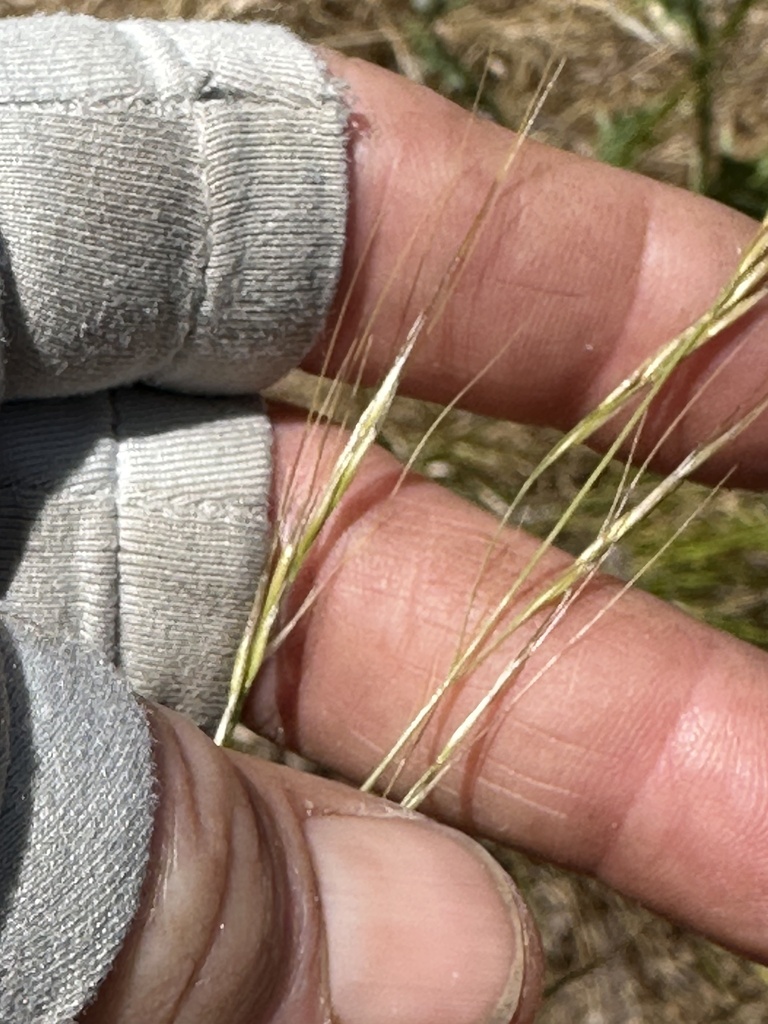
(c) Barbara Banfield, some rights reserved (CC BY) · licence
Family: Poaceae · Type: Grass · Native
Stipa lepida (Foothill needle grass) is a native California grass in the Poaceae family, recognized by variable characteristics and broad habitat range.
Foothill needle grass is a California native perennial found in northwestern, central western, and southwestern California in dry slopes, chaparral, grassland, savanna, and coastal scrub at elevations below 1,400 meters. Flowering from March to June, this grass produces delicate pale tan to straw-colored flowers in open, airy inflorescences with distinctive needle-like awns. Growing with slender stems 35 to 100 centimeters tall and less than 1.2 millimeters in diameter, it forms graceful clumps with slightly hairy internodes. Its leaves are narrow, 12 to 23 centimeters long and 1 to 3.5 millimeters wide, ranging from flat to slightly rolled at the margins. The plant's most distinctive feature is its long, persistent awn measuring 12 to 55 millimeters, which twists and bends, creating a characteristic delicate appearance in grassland landscapes.
Identification and appearance
Key characters: 27 sympatric species; variable characteristics and broad habitat range
Habitat and range
Habitat: dry slopes, chaparral, grassland, savanna, coastal scrub
Elevation: < 1400 m
California counties: Orange, Ventura, Merced, Los Angeles, San Diego, Riverside, Monterey, Santa Barbara, San Bernardino, San Luis Obispo, Sonoma, Napa, Sacramento, El Dorado, Contra Costa, Alameda, Santa Clara, Shasta, Trinity, Humboldt, Tehama, San Mateo, Mariposa, Kern, Marin, San Francisco, Santa Cruz, San Benito, Solano, Yolo, Placer
Outside California: Baja California
Bloom period
Stipa lepida blooms Mar-Jun.
How to tell it apart
vs Nassella: Nassella has feathery plumose awns; Stipa awns are scabrous (rough) not plumose.; vs Oloptum: Oloptum has twice-bent awns with dense crown; Stipa has once-bent awns.; vs Eriocoma: Eriocoma has densely hairy lemmas; Stipa lemmas are smooth to scabrous.; vs Pappostipa: Pappostipa has plumose awns; Stipa awns are rough but not feathery.; vs Bromus: Bromus has multiple-flowered spikelets; Stipa has single-flowered spikelets with bent awns.
Frequently asked questions
Is Stipa lepida native to California?
Yes. Stipa lepida is native to California (recorded as native).
When does Stipa lepida bloom?
Stipa lepida blooms Mar-Jun.
Where in California does Stipa lepida grow?
Stipa lepida occurs in Orange, Ventura, Merced, Los Angeles, San Diego, Riverside, Monterey, Santa Barbara and other counties, at elevations of < 1400 m.
What plant family does Stipa lepida belong to?
Stipa lepida is in the Poaceae family, genus Stipa.
What habitat does Stipa lepida grow in?
Stipa lepida grows in dry slopes, chaparral, grassland, savanna, coastal scrub.
Related species
Other California species in the same genus, family, or bioregion.
Sources: Jepson eFlora · Index of California Plant Names · CalPhotos
Last updated 2026-10-07
Data from The California Species Project — 14,000+ California species with verified data from CNPS, CDFW, USFWS, Cal-IPC, and more.