Stipa occidentalis var. californica
California needle grass
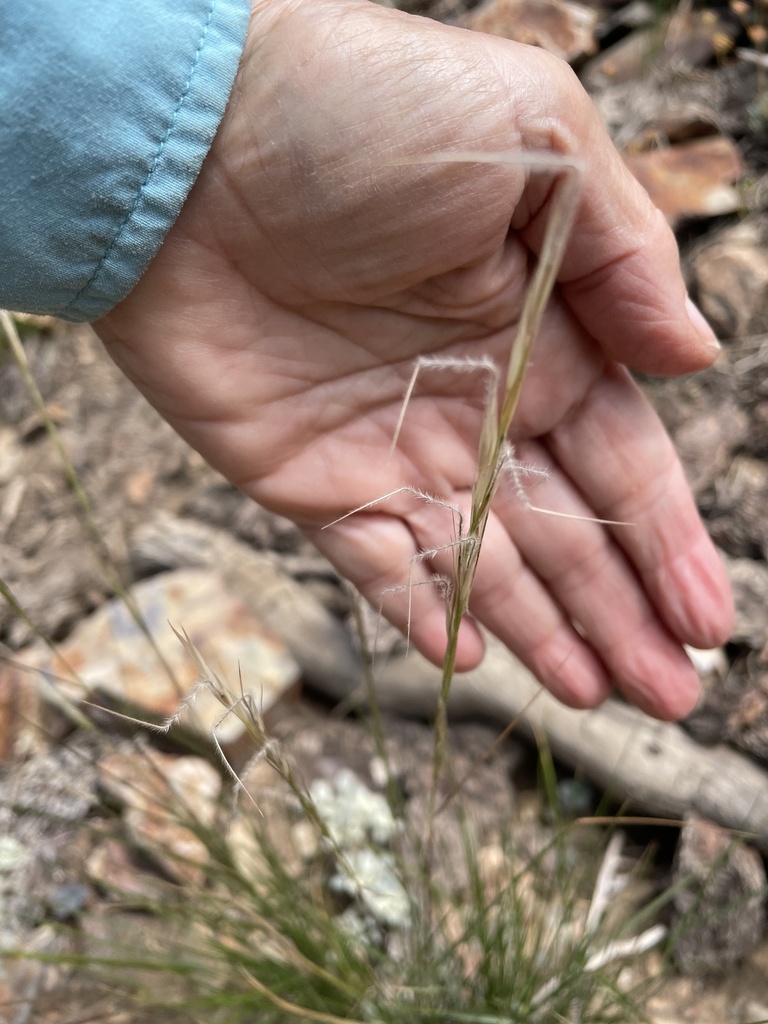
Photo: parent species Stipa occidentalis · no rights reserved · CC0
Family: Poaceae · Type: Grass · Native
Stipa occidentalis var. californica (California needle grass) is a native California grass in the Poaceae family, recognized by green glumes and mixed-length awn hairs.
California needle grass is a native perennial found in the Klamath Ranges, Cascade Range, Sierra Nevada, San Bernardino Mountains, Peninsular Ranges, and Great Basin in sagebrush scrub and conifer forest at elevations of 150 to 3,450 meters. Flowering from May to August, this grass produces green-tinted spikelets with delicate, curved awns 18 to 55 millimeters long. Growing 3 to 10 decimeters tall with slender stems 0.5 to 2 millimeters in diameter, it forms dense tufts with variable stem hairiness. Its leaf blades are narrow, measuring 0.8 to 2 millimeters wide, with sheaths ranging from smooth to densely hairy. The distinctive needle-like awns feature hairs longer at the tip than at the base, creating an elegant, wispy appearance characteristic of native California bunchgrasses.
Identification and appearance
Key characters: 23 sympatric species; distinguished by green glumes and mixed-length awn hairs
Habitat and range
Habitat: Sagebrush scrub, conifer forest
Elevation: 150-3450 m
California counties: Tulare, Los Angeles, Placer, El Dorado, Sierra, San Bernardino, Nevada, Glenn, Plumas, Butte, Tehama, Trinity, Humboldt, Modoc, Siskiyou, Mono, Mariposa, Shasta, San Diego, Alpine, Lassen
Outside California: to Washington, Montana, Wyoming, Utah
Bloom period
Stipa occidentalis var. californica blooms May-Aug.
How to tell it apart
vs Nassella: Nassella has feathery plumose awns; Stipa awns are scabrous (rough) not plumose.; vs Oloptum: Oloptum has twice-bent awns with dense crown; Stipa has once-bent awns.; vs Eriocoma: Eriocoma has densely hairy lemmas; Stipa lemmas are smooth to scabrous.; vs Pappostipa: Pappostipa has plumose awns; Stipa awns are rough but not feathery.; vs Bromus: Bromus has multiple-flowered spikelets; Stipa has single-flowered spikelets with bent awns.
Frequently asked questions
Is Stipa occidentalis var. californica native to California?
Yes. Stipa occidentalis var. californica is native to California (recorded as native).
When does Stipa occidentalis var. californica bloom?
Stipa occidentalis var. californica blooms May-Aug.
Where in California does Stipa occidentalis var. californica grow?
Stipa occidentalis var. californica occurs in Tulare, Los Angeles, Placer, El Dorado, Sierra, San Bernardino, Nevada, Glenn and other counties, at elevations of 150-3450 m.
What plant family does Stipa occidentalis var. californica belong to?
Stipa occidentalis var. californica is in the Poaceae family, genus Stipa.
What habitat does Stipa occidentalis var. californica grow in?
Stipa occidentalis var. californica grows in Sagebrush scrub, conifer forest.
Related species
Other California species in the same genus, family, or bioregion.
Sources: Jepson eFlora · Index of California Plant Names · CalPhotos
Last updated 2026-10-07
Data from The California Species Project — 14,000+ California species with verified data from CNPS, CDFW, USFWS, Cal-IPC, and more.