Stipa speciosa
Desert needle grass
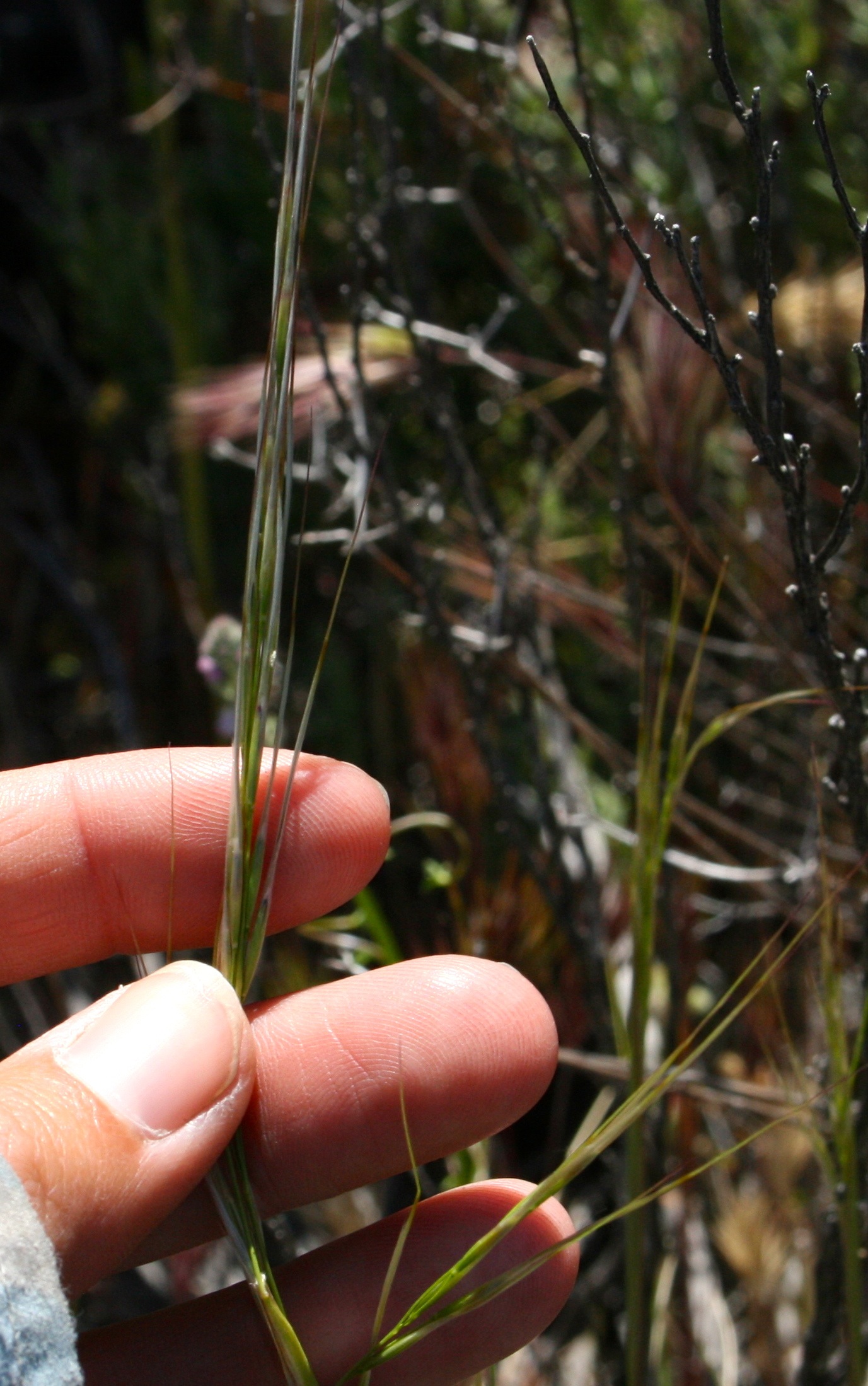
Photo by Chez Brungraber
Family: Poaceae · Type: Grass · Native
Stipa speciosa (Desert needle grass) is a native California grass in the Poaceae family, recognized by distinctive feather-like proximally hairy, once-bent awns.
Desert needle grass is a California native perennial found in southern Sierra Nevada, Tehachapi, San Joaquin Valley, southern Coast Ranges, southwestern California, Great Basin, and Desert regions on rocky slopes, canyons, and washes at elevations below 2,500 meters. Flowering from April to July, this plant produces pale green to straw-colored flowers in dense 10 to 15 centimeter inflorescences with distinctive long, bent awns. Growing with stems 30 to 60 centimeters tall, it features narrow leaf blades 10 to 30 centimeters long and less than 2 millimeters wide. Its leaves have tightly inrolled margins and mostly glabrous sheaths, with the plant characterized by its remarkably long, feather-like awns that are 35 to 45 millimeters long and densely hairy at the base. The fruit features a sharp callus and densely hairy lemma, making it a distinctive grass of arid landscapes.
Identification and appearance
Key characters: 31 sympatric species; distinctive feather-like proximally hairy, once-bent awns
Habitat and range
Habitat: Rocky slopes, canyons, washes
Elevation: < 2500 m
California counties: San Bernardino, Kern, Los Angeles, Riverside, Inyo, Mono, Ventura, San Diego, Imperial, Fresno, Tulare, San Luis Obispo, Plumas, Kings, Monterey
Outside California: to Oregon, Colorado, New Mexico, northern Mexico, South America
Bloom period
Stipa speciosa blooms Apr-Jul.
How to tell it apart
vs Nassella: Nassella has feathery plumose awns; Stipa awns are scabrous (rough) not plumose.; vs Oloptum: Oloptum has twice-bent awns with dense crown; Stipa has once-bent awns.; vs Eriocoma: Eriocoma has densely hairy lemmas; Stipa lemmas are smooth to scabrous.; vs Pappostipa: Pappostipa has plumose awns; Stipa awns are rough but not feathery.; vs Bromus: Bromus has multiple-flowered spikelets; Stipa has single-flowered spikelets with bent awns.
Frequently asked questions
Is Stipa speciosa native to California?
Yes. Stipa speciosa is native to California (recorded as native).
When does Stipa speciosa bloom?
Stipa speciosa blooms Apr-Jul.
Where in California does Stipa speciosa grow?
Stipa speciosa occurs in San Bernardino, Kern, Los Angeles, Riverside, Inyo, Mono, Ventura, San Diego and other counties, at elevations of < 2500 m.
What plant family does Stipa speciosa belong to?
Stipa speciosa is in the Poaceae family, genus Stipa.
What habitat does Stipa speciosa grow in?
Stipa speciosa grows in Rocky slopes, canyons, washes.
Related species
Other California species in the same genus, family, or bioregion.
Sources: Jepson eFlora · Index of California Plant Names · CalPhotos
Last updated 2026-10-07
Data from The California Species Project — 14,000+ California species with verified data from CNPS, CDFW, USFWS, Cal-IPC, and more.