Streptanthus bernardinus
Laguna mountains jewelflower, Laguna Mountains Jewelflower
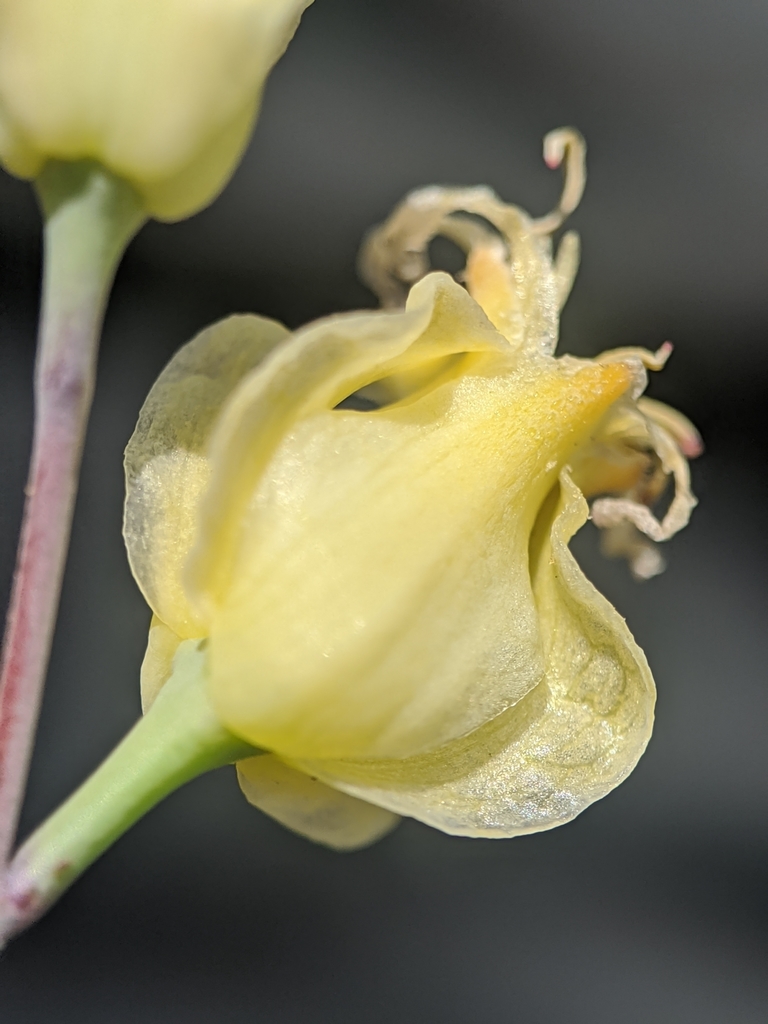
no rights reserved, uploaded by Alex Heyman · CC0
Family: Brassicaceae · Type: Subshrub · Native
Conservation status: CNPS 4.3
Streptanthus bernardinus (Laguna mountains jewelflower) is a native California subshrub in the Brassicaceae family, recognized by flower shape and color distinguish from S. campestris.
Laguna mountains jewelflower is a rare (CNPS 4.3) California native perennial found in eastern Transverse Ranges and Peninsular Ranges in montane conifer forest and chaparral at elevations of 1,200 to 2,500 meters. Flowering from June to August, this plant produces white flowers 7 to 11 millimeters long with pale yellow to white sepals. Growing 25 to 86 centimeters tall with an elevated woody caudex, the plant has erect stems that are simple or few-branched. Its leaves range from oblanceolate basal leaves to mid-stem ovate leaves that clasp the stem, with basal leaf margins often ciliate. The fruit develops as an ascending to spreading pod 5 to 12.7 centimeters long, containing 36 to 56 small oblong seeds.
Identification and appearance
Key characters: 1 sympatric species; flower shape and color distinguish from S. campestris
Habitat and range
Habitat: Montane conifer forest, chaparral
Elevation: 1200-2500 m
California counties: Riverside, San Bernardino, San Diego, Los Angeles, Shasta
Outside California: Baja California
Bloom period
Streptanthus bernardinus blooms Jun-Aug.
Conservation status
CNPS 4.3
How to tell it apart
vs Caulanthus: Seed pods are flattened like sword blades versus cylindrical tubes in Caulanthus.; vs Boechera: Robust plants often over 2.5 feet with large flowers (sepals 4-8mm) versus more delicate habit.; vs Claytonia: Mustard family with 4 petals and 6 stamens versus Claytonia with 5 petals.; vs Silene: Mustard family with seed pods versus Silene with inflated capsules and opposite leaves.; vs Lonicera: Herbaceous mustard with alternate leaves versus woody vine with opposite leaves.
Frequently asked questions
Is Streptanthus bernardinus native to California?
Yes. Streptanthus bernardinus is native to California (recorded as native).
When does Streptanthus bernardinus bloom?
Streptanthus bernardinus blooms Jun-Aug.
Where in California does Streptanthus bernardinus grow?
Streptanthus bernardinus occurs in Riverside, San Bernardino, San Diego, Los Angeles, Shasta, at elevations of 1200-2500 m.
What plant family does Streptanthus bernardinus belong to?
Streptanthus bernardinus is in the Brassicaceae family, genus Streptanthus.
Is Streptanthus bernardinus rare or endangered?
Streptanthus bernardinus carries California Rare Plant Rank 4.3, state rank S3S4.
Related species
Other California species in the same genus, family, or bioregion.
- Streptanthus brachiatus — Socrates mine jewelflower
- Streptanthus brachiatus ssp. brachiatus — Socrates Mine jewel-flower
- Streptanthus brachiatus ssp. hoffmanii — Freed's jewel-flower
- Streptanthus breweri — Brewer's jewelflower
- Streptanthus callistus — Mount hamilton jewelflower
- Streptanthus campestris — Southern jewelflower
Sources: Jepson eFlora · CNPS Rare Plant Inventory · Index of California Plant Names · CalPhotos · CDFW CNDDB
Last updated 2026-10-07
Data from The California Species Project — 14,000+ California species with verified data from CNPS, CDFW, USFWS, Cal-IPC, and more.