Streptanthus brachiatus
Socrates mine jewelflower
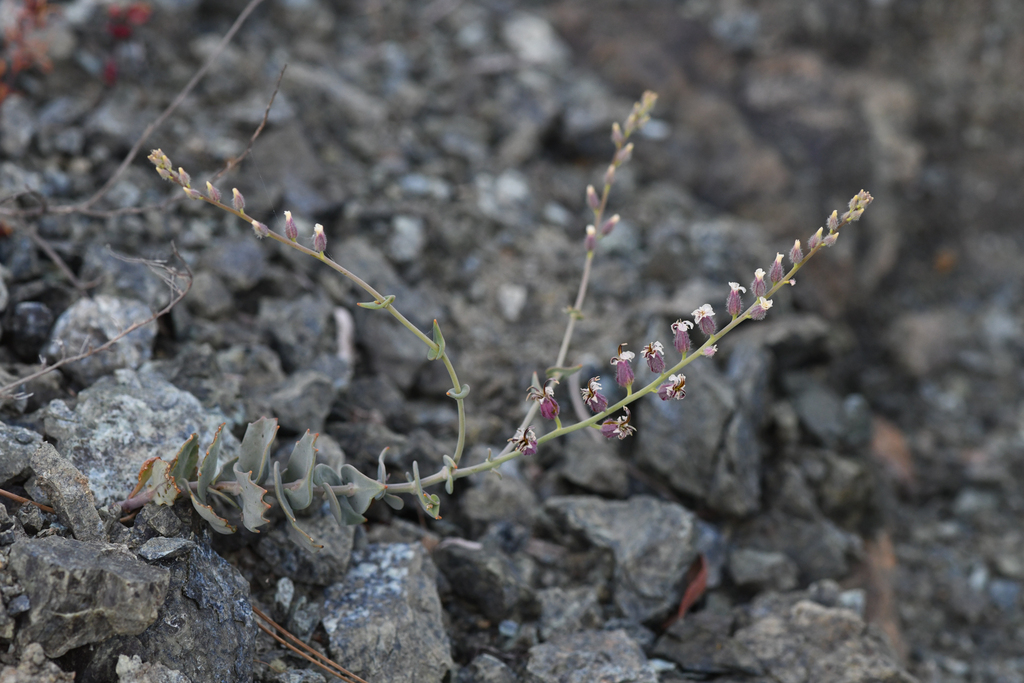
(c) Trevor Van Loon, some rights reserved (CC BY) · licence
Family: Brassicaceae · Type: Subshrub · Native
Conservation status: CNPS 1B.2
Streptanthus brachiatus (Socrates mine jewelflower) is a native California subshrub in the Brassicaceae family, recognized by biennial habit with mottled rosette leaves diagnostic.
Socrates mine jewelflower is a rare (CNPS 1B.2) California native biennial found in southern North Coast Ranges in serpentine barrens, open chaparral, and woodland at elevations of 600 to 950 meters. Flowering from June to July, this plant produces green and purple flowers with white petals that have delicate purple veining and spotting. Growing with branched stems 14 to 50 centimeters tall, it emerges from a basal rosette with broadly obovate leaves that are fleshy and distinctively mottled. Its leaves transition from broad basal rosettes to smaller sessile cauline leaves, ranging from 0.7 to 3.7 centimeters long, with serrated or toothed edges. The plant produces elongated fruits 4 to 6 centimeters long that spread in an ascending pattern, bearing 22 to 30 small oblong seeds.
Identification and appearance
Key characters: 13 sympatric species; biennial habit with mottled rosette leaves diagnostic
Habitat and range
Habitat: Serpentine barrens, open chaparral or woodland
Elevation: 600-950 m
California counties: Sonoma, Lake, Napa
Bloom period
Streptanthus brachiatus blooms Jun-Jul.
Conservation status
CNPS 1B.2
How to tell it apart
vs Caulanthus: Seed pods are flattened like sword blades versus cylindrical tubes in Caulanthus.; vs Boechera: Robust plants often over 2.5 feet with large flowers (sepals 4-8mm) versus more delicate habit.; vs Claytonia: Mustard family with 4 petals and 6 stamens versus Claytonia with 5 petals.; vs Silene: Mustard family with seed pods versus Silene with inflated capsules and opposite leaves.; vs Lonicera: Herbaceous mustard with alternate leaves versus woody vine with opposite leaves.
Frequently asked questions
Is Streptanthus brachiatus native to California?
Yes. Streptanthus brachiatus is native to California (recorded as native).
When does Streptanthus brachiatus bloom?
Streptanthus brachiatus blooms Jun-Jul.
Where in California does Streptanthus brachiatus grow?
Streptanthus brachiatus occurs in Sonoma, Lake, Napa, at elevations of 600-950 m.
What plant family does Streptanthus brachiatus belong to?
Streptanthus brachiatus is in the Brassicaceae family, genus Streptanthus.
Is Streptanthus brachiatus rare or endangered?
Streptanthus brachiatus carries California Rare Plant Rank 1B.2, state rank S1.
Related species
Other California species in the same genus, family, or bioregion.
- Streptanthus brachiatus ssp. brachiatus — Socrates Mine jewel-flower
- Streptanthus brachiatus ssp. hoffmanii — Freed's jewel-flower
- Streptanthus breweri — Brewer's jewelflower
- Streptanthus callistus — Mount hamilton jewelflower
- Streptanthus campestris — Southern jewelflower
- Streptanthus cordatus — Heartleaf jewelflower
Sources: Jepson eFlora · CNPS Rare Plant Inventory · Index of California Plant Names · CalPhotos
Last updated 2026-10-07
Data from The California Species Project — 14,000+ California species with verified data from CNPS, CDFW, USFWS, Cal-IPC, and more.